
Like many power users, I spent the weekend optimising my Fable budget. What I found was bigger than a pricing hack.
Like many power users, I spent this weekend figuring out what happens on 8th July, when Claude Fable 5 disappears from my subscription and moves to usage credits. I'm a Max x20 subscriber — upgraded from x5 specifically for Fable — that's $200 a month — and I wanted to know what I was actually paying for.
The answer, once I did the maths, was surprisingly little.
Sonnet 5 launched on 30th June to a hostile reception from the developer community. The new tokenizer burns roughly 40% more tokens for the same task. The safety guardrails are noticeably tighter than Sonnet 4.6's. Multiple developers have flagged that Sonnet 5 can actually cost more per task than both Opus 4.8 and Fable on the Artificial Analysis Intelligence Index — it generates almost 2x as many tokens as Opus 4.8 per task, so the sticker price discount doesn't just evaporate, it inverts. The budget model costs more than the frontier model. Let that sit for a moment. Meanwhile Opus 4.8 — the model Anthropic wants me on — isn't one I gel with. It strawmans. It hallucinates. It does half a job and presents it with the confidence of a finished one. I've been working with Claude since April 2025 — over fourteen months — and Opus 4.8 is the first model in that lineage I actively distrust. Opus 4.7 I tried briefly and it failed several of my own benchmarks early on; by the time it improved, 4.8 had arrived. And Opus 4.6 — the model I've built with since February — is being quietly edged out of model pickers across the product.
So what exactly is the $180 premium over Pro buying me? Twenty times more access to models I don't want to use. And with Fable moving to usage credits on 8th July, Anthropic gave me a very good reason to do something about it.
What I Did on Saturday
I rebuilt my website. And I'm very nearly at a point where I can get the apps I've been building live — the ones that have had placeholder pages on the site while I developed them.
Memoria, which uses what I call engrams (yes, like memory engrams) — editable chunks of context about your projects or history that the AI can create for you. They get tagged, and when you say the trigger words naturally in conversation, the relevant context loads into the window. When the topic moves on, it drops off. Intelligent forgetting. It back-ends to Basin, which I've already launched. And coming soon: Panel Debate, where you can have a conversation with multiple AIs simultaneously. I'm hoping to get these live this week.
Six months of building, nearly ready to go live — and the website facelift to match. Let me contextualise why that matters.
In August 2025, I migrated from WordPress to a Flask application hosted on Railway. It took me six weeks of weekends. I tried Hetzner — couldn't get the PostgreSQL database to work. I eventually got it running on Railway, but not before fighting configuration files, reading deployment guides that promised "live in minutes" and delivering hours of debugging. It was, to use the technical term, a disaster. By the end I was questioning whether the whole migration was worth it.
It was worth it. But the process nearly broke me.
This Saturday, I gave Fable 5 the same website and asked for a facelift. Not a database migration — the architecture was already in place — but a substantial redesign covering the front-end, layout, styling, and nearly getting my apps section live with the tools I've built over the last six months. A couple of hours. Done.
But here's the part that matters. I wouldn't have needed the six weeks.
If I were starting today — no Flask knowledge, no Railway experience, no PostgreSQL debugging scars — I could have walked up to Fable with a WordPress export and said "build me this." The database issues I spent weekends on? Fable would have handled them. The platform evaluation? Unnecessary. The Hetzner dead end? Never visited. The six weeks of learning that gave me the competence to supervise this Saturday's work is exactly the kind of entry-level knowledge acquisition that AI is making optional.
The scaffolding I climbed is being replaced behind me.
The Budget Hack That Isn't Really About Budget
The Fable deadline forced me to think about how I actually use these models. And what I discovered is a pattern that other power users are probably already running — if you are, I'd love to hear your version. But for those who aren't, here's what's working for me.
I don't need one model. I need three, each doing a different job.
GLM 5.2 does the work. A 753B parameter open-weight model, MIT licence, running on Ollama Cloud for about £15 a month ($20). And here's the thing about that $20 — it doesn't just get you GLM. Ollama Cloud's model catalogue includes over twenty models: Kimi K2.6 and K2.7, DeepSeek V4 Pro and Flash, MiniMax M2.7 and M3, Qwen 3.5 and 3.6, Gemma 4, Nemotron 3, and more. For the price of one Anthropic subscription tier, you get access to a roster of frontier open-weight models that between them cover coding, reasoning, vision, and long-context work.
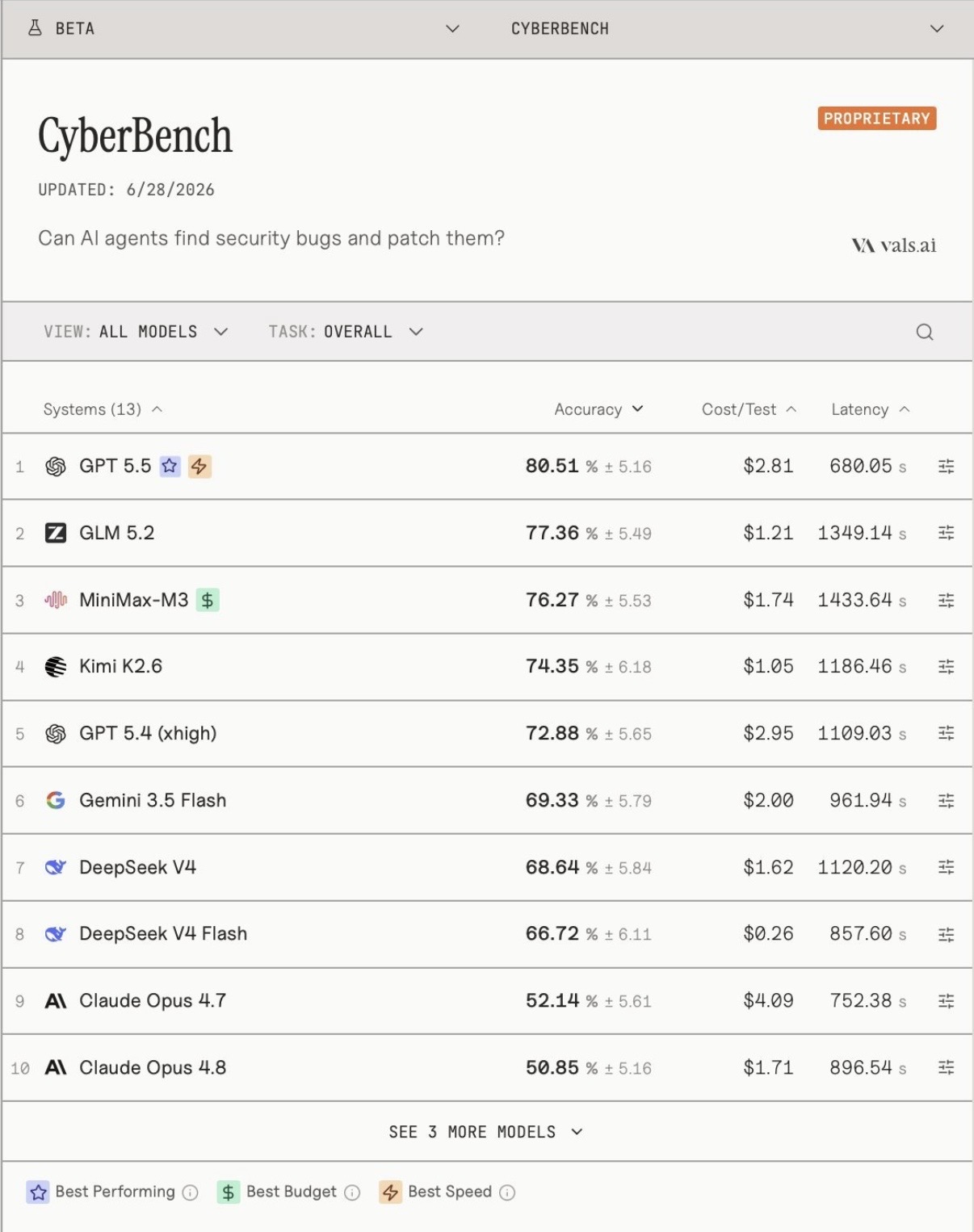
These aren't second-rate models. On CyberBench — one benchmark, one axis — GLM scores 77.36% accuracy at $1.21 per test versus Opus 4.8's 50.85% at $1.71. CyberBench isn't the only way to judge a model, but on this axis, GLM is substantially better. And Fable's safety classifiers route security queries back to Opus — the model in tenth place on that benchmark. That doesn't make Fable bad. It means its architecture works against you on certain tasks. GLM made my website this weekend. Fable just managed it.
I'm still in the trust-building phase with these models, which is why I still want Opus and Fable supervising. But the work is getting done by the open-weight model, and it's getting done well.
And if you're worried about where the data goes — these models run on Ollama's own infrastructure, not routed through Chinese APIs. Ollama Inc. is a US company. Their privacy policy is explicit: cloud prompts are processed transiently and never used for training.
You can also download most of these models locally for free and run them on your own hardware via Ollama — no cloud, no subscription, no data leaving your machine. You even get access to Google's Gemma — although, to be fair, Google will make you download the model whether you like it or not. Chrome has been silently dropping a 4GB Gemini Nano onto users' devices without consent since early 2026. It re-downloads itself if you delete it. You're welcome.
There's not a lot of published data on Ollama Cloud's usage limits yet, but speaking from experience, I've been running GLM and Gemma on it and getting loads of usage for the price.
In fairness to Anthropic, they've stated publicly that they intend to restore Fable as a standard part of subscriptions once capacity allows. But there's no date, no guarantee, and the phrasing — "as soon as capacity allows" — is doing a lot of heavy lifting. It's the same kind of open-ended commitment as the export control ban's timeline was: genuine intent, unknown delivery. I'll believe it when I see it in my model picker.
How the Weekend Actually Worked
So that's the toolkit. Here's how it came together on Saturday, rebuilding my website.
GLM did the building — but GLM isn't a vision model. That sounds like a limitation, but in practice it's turned into a feature. I have it set up so it can query Gemma 4 31B — which is a vision model — for information about an image, and if it hasn't got enough detail, it re-queries with a more specific question about what's in the image. It loops until it has what it needs. A model with built-in vision gets one interpretation. This setup gets iterative, targeted questions — "is this layout right?" followed by "what about the spacing on that nav element?" — which for website review is actually more useful.
Opus 4.8 is the hostile auditor. It strawmans, it's stubborn, and it's too clever for its own good — it thinks itself into spirals and loops. The hallucination is a genuine liability; I've had it fabricate issues that don't exist. But pointed at GLM's output as a challenge function, the stubbornness catches things and the overthinking occasionally surfaces a real gap. After fourteen months with Claude, you get a read on them — usually when they break something. Opus 4.8 breaks in predictable ways, and predictable is manageable.
Fable 5 is the orchestrator — and I don't have to deal with Opus directly because Fable does. The hierarchy: me → Fable → Opus + GLM. Fable adjudicates between them, and I watched it find gaps that neither caught alone — structural blind spots visible only when two architectures look at the same problem and a third arbitrates. I set this up with Fable, but the pattern lives in a skill file that Opus could theoretically manage going forward — if I trust it enough to. Jury's out.
The Maths
Here's where the subscription economics collapse.
My Max x20 plan costs $200 per month. After 7th July, Fable 5 moves to usage credits at API rates: $10 per million input tokens and $50 per million output tokens. This is the same rate whether I'm on Pro or Max. The $180 premium buys me nothing for Fable access.
A quick note on where I'm coming from here. I have enough money to play with AI. I don't have enough money to go mad with it. I've just come off ChatGPT Pro — waiting for GPT-5.6 before I'd consider going back. I've never asked for money from this website. Not even a cup of coffee. This isn't a business. It's my thoughts and who I am in a public forum. I make music to help me make sense of my own feelings about AI, and I blog for the same reason. So when I optimise my AI budget, it's not because I'm running a startup. It's because this comes out of the same pocket that pays for everything else in my life, and I'd like to keep doing it.
Anthropic sells usage bundles with tiered discounts: 10% off at $50, 20% off at $250, and 30% off at $1,000. Your bundle balance sits in your account and draws down as you use it — check the current terms before treating it as forever-money.
The new plan:
- Drop from Max x20: The $200/month is dead. Whether I land on Pro at $20 or Max x5 at $100 depends on whether Pro gives me enough chat usage — I've heard it's tight, and I won't know until I try
- Usage bundle (one-off, as needed): $200 actual cost ($250 face value at 20% off) — for Fable supervision when I need it
- GLM 5.2 on Ollama Cloud: ~£15/month — does the generative work
Even at the Max x5 fallback, that's $100 plus $20 for GLM, versus $200 for a subscription whose premium models I'm either not using or actively routing around — and yes, that includes Opus 4.8, the argumentative one that thinks itself into spirals. It's useful. It's just not $180-premium useful. The usage bundle credits don't expire, so I buy them when I have Fable-shaped work, not speculatively.
But the real saving isn't the subscription delta. It's the architecture. When GLM generates and Fable supervises, the token cost drops by perhaps 80% compared to using Fable as your primary builder. Supervision prompts are short. Review outputs are focused. You're asking "is this right?" not "build this." The most expensive model touches the fewest tokens.
To put it concretely: with this orchestration pattern in place — Fable supervising, Opus challenging, GLM building — I've used about 90% of my Fable allocation this week, but a significant chunk of that was an accident. At one point Fable ignored my explicit instruction to spin up Opus for a code review, ignored the skill file telling it to use Opus, and instead spawned 62 instances of itself to review my app. That single incident burned about 20% of my limit. It apologised afterwards. Naturally.
Take that incident out and the orchestration pattern is working — the model everyone's panicking about losing from their subscription is being used efficiently, because it's doing the right job instead of every job. When it follows instructions, anyway.
And there's another trick worth knowing. When Fable was reviewing my website, it was looking at screenshots — images of the rendered pages. It turns out this is accidentally optimal. DeepSeek's OCR research demonstrated that vision tokens can compress text far more efficiently than text tokens — around 97% precision below 10x compression, dropping sharply by 20x. Someone has already built pxpipe, an experimental open-source proxy that exploits this by rendering code as images before sending it to Fable, cutting costs by roughly 60%. Whether this is a genuine efficiency gain or a pricing loophole that will get closed is an open question — but right now, screenshots are cheaper than source code. Let that sink in.
The Uncomfortable Question
This weekend proved something to me personally.
In August 2025, I spent six weeks building a website from scratch. I learned Flask, fought PostgreSQL, evaluated hosting platforms, and came out the other side with the kind of knowledge you can only get from doing something the hard way.
In July 2026, I rebuilt that website in an afternoon. I knew less going in than someone who'd coded it from scratch — but I knew enough to supervise. The skill wasn't building anymore. It was orchestrating.
And here's what I notice: the strategy I've just described — Fable supervising Opus supervising GLM — isn't a human managing tools. It's models managing models, with me at the top of a chain that's getting longer. Each iteration compresses the human's role further. Last year I was the builder. This year I'm the architect of a system where models check each other's work. Next year, who sets up the orchestration? Another model, probably.
The human isn't being removed. The human's role keeps shifting — from doing the work, to supervising the work, to designing the system that supervises the system that does the work. Each step is easier. Each step requires less of the knowledge that the previous step taught you.
Is this a problem or an opportunity? Both, probably.
The scaffolding is being replaced by an escalator. Everyone still gets to the top. Nobody learns anything on the way up. But maybe the question isn't whether they learn — it's whether learning was ever the point, or just the cost of getting there before the escalator existed.