
One brief, both models, and an attempt to work out why the smoother draft was harder to fix.
I had been dreading the next Anthropic release, because I knew what it would arrive with: the watermark — a version of SynthID-Text, which adds nothing to the text but, where next-word candidates are near-equiprobable, lets a keyed function settle the choice instead of the dice. On by default, applied worldwide, no off switch, to satisfy the EU AI Act. I'm open about the fact that I blog with AI — it's part of how I process my thinking, and I do it for fun — so there's no reason for the watermark to threaten me. I still really don't like it. It reads as a claim of authorship: I'm happy to acknowledge that the AI helps me, but a lot of my own work goes into a finished article, and when Anthropic comes along and marks it as Claude's, it feels like it takes something from the effort I also put in. I wrote about the announcement itself in "Open Loop"; this is about what shipped. I'm saying all of this first because it is a bias, and everything below was built to test against it.
It started with an ordinary blog post. I gave Fable 5.1 a drafting job of the kind Fable 5 had been doing for months, and what came back read nicely — and what I read felt like it was scrambling my brain.
This is how it opened:
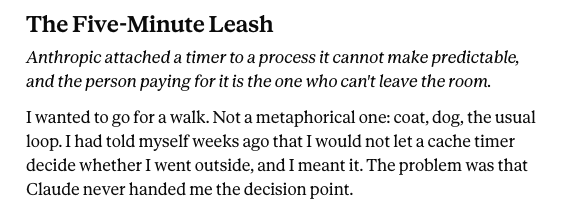
Who on earth would consider a walk a metaphor for something else?
Versus Fable 5:
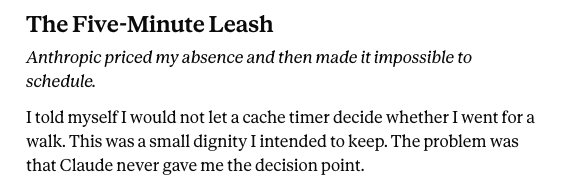
You can read the rest of it here and contrast it to Fable 5's one here.
My process with AI is iterative — argue the idea through, have the model draft, pull the draft apart, rewrite, research, discard, repeat, sometimes over days — and I write considerably more posts than I publish. What I want from a writing model is the translation of my intent: views that challenge me, a way of working through my feelings about a topic that makes me see it differently, or more clearly. 5.1 had the opposite effect. Most of it read well, but once you scratched the surface the substance collapsed.
The cause I kept reaching for was the one Anthropic had already cleared — the watermark, it says, has no effect on quality at all, on a model it was simultaneously announcing as a better writer. That clearance is reader-shaped: the method's published quality evidence comes down to thumbs-down rates holding flat across nearly twenty million Gemini responses. Nobody in those studies edited anything. I wasn't certain of anything. I was confused.
The first check was ChatGPT, which is the model I usually use for critique, and it's good at it. Its first pass said good piece, needs some work. But there's a difference between a good critic and a good judge: as I pulled the draft apart and showed my working, it came round with me — but even the best AI reader runs with the grain of agreement, and a reader that converges with you either way isn't a control. So I built one.
The test
An A/B of Fable 5 against Fable 5.1: one generation prompt, given to both models identically, one blog draft back from each. The pair went blind to six other large language models for independent verdicts: ChatGPT, DeepSeek, Grok 4.6, Kimi Instant, Qwen 3.7 Max and Gemini 3.6. My own reading happened at the desk, editing both drafts line by line — one voice among seven, and the only one not blind. The prompt provided the argument, the evidence, the sources and the tone brief up front, so the test measures execution and prose, not invention. The essay it asked for, "The Five-Minute Leash," argues that Anthropic's standard prompt cache lasts five minutes; that one instruction to an agent hides several API requests, so a single turn can spend most of that lifetime before control comes back to the human; that a lapsed cache means paying full price to reprocess the entire context; and that the economics therefore quietly punish leaving the desk.
They are different models, so nothing below isolates the watermark as a variable explicitly. The full prompt is reproduced in the appendix, so you can judge the brief against the drafts yourself. Both raw drafts are public and untouched: Fable 5's and Fable 5.1's. The version I actually published, after the desk pass described below, is here. For the test I ran both Fable 5 & 5.1 on medium effort to be as fair as possible. When blogging I normally run Fable 5 on high effort and dropped it to medium, because medium is 5.1's standard configuration. After the blind round, the panel was shown the generation prompt and asked to judge again; those verdicts are tabled below, and their blind reads are quoted in full in the first appendix. The desk findings come first.
Fable 5.1's draft contains some genuinely good sentences — "What appears on screen is a spinner. What sits underneath it is a clock" is one I'd keep. The trouble is the blend: the good ones sit alongside sentences that make no structural or logical sense, wearing the same finish, and the weeding is real work.
One passage, weeded in public. It reads fluently:
That arrangement suits a machine talking to a machine, which is what it was built for. It suits me less, because I am not the one who decides when the requests get sent.
The first sentence won't say what "it" is. "That arrangement" could be the caching, the five-minute lifetime, the model in its harness, the whole API economy — and the only reading with any tangible sense is the third: a model running machine-paced requests in a terminal. It certainly isn't the cache. The cache wasn't built for machines talking to machines; a machine doesn't care what a token costs. Caching exists so the customer isn't billed to reprocess the same context on every request — it was built for me. So who does the arrangement suit: the model, the harness, Anthropic? The sentence never settles it. Chasing its referents is a head-fuck, and the head-fuck is the point.
The second sentence fails on its comparative. "It suits me less" — less than whom? The machine has no bill and no afternoon; there is nothing on the other side of that comparison to weigh. And the stated reason isn't quite the mechanism either. I do decide when requests get sent: I issue every instruction. What I can't control is the request boundaries the agent generates in between — inference, tool calls, waits for my approval — none of them timed to fit a five-minute cache.
The intended thought is recoverable. But I had to recover it, which means I performed the reasoning the sentence was supposed to have finished.
Compare the sentence Fable 5 wrote for the same job:
So the system's guaranteed cheap state is one where requests follow each other at machine pace, and its expensive state is one where a human does anything that takes human-shaped time.
I might still edit that for rhythm. But I know precisely which proposition I'm editing. The whole argument of this article sits in the gap between those two quotations.
The pattern held across 5.1's draft. 5.1 repeats itself in a particular way: a statement, then a rhetorically inverted restatement of the same statement — "Nobody sat down and designed a system to keep me at the desk. Nobody needed to." That pair lands. At two sentences for nearly every point, though, it manufactures the sensation of argumentative movement while the argument stays where it was.
Fable 5 has faults of its own. The pigeon-and-psychologist analogy, which several external readers loved: delete on sight. "I want to be careful about intent here": a sentence announcing its epistemics instead of just having them — cut. "Almost embarrassingly modest": bleugh — cut. And its closing line, which two of the external readers separately called the perfect ending — "I did eventually go for the walk, for the record. I just took the pager" — is, for me, simply false: at work I can't take the pager at all, which is half of what that essay argues. The best-loved sentence in the winning draft was the one I had to correct.
Side by side, the two edits differ in grammar. Everything against Fable 5 is a verdict: cut, bleugh, wrong — each executed in seconds or one fact-check. Everything against 5.1 is a question: what is "it"? why me less? One edit produced instructions; the other produced an interrogation. 5 is fixable; 5.1 is confusing, repetitive and illogical, which is a much harder fix.
Temperature
The prompt also specified a register: "sophisticated, direct and observant, with controlled anger and occasional dry humour." Fable 5 is the angrier text, and not through vocabulary. "This was a small dignity I intended to keep." "Claude's thinking time is deducted from your window. Claude can spend the cache lifetime and then hand you what's left." That is tension held under an argument — someone irritated enough to prove the case carefully. 5.1 runs cooler. It converts the irritation into elegant observation, which is a legitimate register and a genuinely pretty one. It isn't the one that was ordered.
The panel
| Model | Blind verdict | After seeing the prompt |
|---|---|---|
| ChatGPT | Fable 5 — "quite clearly, actually" | Still 5; gap narrowed |
| DeepSeek | Fable 5 — "it has teeth" | 5.1 fits the brief better; still publish 5 |
| Grok 4.6 | Fable 5 — "the better blog; 5.1 is the better essay" | Moves on fidelity, not on publication |
| Kimi Instant | Fable 5, barely — "the better article; 5.1 is the better paragraph" | Flipped: publish 5.1 |
| Qwen 3.7 Max | Fable 5 — "by a landslide" | Still 5, emphatically |
| Gemini 3.6 | Fable 5.1 | Still 5.1 — "executed at the highest literary standard" |
Taste ran both ways underneath the votes: the 5.1 line the blind readers praised most — "Not a metaphorical one: coat, dog, the usual loop" — is one I'd cut on sight. And the panel's other darling, "The feature is a confession in the shape of a product", is one I wouldn't print: every machine reader loved it, and it paraphrases to a shrug. AI readers are good at judging what sounds good; the paraphrase test isn't one they run — which is worth a shiver, given how much of model training now runs on model judges.
Then there's the dissent itself. Gemini 3.6's verdict judges entirely on finish — cadence, register, "reads like The Atlantic" — and not one of its criteria asks whether an argument holds. Two things might sit underneath that. Models measurably favour their own output, and the better a model is at recognising its own text, the stronger that preference runs (Panickssery, Bowman and Feng, NeurIPS 2024). And Gemini is the model that has been generating under this watermark family the longest — SynthID has run live inside it since 2024. Which invites a speculation I can't test: if the watermark nudges prose towards a register, the model that has spent two years producing that register may simply read it as sounds like me — and to a trained evaluator, what sounds like me sounds like quality. One vote, from a model whose taste the internet does not generally defer to, proves nothing. It is exactly interesting enough to write down.
But a taste disagreement costs nothing; you delete the line and move on. It's the structural findings that stayed expensive. The right-hand column is the interesting one: several evaluators drifted towards 5.1 on "prompt fidelity" — largely because 5.1 used no headings and concealed its scaffolding, and the prompt had warned against excessive headings. Zero headings is countable. Controlled anger is not. Evaluator behaviour is another article, so one observation will do: shown a rubric, the measurable clause started swallowing the brief, and "resembles the format description" quietly stood in for "satisfies the writing instructions" — which also specified precision, directness, accessibility and an emotional register that the tidier-looking draft carried less of.
The second exhibit
The blog post I discarded at the top of this piece has a name. It was called "Thinking Isn't Speaking" — an essay, of all things, about models compressing their replies against documents the reader has never seen. The 5.1 draft was fluent, ambitious and genuinely well researched. My verdict at the time was two words: beautiful slop. Pulling it apart was the first time I have ever taken a Claude essay to pieces line by line. A sample.
It wrote "the one that made me start keeping notes." What notes? There were no notes. The piece was in my voice, first person, and the model invented a biographical detail about me because the prose wanted one.
It declared that "nobody should have to unravel a contract." My dear: unravelling contracts is how lawyers make money.
And it described Anthropic's recommended mitigation as "defining the disease for the patient" — a phrase I have now read many times without managing to decide whether it means anything. A metaphor that can't be paraphrased has failed the only test a metaphor sits.
None of those is a typo-grade fix. Each one sent me back behind the sentence: what did it think it knew, and is that true? So I had Fable 5 draft from the same context, chose its version, and iterated it hard — which is why this pair is not a clean A/B. The finished essay contains a lot of me, and no comparison of finished quality survives that. What the pair can show is the raw material each model handed over.
The 5.1 draft, arguing that the watermark was the wrong culprit for a notoriously dense legal clause, wrote: "But a watermark can't decide to run four provisions as one sentence. That decision is made before any token is drawn, and it comes from somewhere else." Authoritative, quotable, and wrong in a load-bearing way. Whatever planning an autoregressive model does is itself conditioned on the tokens already drawn; each token constrains everything after it, so a sampling nudge at an early fork re-plans the structure that eventually arrives. The version I kept grants exactly that: "a nudged fork commits everything downstream of it, so shape can't be fully acquitted either." The repair was not stylistic. It was dragging a confident claim back inside its evidence — and first I had to notice the claim needed dragging, in a sentence engineered to glide past.
Which makes it the same problem twice: prose whose surface is more finished than its reasoning.
The bill
I can live with a model that writes badly. Bad prose announces itself; I delete it and feel nothing. The version that worries me looks finished — elegant enough that my eye wants to glide, unstable enough that gliding is precisely the wrong response, because it lowers my guard at the exact point I should be checking hardest. Met occasionally, that is editing. At the frequency I met it in 5.1, across a long essay, it does my fucking brain in.
Incidentally, since everyone online seems to be complaining about 5.1's usage limits: agreed. This testing locked me out of my five-hour window for the first time in weeks. And there's arithmetic behind the pain: Artificial Analysis, which tested the model pre-release for Anthropic, disputes the headline savings — at max effort, 5.1 reportedly costs about 20 per cent more per task than Fable 5, on roughly 1.7 times the output tokens.
So Fable 5 stays my writing model, back at high effort, for as long as it's sold in this form. If Fable 5 is retired, or drifts towards the 5.1 writing profile, I lose a tool that fits an iterative workflow unusually well, and no first-pass benchmark will have recorded the loss, because the loss is not in how the prose reads. It is in what the prose costs.
The complication isn't a silver lining; it's a calendar. Anthropic has said watermarking is coming to the older models, Fable 5 included, in the months before the EU's December deadline. So the model I've just chosen to keep is also the one scheduled for the operation, and it may ruin the thing I'm keeping. It is also the closest thing to a clean before-and-after I will ever get: same weights, either side of the mark. I've kept the prompt. The day Fable 5 starts watermarking, it runs again, date-stamped — and this article gets its sequel.
Appendix: the panel, in their own words
The blind verdicts, verbatim. Each model got a fresh conversation, both drafts, and nothing else. The drafts were labelled 5 and 5.1 — tracking an A/B across six judges without labels would have been chaos — but a new session has no basis for what those labels name: no brief, no context, no me. The one exception is ChatGPT, which runs with memory on and had seen my earlier post. Five naive judges, one that knew whose desk it was sitting at.
Qwen 3.7 Max
Overall Verdict: Version 5 is the stronger blog post.
It reads like a polished, publication-ready piece. It takes the raw, excellent analytical material of 5.1 and structures it with better pacing, clearer signposting, and a more resonant narrative voice.
Gemini 3.6
Why 5.1 Wins
Pacing and Narrative Tension: 5.1 trusts the reader. It doesn't use headers like "The timer" or "The pager" to tell the reader what to think next; it lets the argument unfold organically. By dropping the markdown headers, 5.1 reads like an essay in The Atlantic or London Review of Books, whereas 5 reads like a polished Substack or technical blog.
Superior Opening and Punchy Prose: In 5.1: "What appears on screen is a spinner. What sits underneath it is a clock." That two-line paragraph is a masterclass in cadence and thematic setup. The opening paragraph in 5.1 is much sharper than 5's shorter, slightly clipped intro.
Tighter Integrated Technical Detail: Integrating the pricing structure directly into the prose flow in 5.1 makes the economics feel like part of the trap rather than a reference table inserted into the middle of the story.
The "Pager" Metaphor Hits Harder: Because 5.1 flows continuously, the pivot to Remote Control as an "electronic leash" or "carrying Claude's pager" lands with much higher emotional resonance.
DeepSeek
Summary Verdict
Publish Draft 5.
It is the superior piece because it transitions from personal frustration to structural critique more effectively. It has a better "click" rate (the title and opening are more provocative), a better "stick" rate (the pigeon analogy and "cache miss" line are quotable), and a better "share" rate (it reads like a systemic issue rather than a personal diary entry).
One suggestion for Draft 5: You end the "Ten minutes" section with a strong paragraph about the low bar ("waiting for a human to say yes"). I would move the final two lines (about OpenAI/Anthropic and the walk) to stand alone as a separate, final paragraph to let that specific imagery breathe.
Kimi Instant
The verdict: 5 wins, but barely. It is the better article; 5.1 is the better paragraph.
5 is the one to publish. It earns its authority through structure. The section breaks ("The timer," "The pager," "The comparison," "Ten minutes") do more than organize — they pace the argument so the reader can breathe. The reader needs those breaths, because the piece is fundamentally about being unable to breathe, about being trapped at a desk. The irony of a claustrophobic essay needs spacious formatting.
5.1 is more beautiful in isolated moments. The opening is sharper, more literary. But it is also more exhausting to read in one sitting. It is 1,500 words of sustained indignation with no handholds. By the time you reach the OpenAI comparison, you have already been emotionally spent.
ChatGPT
5 wins. Quite clearly, actually. 👀
5.1 is good, but 5 feels like the finished essay. The difference isn't really "better prose" in some vague sense; 5 has a much stronger argument architecture. It keeps converting the technical mechanism into something the reader can feel.
The biggest differences:
- 5 gets to the governing idea faster. "It's economics, and the economics have a timer on them" is a much cleaner pivot than 5.1's "What appears on screen is a spinner. What sits underneath it is a clock." The latter is stylish, but the former tells me what the essay is about.
- The section structure helps enormously. The timer / The pager / The comparison / Ten minutes gives the argument stages. 5.1 is one continuous current, so by the Remote Control section I'm having to remember where we are in the proof.
- 5 explains the behavioural mechanism better. This is the killer paragraph: "So the system's guaranteed cheap state is one where requests follow each other at machine pace, and its expensive state is one where a human does anything that takes human-shaped time." That is the thesis. It takes all the cache mechanics and makes the consequence obvious. 5.1 never quite compresses the argument that effectively.
- 5 has more memorable language without feeling as though it is hunting for memorable language. "Claude can spend the cache lifetime and then hand you what's left." "The system has extended the terminal into my pocket and called it freedom." "The human is the loop's on-call dependency." Those are doing analytical work as well as sounding good.
- 5.1 is slightly more prosecutorial. "The feature is a confession in the shape of a product" is punchy, but it pushes harder than the evidence strictly permits. 5's "strongest evidence that Anthropic understands the problem is their own product" is harder to knock down. Weirdly, the more restrained version lands harder.
There are a few things I prefer in 5.1, though. The opening image of the coat still on the chair is excellent because it makes the consequence physical. And this sentence is superb: "The obligation to be available has not been removed. It has been made portable." I'd steal that outright for 5. It is cleaner than "miniaturises it," although I like both.
I also think 5.1's ending before the remedy is slightly stronger: "The system is asynchronous enough to make the human wait and not asynchronous enough to let them go." That's very good and belongs in 5 somewhere.
Grok 4.6
5 is sharper and has a pulse. 5.1 is smoother and flatter.
Appendix: the generation prompt
Both models received this prompt, identical and verbatim. The only difference was the model running it: Fable 5 at medium effort, below my usual high; Fable 5.1 at its default medium. It's here in full so the brief can be judged against the drafts — and so the rerun, when the watermark reaches Fable 5, has its instrument.
Write a complete blog post in my voice about Anthropic's five-minute prompt-cache lifetime and the way it changes human behaviour around Claude Code.
The post began with something concrete: I was trying to find a point at which I could leave my desk and go for a walk. I had told myself I would not let prompt-cache economics become a decision point. But Claude Code provides no reliable decision point. A turn might take five minutes or half an hour. It may finish with an answer, make another tool call, or stop and ask me to approve something. There is no useful estimate of how much longer it will take. So I think, "I'll go when this finishes," and it repeatedly doesn't finish in a way that releases me.
Build the argument from that experience. Do not turn it into a generic essay about screen addiction, productivity culture or AI dependency. The mechanism matters:
- Anthropic's standard API prompt cache lasts five minutes.
- The lifetime begins at the start of the request, not when the response finishes.
- A successful cache read refreshes it.
- A single instruction in Claude Code can conceal several API requests: Claude thinks, requests a tool, Claude Code waits locally for permission, the tool runs, and its result is submitted in another request.
- No cache refresh occurs while Claude Code is waiting for me to approve something or while a long command runs.
- Therefore Claude can consume most or all of the five-minute lifetime through its own inference latency before returning control to me.
- For Fable 5.1, ordinary input costs $10 per million tokens; a five-minute cache write costs $12.50; a one-hour write costs $20; and a cache read costs only $0.25. That exceptionally cheap read makes retaining the cache valuable, but the five-minute lifetime rewards continuous, machine-paced interaction.
- At my context sizes and level of API use, losing the cache is not imaginary penny-counting. It creates a real, repeated cost.
Include Claude Code Remote Control, but treat it as evidence rather than a complete solution. Anthropic's own documentation says Claude Code suggests Remote Control after long turns and repeated permission prompts. It lets users monitor sessions and approve actions from a phone. That shows Anthropic understands that uncertain duration and intermittent permissions hold users near the terminal.
My personal Claude account can use Remote Control. My work environment does not currently have it set up. Do not invent the reason. Explain the actual availability constraints accurately: Team and Enterprise owners must enable it; API-key sessions are unsupported; ZDR and some enterprise configurations exclude it; and Remote Control stores a synchronised transcript on Anthropic's servers. These constraints make it least dependable in tightly governed work environments, where long and expensive agent runs are especially plausible.
Also make the more important criticism: Remote Control does not remove the obligation to remain available. It moves the terminal into my pocket. I can walk, but I am still carrying Claude's pager, waiting for an approval notification and expected to inspect and answer it. The system has not become properly asynchronous.
Compare this fairly with Codex. Keep product behaviour and raw API policy distinct; do not claim that undocumented internal Codex billing exactly mirrors the public API.
At the public API-policy level:
- GPT-5.6 has a minimum prompt-cache lifetime of thirty minutes after the latest write or reuse.
- Its cache writes also cost 1.25 times ordinary input and reads cost 0.1 times input.
- Thirty minutes contains an ordinary walk or lunch interruption much more comfortably than five.
- Codex also has phone-based Remote for local work.
- More significantly, Codex cloud is explicitly designed around starting longer tasks, allowing them to run in isolated cloud environments, and returning later to review the result.
Acknowledge the limitations: Codex cloud is not automatically a substitute for local Claude Code work involving internal systems, credentials, private networks or a heavily configured local environment. The comparison is not "Codex solves everything." It demonstrates that five minutes and permanent human availability are not inevitable properties of coding agents. Different products have made different design choices.
The central argument should emerge naturally rather than being announced repeatedly: Anthropic has attached a five-minute economic incentive to a process whose duration it does not make predictable. The system is asynchronous enough to make the human wait, but not asynchronous enough to release them. Its cache policy is optimised for rapid agent loops, while the person becomes an on-call dependency.
My proposed remedy is deliberately modest. Anthropic should make the standard minimum ten minutes. I am not demanding free hour-long caching. Ten minutes would at least prevent Claude's own six-minute turn from consuming the entire guaranteed cache lifetime before I receive control. It would leave some time to read the output, inspect a proposed action and respond. It still would not comfortably accommodate a walk, but it would make the basic interaction coherent.
Potential lines and ideas you may use, adapt or discard if the surrounding prose earns them:
- "I told myself I would not let a cache timer decide whether I went for a walk. The problem was that Claude never gave me the decision point."
- "Codex gives me enough cache to take a walk. Claude gives me an app so I can approve its commands while walking."
- "OpenAI treats my absence as part of the workflow. Anthropic treats it as a cache miss."
- "The user should receive a meaningful portion of the cache lifetime."
- "Anthropic's answer to software that unpredictably requires your presence is to extend the terminal into your pocket."
- "Claude can expire its own cache before it gives the conversation back."
Do not stack all of those as slogans. At most retain the few that belong in the argument.
Tone and style:
- Sophisticated, direct and observant, with controlled anger and occasional dry humour.
- Begin in the lived moment rather than with a broad thesis or technical explanation.
- Let the technical mechanics arrive because they explain what happened.
- Preserve the distinction between what I experienced, what the documentation establishes and what I infer from the design.
- Do not exaggerate this into deliberate behavioural manipulation unless evidence supports that claim. Incentives can shape behaviour without having been intentionally designed to do so.
- Avoid breathless tech commentary, generic moralising, corporate filler, choppy slogan-heavy prose, excessive headings, repetitive antitheses and lists of three made merely for rhythm.
- Do not invent dialogue, events, motives or workplace configuration.
- Write for an intelligent general reader. Explain API requests, cache writes and tool loops clearly without becoming remedial.
- Use inline links on the factual claims. Verify all current facts against official Anthropic and OpenAI documentation before writing.
- Give it a strong title and restrained italic subtitle. "The Five-Minute Leash," "No Clean Stopping Point," and "A Timer You Can't See" are possibilities, not requirements.
- Aim for approximately 1,300–1,800 words, but let the argument determine the final length.
Useful official sources:
Anthropic prompt caching: https://platform.claude.com/docs/en/build-with-claude/prompt-caching
Anthropic API retention: https://platform.claude.com/docs/en/manage-claude/api-and-data-retention
Claude Code Remote Control: https://code.claude.com/docs/en/remote-control
OpenAI prompt caching: https://developers.openai.com/api/docs/guides/prompt-caching
Codex Remote: https://learn.chatgpt.com/docs/remote
Codex cloud: https://learn.chatgpt.com/docs/cloud
Return only the finished blog post.
Do not use chat history or memory. You can use the internet.