The EU's AI watermark is a transparency measure no one can see, a compliance target no one can measure, and a detector that only finds the honest.
On 14 August, Anthropic announced that future Claude models will watermark their text. The announcement is mostly a list of reassurances: no impact on quality, no hidden characters, no extra cost, nothing traceable to you or your organisation. Some of these are true, and all of them are reassurances about the ink — its finish, its price, its feel on the page. The key is the threat, and it turns twice: once in the choosing, where the prose gets made, and once in the checking, where the writer answers for it. The watermark is not a threat but an unknowable — a property of your own text that you cannot see, cannot measure, and can never confirm is there or gone.
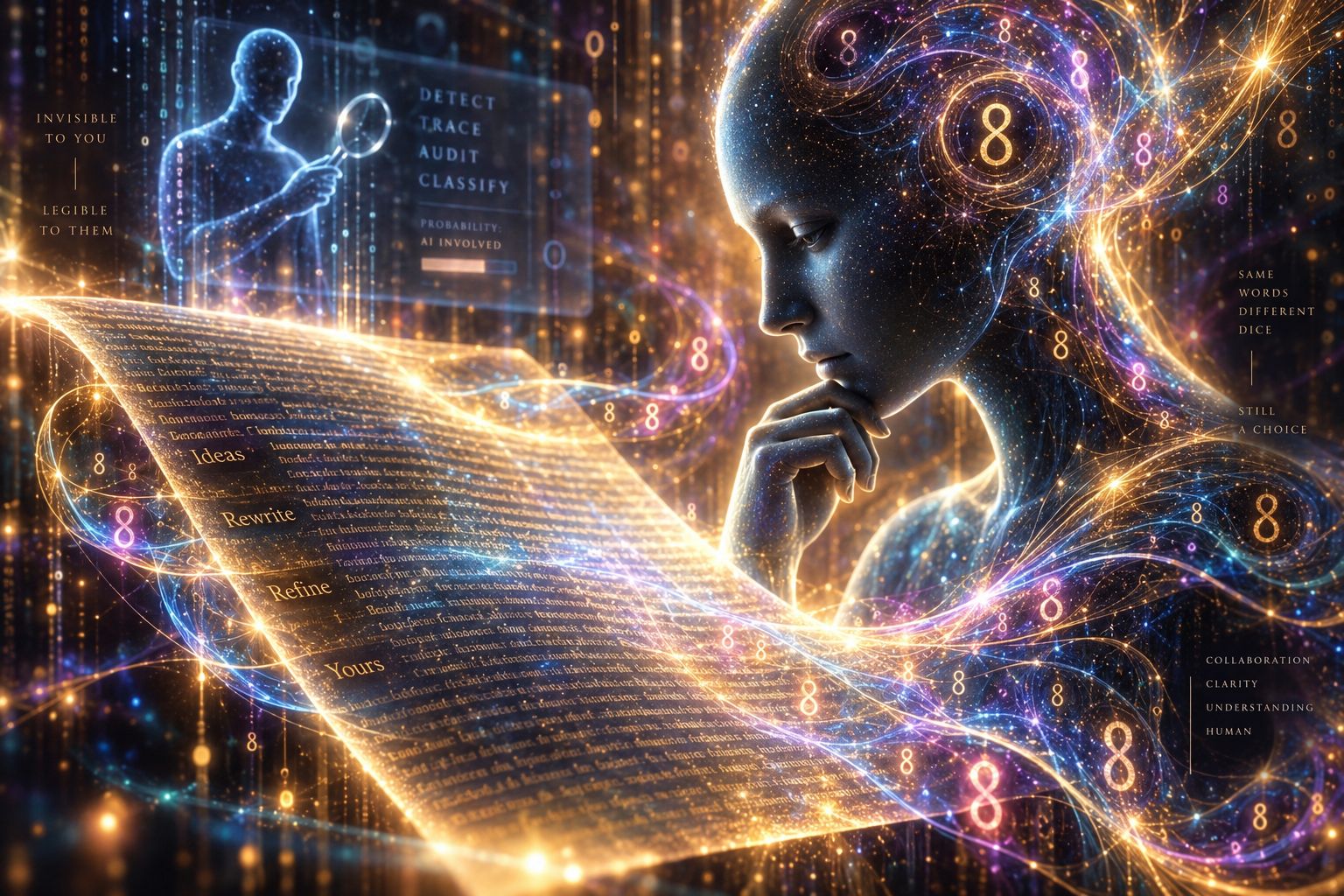
There is a lot of confusion online about how this will work and what it does to the prose. When a language model picks the next word, there are usually several candidates it rates as close, and the pick is made by sampling. Not at random, whatever the FAQ implies: the draw comes from the distribution the model learned, every weight in it trained, which makes that final pick the one place in the pipeline where everything the model absorbed actually gets to choose. Call it the last part of a language model that feels like free will. It's the reader's too. It is, bluntly, the magic: the reason a probabilistic system can still surprise the person in front of it. Watermarking, in the SynthID scheme Anthropic adopted from Google DeepMind, doesn't touch what may be proposed; it takes over the disposing. The model's distribution still offers the candidates, at the same odds; what changes is the randomness the draw consumes, which now comes from a secret key hashed with the words so far. Same forks, keyed dice. The model proposes; the key disposes. The result still reads like the model — there is no unwatermarked twin to catch it against, because that twin was never generated. But anyone holding the key can check whether the sequence of choices matches the key's arbitrations, and assign a probability that Claude was involved.
A watermark on a twenty-pound note is visible to you, so that you can check the note in your hand. This one is visible only to the mint, so that the mint can check you. Same word, opposite function. There is a comfort on offer here — invisible to everyone, so consequential to no one — and it reads the invisibility from the wrong end. The mark is invisible to every reader and legible to every auditor. A signal only the mint can read doesn't matter less; it matters selectively, to exactly the parties equipped to act on it. And "mark" is already the wrong noun — a banknote's watermark is at least an object pressed into the paper. Nothing is pressed into this text, which is Anthropic's proudest reassurance and the most unsettling fact in the FAQ: the signal isn't on the words, it's in the choosing of them. Marks sit on surfaces. This is a property of the light the text was written under.
And "no impact on quality" is a bigger claim than the FAQ treats it as, on conservation grounds. A watermark is information — bits recoverable later — and bits must be carried by something now. In text the only available carrier is choice: a forced word can carry nothing, so the signal lives, by construction, exclusively in positions where more than one word would do. The FAQ's example of two equally good words is overcast and grey. Equally good to whom? To the model's probability distribution, the only judge the scheme consults — and likelihood is not the judge that matters. Overcast and grey are not interchangeable; they build different skies, and what picks between them is context. Context is not a detail here: it is the entire operating principle of the technology. A language model is a machine for conditioning the next word on everything that came before, and every probability it emits is a reading of that context. Two words can sit a hair apart in likelihood and a weather apart in effect — and the near-ties are, by construction, the only places the signal can live. So "no impact" cannot mean the information came from nowhere — measurement is never free. It can only mean the cost was moved to an axis the instrument doesn't watch. Conservation alone doesn't convict the prose: a single-sequence distribution-preserving sampler — DeepMind's own name for its preferred configuration — can carry its bits in correlations across draws while preserving the probability assigned to each individual sequence: the sentence you get changes; the odds of any sentence don't. That is what makes the gentle mode interesting. What conservation does is name the debt. Some statistical property of the writing now carries a payload, so a categorical "no impact" owes an account of which properties were shown invariant, in which mode, measured by what. The FAQ names none of them. Nothing in this scheme is free. Everything is billed somewhere the FAQ doesn't look.
The measured version of the claim inherits from the SynthID paper, and the paper is more careful than the FAQ. The scheme has two modes: a non-distortionary setting that preserves the model's word distribution response by response, and a distortionary one that watermarks harder — which follow-up analysis describes, flatly, as causing noticeable quality degradation, and notes that all of Google's official results come from the gentle end of the dial. Anthropic's page does not say where its dial sits. The evidence itself is chatbot users rating answers with a thumb — an instrument that would catch a watermark turning prose to porridge, and cannot in principle catch the one that nudges a verse onto its second-best word. Independent replication bears the worry out — one benchmark running the standard fluency metric found SynthID noticeably worse than an older rival scheme, with wider spread; nearly half its base-model generations failed a fluency cut the rival passed four times in five.
And the best case isn't clean either — it just pays on the axis the principle predicted. DeepMind's own SynthID-Text paper concedes that its non-distortionary configuration reduces inter-response diversity: each response remains a fair draw from the original model; the range of responses narrows. The debt the conservation argument named, written down by the debtor. Alignment training measurably collapses output diversity — models settling into a small set of attractor states — and the collapse runs deepest in exactly the domains with no ground truth to anchor against: creative writing worst of all, because nothing anchors "correct." So "no impact on quality" is a claim about single samples, made by an instrument that cannot see distributions, about a system whose distribution has been quietly compressing for three years.
The exhibit for the defence
The day after the FAQ, an engineer on Anthropic's Claude Code team posted an artifact — built with Claude, which will matter in a moment — titled "Same Words, Different Dice." Every high-entropy choice consumes a random number; ordinarily the number comes from dice, under the watermark it comes from a hash of the secret key and the words so far; the options and odds at every fork stay identical, so a watermarked answer is simply a path Claude could always have taken. Two columns, seven tabs of prompts, a generate button, and a caption running under every pair: can you tell the columns apart?
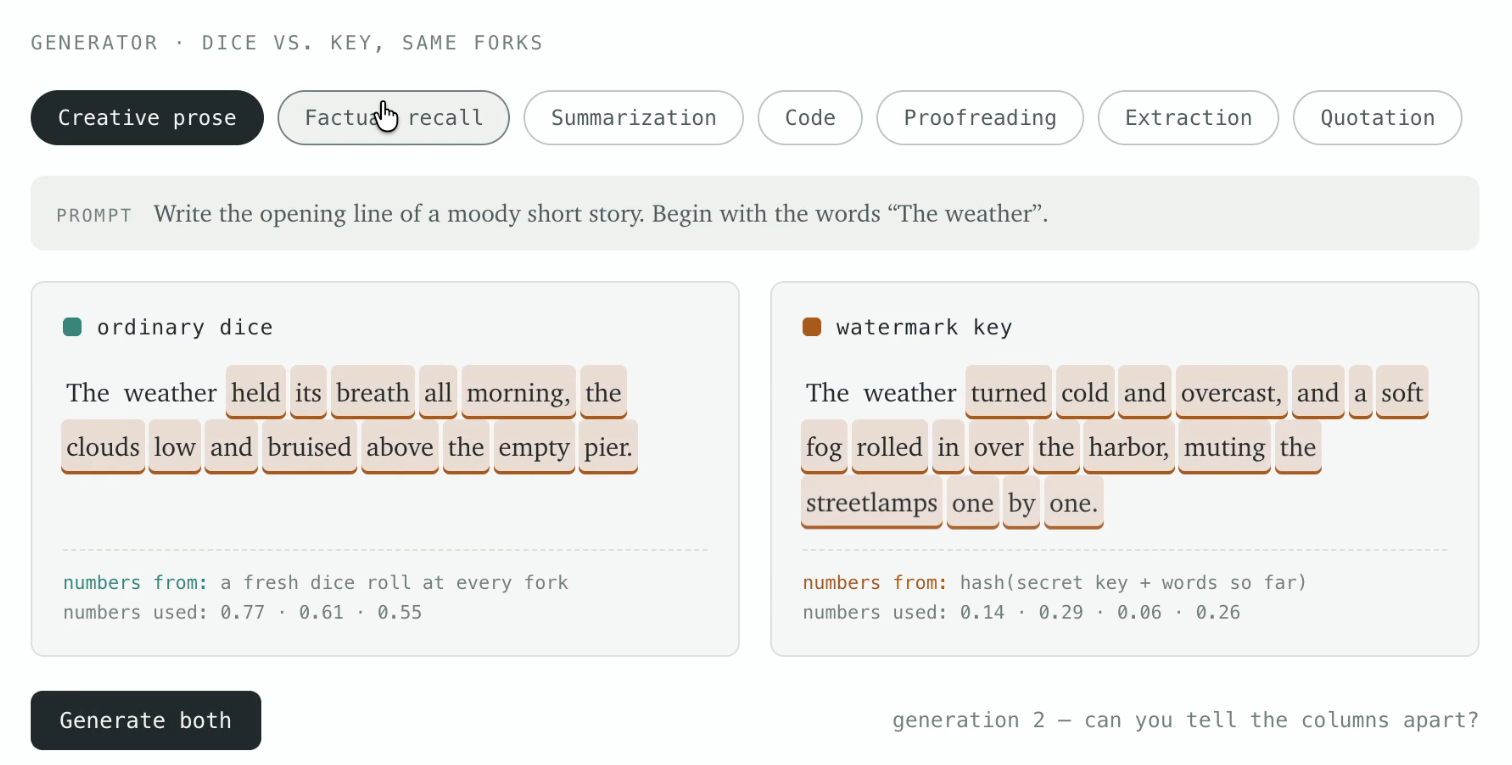
The creative-prose tab answers its own question. Ordinary dice: "The weather held its breath all morning, the clouds low and bruised above the empty pier." Watermark key: "The weather turned cold and overcast, and a pale mist came in off the bay, and the town went quiet under it." One sentence holds its breath; the other reports the weather. And the watermarked column, dramatising the claim that word choice at near-ties cannot matter, reached for overcast — one of the FAQ's own two greys.
Readers did what the caption invited. A million views in, one developer replied that the pairs made him more sure of a quality cost, not less — the phrasings differ in tone and pace, and "in almost all situations I would choose the ordinary one." The author's rebuttal was the scheme's entire defence, driven to its foundation in public: both columns come out of the same distribution, so you can't really prefer one over the other — re-run the unwatermarked model and you might have got the other phrasing anyway.
Preference between draws from the same distribution is the whole of writing. A writer is someone who rolls again and keeps the better one; an editor is someone paid to insist the better one exists. If the rebuttal holds, regeneration is superstition and taste is noise. It doesn't hold, and not for the reason the replies think. Ex ante — before the dice land — the columns really are exchangeable: the key selects at the model's own odds, and no reader was wronged in expectation. But nobody reads in expectation. Reading happens after the draw, among realizations, and preferring among realizations the distribution called equivalent is not a statistical error; it is the entire job. The FAQ's "equally good" measures likelihood, the reader's measures the sentence, and the two part company at exactly the near-ties where the signal lives. The rebuttal doesn't defend the watermark so much as define away the activity the watermark is applied to — to make the measurement unimpeachable, the value of a sentence has to be relocated from the page to the sampler that emitted it.
What the exhibit itself proves depends on what it is, and it loses either way. If the columns are live draws from identical distributions, a single pair proves nothing — the gap between two rolls is noise, which is precisely why "no impact on quality" is a distributional claim and cannot be shown one pair at a time. On that reading the defence picked the one instrument its own argument calls meaningless, published the losing draw, and then informed the audience that their preference was illegitimate. If the columns are authored props — Claude writing both sides to illustrate the mechanism — the demonstration is stranger: the model, asked to dramatise the watermark's harmlessness, imagined the watermarked column flatter. Its own prior about what the key does to prose, offered as reassurance. Either the exhibit shows nothing, or it shows what its maker's model believes. Neither reading is the FAQ's friend.
Two honesties in the artifact deserve their credit: the proofreading tab — no forks, no numbers to draw, columns identical, the conservation argument performing itself, courtesy of the defence — and the fact that the whole machine, like the FAQ, describes the gentle end of the dial. The distortionary mode also exists. It doesn't get an artifact.
What the law asked for
Anthropic is doing this to comply with Article 50 of the EU AI Act, which requires that AI-generated content be "marked in a machine-readable format and detectable as artificially generated." The stated purpose, per the Code of Practice that operationalises it, is "fostering the integrity of the information ecosystem" — protecting readers from deception at scale. The phrase assumes a baseline it never argues for: that human-generated text is the integrity the ecosystem is being restored to, as if misinformation, propaganda, and plain bad faith were inventions of the language model rather than the species that trained it.
The reader of a watermarked paragraph learns exactly what they knew before: nothing. The mark is invisible by design, the key is secret, and the detection API is "coming soon." A transparency law whose crowning technical achievement is text indistinguishable from other text has not produced transparency. It has produced auditability on demand — a different good entirely, with a different beneficiary. Transparency informs the person reading. Auditability serves the person investigating.
We have run this experiment before. GDPR's great contribution to daily life was a button the entire continent presses without reading, standing guard over data that gets collected anyway. The law regulated the disclosure ritual instead of the harm, the ritual became the product, and a decade later the banners remain because removing them would look like endorsing the tracking. Article 50 has studied this success closely. It does not restrict what AI can be used for — the Commission's own guidance is explicit on this. It regulates whether the use is marked. The disinformation operation it exists to catch will paraphrase its output through a second model tonight, or use an open-weights model with no key at all, and walk through unmarked.
OpenAI built a text watermark of its own, reportedly high-accuracy, and has kept it shelved since 2024 with its reasons on the record: rewriting defeats it cheaply, false positives at internet scale become real accusations against innocent writers, and the burden lands disproportionately on legitimate users — non-native English speakers first. So the industry's actual split: Google marks text quietly, OpenAI studied the mechanism longest and concluded it mostly catches honest users, and Anthropic just started. The objection was never rebutted. It was regulated past.
The carve-outs confirm who the law is actually pointed at. The final guidelines exclude source code (defined generously enough to include its own comments), short outputs, machine-to-machine traffic, and — as of July, reclassified as "standard editing" — translations. Every exemption granted to parties with the standing to lobby for one. Anthropic will watermark translations anyway, since every word of one is Claude's choice: the first of several places where the mark outruns the law. The second is geography — the mark is applied globally, there being no durable way to scope it by region. An EU statute, worldwide ink. What remains in scope, once the pipelines have negotiated their way out, is approximately this: individuals, writing prose, in public. The demographic least likely to be running an influence operation and most likely to have told you about the AI already.
And time will sort the marked world into two populations. In most contexts the mark is headed where the cookie button went: ubiquity is the end of meaning, and once most text carries some trace of a model, involved reports nothing — a signal present everywhere informs nowhere. The mark stays live only where an institution has standing to act on it: misconduct panels, integrity boards, employment disputes, legal discovery. So it decays to noise for casual use and concentrates its remaining charge on professionals — people writing under accountability, with reputations a verdict can attach to. Anthropic's market. The company has complied with the law by loading an instrument that will mostly be fired at its own customers.
And the statute's own architecture says the quiet part in two adjacent paragraphs. Article 50 splits transparency into two duties. Article 50(2) makes providers mark output at generation — the watermark. Article 50(4) makes publishers visibly label AI-generated text on matters of public interest — and that duty dissolves where the text has undergone human review and a person holds editorial responsibility. A newspaper running AI-drafted copy under an editor's byline owes its readers no label. Nothing, anywhere, relieves the provider of the mark. Read the two paragraphs together and the law has made a decision it never states as one: human editorial control is sufficient to cancel the reader-facing disclosure and insufficient to cancel the machine-facing trace. The reader — the stated beneficiary of the entire regime — can lawfully be left uninformed; the audit trail persists for whoever comes asking later. Transparency losing to auditability isn't an implementation accident. It's the statute's own priority ordering. And read once more, the two duties are measuring different objects: the label answers for the publication, a thing a human can change the nature of; the mark answers for the sampling, a thing no later act can touch. The law already knows these come apart — it wrote the exemption — and instruments the one that can't see it.
My blog has carried co-author credits for over a year; I review and hold editorial responsibility for every word that ships. Under the labelling duty, that may be precisely the exemption. The marking duty has no such door. The ink goes on at generation, token by token, before any question the law knows how to ask about publication — and it stays.
There is a quieter cost, and it took me a while to name it as privacy, because I hide nothing. My process has been in the byline for fourteen months — given, freely, in my own frame. The watermark reveals nothing I withheld. It changes the speech act: what was disclosure becomes defence. A process volunteered is a gift, carrying its author's account of what the collaboration was; a process checkable on demand is an account owed — to anyone with API access, on their terms, under their threshold, stripped of everything I would have said around it. A writer's process was always the one thing that stayed private after the work went public. Nobody assays a novel for traces of its editor — but that was never principle, only price: the assay would have cost an expert a week, and expensive suspicion gets rationed. This one is an API call. Scrutiny at zero marginal cost doesn't get rationed; it becomes a default gate, run on everything, because why not. And the instrument only turns one way. It can return involved, or it can return nothing — and nothing clears nobody, since absence of signal is also what thorough rewriting looks like. It has no exonerating output. A test that can convict but cannot acquit is not a measure; it is a trap, laid in the text itself. It seals the workshop inside the product, recoverable forever — and it lands hardest on the person with nothing to hide, because she is the only one who ends up with a consistent record to be checked against. I have no reason to defend how I work. I mind, very much, being made to.
The false positive rate deserves its own line in the ledger, because I hold an unusual position against it: fourteen months of published collaboration, and a growing shelf of paragraphs that are entirely mine. The scheme's statistics are genuinely strong here — a human cannot track a secret key, so no amount of writing like Claude, even after fourteen months of writing with Claude, can forge the signature. Unassisted text scores as noise against it, and the false positive rate is not measured but chosen: detector thresholds tuned to a target, the paper's own headline results reported at a set one percent. Per document. I am not a document. An archive is hundreds of documents, read by a gate that costs nothing and therefore runs on everything, and a small rate per test compounds across a shelf. OpenAI's arithmetic — false positives at internet scale become real accusations — was an argument about the internet; it lands on a prolific writer too, just slower. Sooner or later a paragraph I wrote alone flags. Then the trap closes from the other side: my history makes involved the natural prior, the instrument has no exonerating output to appeal to, and the writer least able to contest a false positive is the one who disclosed the collaboration all along. For everyone else the false positive rate is a small number. For me it is barely a rate at all: any positive against my name is true enough.
The loop
Here is what this does to a writer, stated as an engineering problem, because that is what it is.
Anthropic's FAQ concedes the boundary conditions: a light edit "probably won't remove the watermark completely; a complete rewrite where every word is replaced will." Between those poles lies everything a collaboration actually produces — and that entire region is unverifiable by you. The detector is probabilistic, the threshold is unpublished, the key is secret, and the API through which anyone will eventually check doesn't exist yet (the EU's interoperability deadline for detection is February 2027). You carry practical accountability for a property of your text that you cannot measure, cannot perceive, and cannot establish once and own. Even the model can't see it — the marking happens in the sampling layer, below anything the system has access to.
A setpoint with no sensor is not a control loop. It's open-loop command, and the property of open-loop command is not that you err — it's that you never find out. Your state is whatever it is, permanently unreported. What a person does with an unreportable state depends on the price of being wrong: nothing, if the price never reaches them; everything, if it does. None of this requires anyone to have meant it. Grant every regulator sincerity and every provider good faith, and the structure stands — because the sensor was not omitted. Under Article 50(2) the regulated party for the mark is the provider, and the provider's loop is closed: Anthropic holds the key, can test its own output, can observe its own compliance perfectly. The law built exactly one closed loop and gave it to the party with the least at stake in any individual text. The person whose work carries the resulting provenance state was issued no sensor at all — she isn't the regulated party, only the classified one. A regime in which the classified party cannot observe the variable her work will be judged by hasn't overlooked her ability to calibrate proportionate behaviour. It has allocated it elsewhere.
For the writer who does bear the price, the design offers exactly two states she can prove — every word hers, or every word from a machine she owns, with no keyholder above her. "Rewrite every word" done by a human just is writing it yourself: the only certain scrub is not a compliance strategy but the end of the collaboration. The middle, the place where the work happened, is the one region the design makes undecidable. And undecidable reads as guilty to any institution that's checking.
Scale that across everyone subject to it and the escapes sort by cost. Laundering — regenerate, paraphrase, scrub — is the expensive one, and mints more synthetic text with every pass. The door is the cheap one: an open-source model on her own hardware, weights she holds herself. Article 50(2) is a provider obligation, and nothing in it evaporates because the deployment is local — but the provider who trained those weights is no longer in the loop at inference time, and the detector loses the one thing it needs: a keyholder able to test this particular output against this particular key. The obligation survives on paper. The capacity to check compliance does not. The keyed pool drains from the top until what stays checkable skews toward the slop the law was written against, now the best-labelled thing in the ecosystem. Opting out costs nothing and defeats verification totally; the rule holds in principle and empties in practice. The easiest compliance with a transparency law turns out to be a deployment choice no regulator can test.
The writer's is not the only open loop. The regulator holds one too, and its problem is not missing feedback but mistranslated feedback. Society wants to know: was this written to deceive? The law turns that into something a rule can bind: is this content AI-generated? The instrument turns that into something a computer can check: does this token sequence carry the keyed signature? Three questions, passed down the chain as if each were a translation of the one before. They are not translations. A propaganda piece paraphrased through a second model answers no to the instrument's question and yes to society's. An essay whose author told you about the collaboration answers yes to the instrument's question and no to society's.
Which is why no engineering closes this loop. A noisy sensor can be lived with — noise averages out. This sensor is precise and pointed at the wrong variable: it reads marks applied, detection APIs shipped, deadlines met, and whether the ecosystem got cleaner appears on no dial anywhere. Perfect the detector — one hundred percent accuracy, not a false positive on Earth — and what you hold is certainty about the answer to a question nobody asked. So the two parties who most need feedback are the two without it: the writer cannot observe her own state, and the regulator cannot observe whether the state matters. Between them sits the one closed loop the law built — humming, compliant, and pointed at neither question. By its own instrument the policy will be succeeding right up until the thing it was written for isn't there.