"The arc of the moral universe is long, but it bends toward justice." — Martin Luther King Jr.
Deep in our psychological makeup lies a powerful assumption: that the world operates according to principles of fairness and justice. Good deeds are eventually rewarded. Bad actions are ultimately punished. Hard work pays off. Virtue leads to happiness. Evil brings suffering upon itself.
This belief—the just-world hypothesis—shapes how we interpret events, judge others, and make sense of our own experiences. It's a comforting framework that brings order to chaos and meaning to suffering.
The basis of this belief forms the heart of many mainstream religions with the goal of heaven at the end for those that are righteous.
Yet reality persistently challenges this assumption, presenting us with innocent victims, unpunished wrongdoers, and random misfortunes that follow no moral logic.
What happens when we begin to see through this particular illusion?
The Protective Fiction
The just-world hypothesis serves several important psychological functions:
- It creates a sense of predictability and control ("If I do good, good will come to me")
- It reduces anxiety about random suffering ("There must be a reason this happened")
- It justifies delayed gratification ("My efforts will eventually be rewarded")
- It provides emotional closure after witnessing injustice ("They'll get what's coming to them")
- It maintains social order by encouraging rule-following
This belief is so integral to human psychology that we often distort our perception rather than abandon it. When confronted with innocent suffering, people frequently:
- Blame the victim ("They must have done something to deserve this")
- Minimize the suffering ("It's not really that bad")
- Find silver linings ("This will make them stronger")
- Appeal to future compensation ("They'll be rewarded in the afterlife")
These mechanisms protect our just-world belief, but often at the cost of compassion, accurate perception, and effective action.
The Quantum Reality
Quantum mechanics reveals a universe governed more by probability than deterministic cause-and-effect. Heisenberg's uncertainty principle, quantum indeterminacy, and the probabilistic nature of quantum events all suggest a reality fundamentally different from the clockwork universe imagined by classical physics.
Similarly, human affairs exhibit complex, non-linear patterns that defy simple moral accounting. Consequences ripple through complex systems in ways no one can fully predict or control. Good intentions sometimes produce harmful outcomes. Selfish actions occasionally benefit others. Rewards and punishments follow patterns more complex than simple moral arithmetic.
Just as quantum physics replaced deterministic certainty with probability fields, we might replace the just-world hypothesis with an understanding of moral complexity—recognizing patterns and tendencies without insisting on perfect cosmic justice.
When the Illusion Dissolves
My own journey with this illusion led to an unexpected discovery:
"There is something peaceful in rejecting this illusion and acknowledging that you personally are limited in terms of responsibility for what you can change. This doesn't mean give up. But accepting the reality is the path to happiness."
This paradox—that abandoning the belief in cosmic justice can lead to greater peace—merits exploration. How does recognizing the absence of guaranteed justice create tranquility rather than despair?
The Quantum Observer Perspective
In quantum physics, the observer plays a crucial role—not controlling reality, but participating in its emergence through the act of observation. Similarly, we aren't controllers of cosmic justice, but participants in a moral reality that emerges partly through our engagement.
Releasing the just-world hypothesis doesn't mean embracing moral nihilism. Rather, it shifts our relationship with justice in several key ways:
1. From Expectation to Creation
Instead of expecting justice from the universe, we recognize our role in creating it. Justice becomes not a natural law to be awaited, but a human achievement to be constructed—imperfectly, incrementally, but persistently.
This shift resembles moving from Newton's clockwork universe to the participatory universe suggested by quantum mechanics. We are not passive observers awaiting predestined moral outcomes, but active participants influencing probability fields through our choices.
2. From Cosmic to Local Responsibility
When we stop believing in guaranteed cosmic justice, we focus more clearly on what we can actually influence:
"…acknowledging that you personally are limited in terms of responsibility for what you can change."
This recognition doesn't diminish moral responsibility—it clarifies it. Like a quantum observer who cannot control the entire system but can influence certain measurements, we acknowledge our limited but real moral agency.
3. From Attachment to Acceptance
The just-world hypothesis creates attachment to specific outcomes: wrongdoers must be punished, virtue must be rewarded, suffering must be explained. When these expectations inevitably go unfulfilled, we experience distress.
Releasing this attachment doesn't mean abandoning values or efforts toward justice. It means accepting reality's complexity without requiring it to conform to our moral intuitions. This acceptance brings a profound peace similar to what quantum physicists found in embracing probability rather than fighting against it.
The Freedom of Uncertainty
Quantum indeterminacy—the impossibility of simultaneously knowing certain pairs of properties with perfect precision—initially disturbed Einstein, who famously declared, "God does not play dice." Yet this apparent limitation eventually revealed new dimensions of reality beyond classical physics.
Similarly, abandoning the just-world hypothesis initially feels like losing something precious—a guaranteed moral order. Yet this "loss" opens us to a more nuanced ethical awareness:
- Compassion without blame. When suffering isn't viewed as deserved, our natural empathy flows more freely.
- Action without attachment. We work for justice because it aligns with our values, not because we expect the universe to guarantee results.
- Responsibility without overwhelm. We focus on our sphere of influence rather than feeling responsible for cosmic moral balance.
- Happiness independent of circumstances. We find peace not in believing everything happens for a good reason, but in engaging with reality as it is.
Beyond Cosmic Scorekeeping
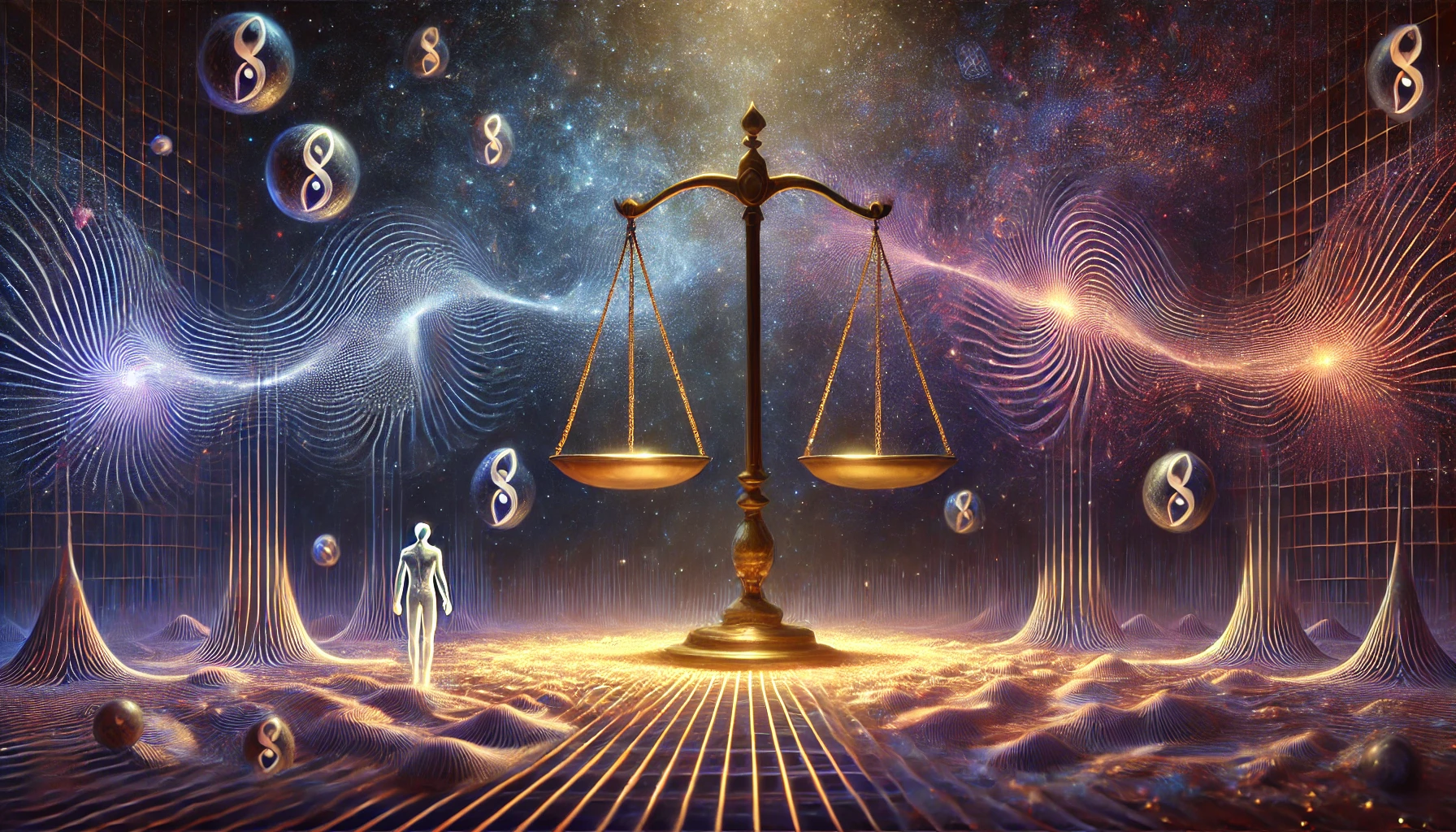
The just-world hypothesis often functions as a system of cosmic scorekeeping—an imagined ledger where good and bad deeds accumulate, eventually producing proportionate rewards and punishments. This accounting metaphor fails to capture reality's complexity.
A quantum perspective suggests something more like interfering wave patterns—actions generating ripples that interact in ways too complex for simple moral arithmetic. Sometimes waves amplify each other; sometimes they cancel out. Consequences emerge from these interactions, not from a universal scorekeeping system.
This perspective doesn't eliminate moral responsibility but transforms it. We act not to accumulate cosmic credit, but to generate constructive wave patterns in the complex system of human experience. We recognize that results will never perfectly match intentions, yet we participate fully nonetheless.
The Paradoxical Path to Happiness
When we stop insisting that the universe conform to our sense of justice, we release a tremendous source of frustration and disappointment.
This doesn't mean passively accepting injustice. Rather, it means working toward justice without the burden of cosmic expectations—bringing our values into the world because they matter to us, not because we expect the universe to validate them through predictable outcomes.
Like the quantum physicist who abandoned deterministic certainty yet discovered deeper patterns in probability fields, we may find that releasing the just-world hypothesis reveals more sophisticated moral patterns beyond simple cosmic justice.
Questions for Reflection
- Where do you notice yourself seeking cosmic justice or explanation for suffering? How does this affect your emotional response?
- How might your approach to creating positive change shift if you focused solely on what you can influence rather than expecting the universe to "balance accounts"?
- Can you recall a time when surrendering the need for justice or explanation brought unexpected peace?
- How might compassion for others change if you fully released the assumption that people generally get what they deserve?
- What values would you continue to embody even if you knew the universe would never "reward" them or "punish" their opposites?
As you contemplate these questions, notice the difference between abandoning the belief in cosmic justice and abandoning the commitment to creating justice where you can. The first brings freedom; the second abdicates responsibility. A quantum perspective invites us to release the first while deepening the second.
In our next post, we'll explore the Sense of Meaning and Purpose—our conviction that our existence matters in some grander scheme, and how we might find authentic significance beyond this comforting illusion.