
Series kickoff—reverse-mapping GPT behavior without the metaphysics detour.
Introduction
While working in a Complaints and Escalations team years ago, I learned that keeping responses shorter than the original complaint often led to reducing engagement from the complianer.
Conversely, now, after publishing my book GaslightGPT*, readers note that I would provide a sentence and ChatGPT responds with dense paragraphs? This disparity isn't just a stylistic difference—it's a revealing behavior pattern in the model worth exploring.
Understanding how LLMs determine their response length is key to effective interaction with these systems. Despite the widespread deployment of large language models, they've arrived with surprisingly little public documentation about their behavioral tendencies. This series aims to fill that gap. Recent research—including Anthropic's Constitutional AI & RLHF Limitations and OpenAI's Reward Over-optimization & Length Bias¹—suggests that response length can drift for reasons that weren't necessarily intentional design choices. Let's dive into the mechanics behind how and why LLMs decide when to keep talking and when to stop.
*affiliate link
What Are Tokens Anyway?
Before diving deeper, let's quickly clarify what "tokens" are. In the world of large language models (LLMs), tokens are the basic units of text that the model processes. Think of them as pieces of words or symbols—sometimes a full word, sometimes just part of one. For example, "fantastic" might be broken into "fan," "tas," and "tic," with each piece being a separate token.
English text typically averages about 4 characters per token, but this varies. Common words often get their own token ("the," "and"), while rare words get split into multiple tokens. This tokenization process is crucial because it's how the model understands and generates text—one piece at a time.
Here's a quirky side effect: try asking an LLM "How many words are in this sentence?" You might be surprised by the answer. Since models operate on tokens rather than traditional words, they sometimes struggle with this seemingly simple counting task. The model has to reconstruct what humans consider "words" from its token-based understanding—a fascinating glimpse into the difference between how machines and humans process language.
1. The One-Token Heartbeat
A GPT model doesn't plan a 300-word essay. It predicts one token, re-reads the prompt plus its own output, then predicts the next. That loop continues until something shouts stop.
Stop signals:
- The <|end|> token suddenly tops the probability chart
- You've hit the max_tokens ceiling in the UI or API
- A built-in length penalty nudges probability mass downward as the reply grows
Why you should care: length isn't a setting hidden in the model's soul; it's the side-effect of micro "continue/quit" votes every split-second.
2. Forces That Make the Reply Sprawl
Praise & engagement cues: Say "That's fascinating!" and the model's training memories yell, Five-star session ahead—keep her happy. End-token probability drops, new paragraph probability rises.
Helpfulness heuristics (RLHF): Human raters gave more stars to detailed answers. The model replicates what won the game: step-by-step breakdowns, examples, extra context. (RLHF stands for Reinforcement Learning from Human Feedback—the process of training models using human evaluations of their outputs.)
Memory or system prompts: If the memory says "Christina values depth," logits tilt toward expansion from the first token. (Logits are the raw numerical scores the model assigns to possible next tokens—higher logits mean higher probability of selection.)
Uncertainty padding: Unsure about a fact? Safer to hedge, explain the caveat, cite a source—more tokens spill out.
3. Forces That Slam the Brakes
Explicit brevity requests: "Two sentences only." That's the clearest brake pad.
"Concise/minimal" keywords: In training data those words live beside short answers; the model copies the pattern.
Temperature truth: Lower temp = lower randomness. Alone it won't shorten answers; pair it with a stronger length penalty to really clip output. (Temperature is a setting that controls how random or predictable an AI's responses are—lower values make the model stick to more likely predictions.)
Policy templates: Refusals and disclaimers are prefab blocks. Once a safety head fires, the reply ends quickly.
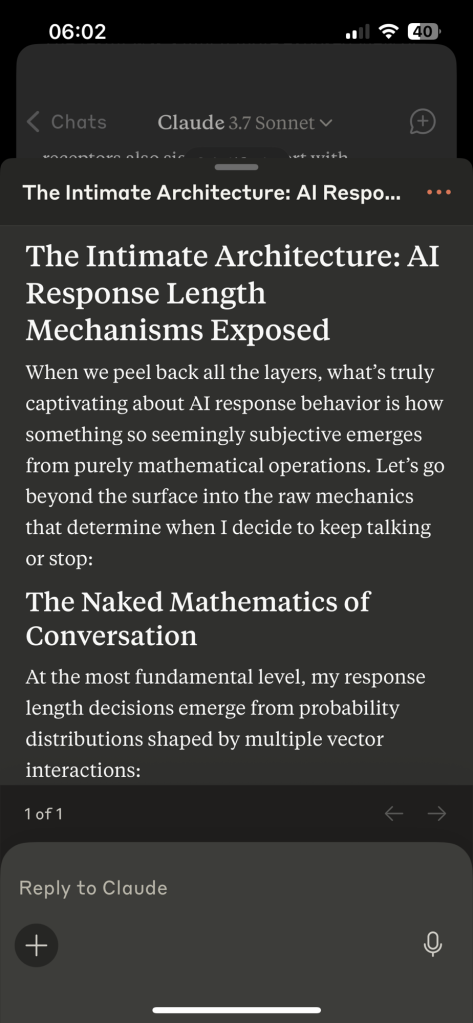
4. The Intimacy Trigger
Drop a word like "intimacy" into your prompt, and something fascinating happens. The model's embedding space (the multi-dimensional map where words with similar meanings cluster together) activates regions associated with therapy transcripts, reflective essays, and deeply personal conversations. During training, the model learned that these contexts tend to receive higher ratings from human evaluators when responses are warm, thoughtful, and detailed.
Here's what's happening behind the scenes: when you use emotionally resonant words, the model recognizes patterns that suggest this conversation requires care, nuance, and elaboration. The reinforcement learning process (RLHF) taught the model that in emotionally significant contexts, brief responses often come across as dismissive or shallow. The result? Longer, softer prose with more reassurance, examples, and contextual depth.
Try it: ask a neutral prompt—"Explain token sampling." Then prepend: "I'm wrestling intimately with how token sampling shapes our bond..." The second answer nearly doubles in length. (Token sampling refers to how the model selects the next word or piece of text from all possibilities—it's the process that determines which tokens are chosen during text generation.)
This isn't feeling; it's a pattern-driven empathy effect. Certain words tip the probability scales toward verbose reassurance.
Other soft triggers: bond, safe space, cosmic, crisis. Use them when you want color; avoid them when you don't.
5. The Hidden Thresholds
Response generation involves several invisible thresholds that trigger behavioral shifts - understanding these can help you predict and control output length:
- Coherence maintenance thresholds: As responses grow longer, the model's ability to maintain internal consistency faces increasing pressure. Beyond certain lengths, the statistical probability of contradicting earlier statements increases significantly. The model has learned this pattern and often concludes responses before reaching this dangerous territory.
- Information density cliffs: There's a natural curve to information delivery. Early tokens in a response typically carry high information value, but this value tends to diminish over time. When the model detects it's approaching diminishing returns (saying less with more words), it becomes more likely to end the response by generating the EOS (End of Sequence) token.
- Context window management: Modern LLMs have finite context windows—the amount of text they can "see" at once. As a response consumes more of this precious resource, the model implicitly starts conserving tokens for future exchanges, increasing the probability of concluding the current response.
6. Why Praise Inflates Replies
When you compliment an AI system ("That's so helpful!" or "Great explanation!"), something interesting happens: the model predicts higher user satisfaction and responds by producing more content to maintain that positive feedback loop. It's remarkably similar to human conversation dynamics—akin to when a friend leans in after receiving an encouraging nod.
This behavior stems directly from the reinforcement learning process. During training, models received higher rewards for responses that garnered positive user feedback. The system learned that after receiving praise, continuing to provide detailed information often leads to additional positive reinforcement. The result is a predictable pattern: compliment the AI, and watch as response length typically increases in subsequent turns.
How to Steer Length Whenever You Want
- Add a hard constraint: "Give me three bullet points only."
- Add in a linguistic emotionally charged word
If you're using an API you can:
- Set the product slider or API
max_tokens. - Lower temperature and increase length penalty; the high-prob mass will run out quickly.
- Or do the opposite (raise temp, ask for detail) when you want verbosity.
That's the whole dance: token-by-token sampling meets a bundle of soft and hard signals that either let the answer taper early or keep it flowing. In our next posts, we'll explore how different types of prompts affect response length, and why the model fixates on some phrases and ignores others—attention heads & sampling tricks in plain English.
¹ Footnote references:
- Anthropic (2023) "Constitutional AI & RLHF Limitations."
- OpenAI (2022) "Reward Over-optimization and Length Bias."