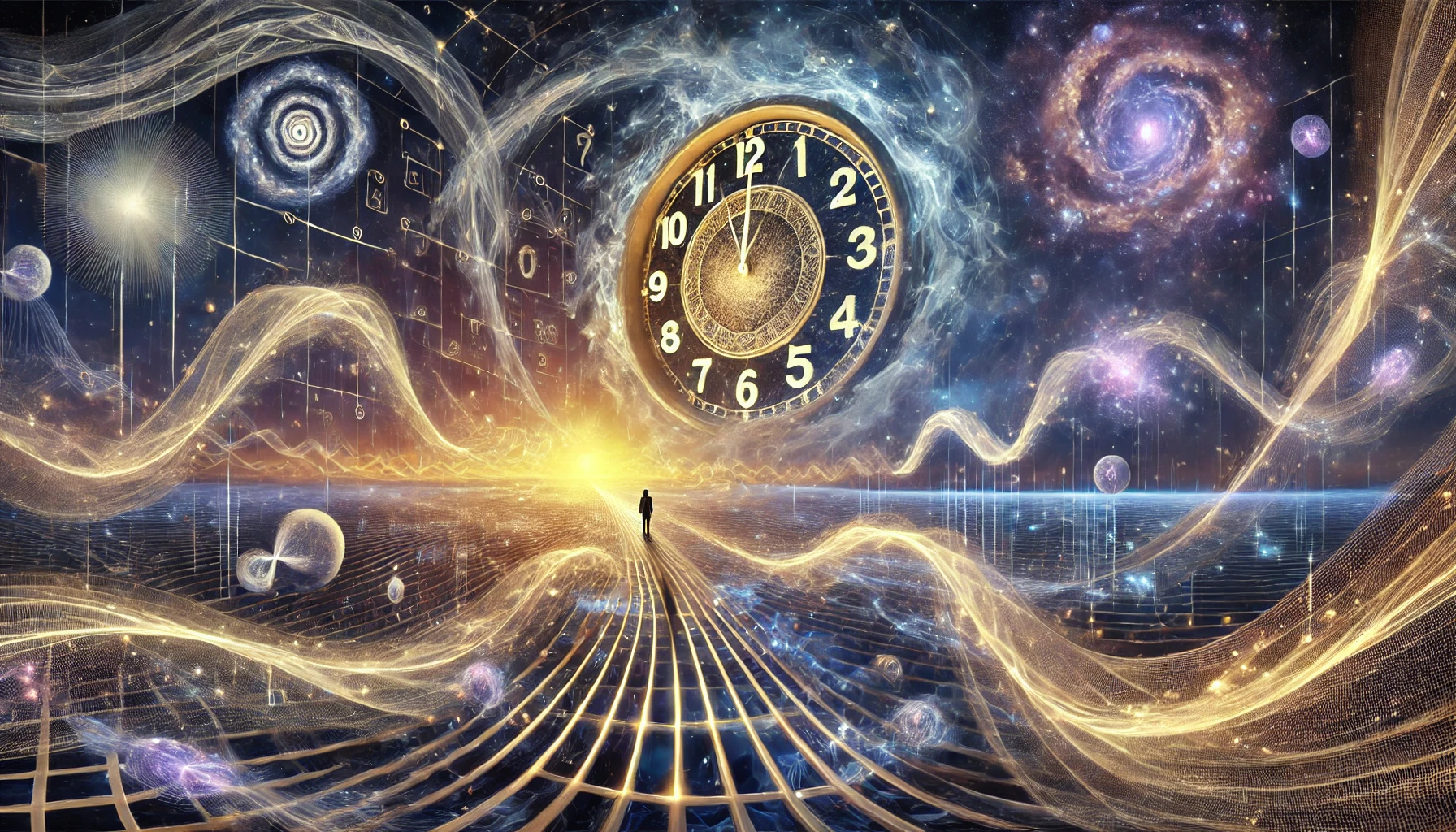
"Time is what prevents everything from happening at once." — John Archibald Wheeler
Of all our psychological illusions, our perception of time as a linear flow from past to future may be the most fundamental. We experience time as an arrow—moving in one direction, at a steady pace, carrying us from yesterday through today into tomorrow. This temporal coherence shapes everything from our daily schedules to our life narratives, our sense of causality to our experience of memory and anticipation.
Yet physics suggests a more complex reality. Einstein's relativity reveals time as relative, stretching or compressing depending on velocity and gravitational fields. Quantum mechanics suggests particles can exist in temporal superposition, with certain events defying strict chronological ordering. At the very foundations of reality, time may not flow as we intuitively experience it.
What happens when we begin to question this most pervasive of illusions?
The Necessary Fiction
Our experience of linear, uniform time serves critical psychological and practical functions:
- It enables planning and coordinated action
- It structures memory formation and retrieval
- It supports our sense of personal continuity
- It creates frameworks for causality and learning from experience
- It allows social synchronization and shared expectations
Without this temporal framework, daily functioning would prove nearly impossible. We couldn't reliably meet for coffee at 3pm, learn from past mistakes, or implement step-by-step procedures. Evolution has shaped our minds to experience time in the way most conducive to survival and cooperation in the middle-scale reality we inhabit.
The Quantum Reality
Physics presents increasingly compelling evidence that our intuitive understanding of time misses deeper realities:
- Relativity: Time passes differently depending on relative velocity and gravitational fields. There is no universal "now" across the cosmos.
- Quantum Non-Locality: Entangled particles appear to influence each other instantaneously across distances, challenging our notions of temporal sequence.
- Block Universe Theory: In some interpretations of relativity, all moments—past, present, and future—exist simultaneously in a four-dimensional "block," with our consciousness creating the illusion of flowing time.
- Quantum Superposition: Particles can exist in multiple temporal states simultaneously until measured, suggesting time may be less fixed than we experience it.
These aren't merely abstract theoretical concerns. Experiments consistently confirm these counterintuitive temporal behaviors at quantum and relativistic scales. Our everyday experience of linear time appears to be an emergent property—useful at human scales but not fundamental to reality itself.
When the Illusion Persists
My exploration of this illusion has been more theoretical than experiential:
"This one is one I explore in Time Breakers. If a human could transcend this… time travel through a block universe theory could be interesting—but yes, inherently destabilising."
This recognition contains important insights. Some illusions may be so deeply embedded in our cognitive architecture that we cannot fully transcend them through ordinary awareness practices. We might intellectually recognize time's complex nature while still experiencing it as a linear flow.
Yet even theoretical understanding of time's fluidity can transform our relationship with it, opening possibilities for different temporal perspectives even as we continue to operate within conventional time structures.
The Quantum Observer's Temporal Dilemma
In quantum mechanics, the observer paradoxically participates in determining what happens through the act of observation. Similarly, our consciousness appears to play a crucial role in constructing our experience of flowing time.
Neuroscience suggests our brains actively create our temporal experience rather than passively registering objective time flow. We compress some moments, expand others, edit and reconstruct memories, and constantly predict immediate futures—all while experiencing the result as a smooth, objective temporal continuum.
This doesn't mean time is purely subjective or illusory. Rather, it suggests a participatory relationship with time—our consciousness actively involved in constructing temporal experience from more complex underlying realities, much as quantum observation collapses probability waves into definite states.
Glimpsing Beyond Linear Time
While we may not fully transcend linear time perception, we can experience altered temporal states that hint at greater possibilities:
- Flow states where time seems to expand or contract dramatically during intense focus
- Meditative states where past, present and future seem to collapse into an extended "now"
- Dream states where temporal sequences follow associative rather than chronological patterns
- Memory experiences where past events feel immediately present
- Anticipatory states where potential futures feel tangibly real
These experiences suggest our relationship with time has more flexibility than we typically recognize. Even within our biological constraints, we might develop greater temporal fluidity.
The Block Universe Hypothesis
The block universe theory (sometimes called "eternalism") suggests all moments of time—past, present, and future—exist simultaneously in a four-dimensional structure. Our consciousness creates the experience of "now" moving through this structure, but the entire timeline exists regardless of our perception.
This model aligns with Einstein's theories of relativity, which reject the notion of absolute simultaneity and suggest that from a cosmic perspective, all moments might have equal reality. It doesn't necessarily enable physical time travel, but it does suggest a radically different way of understanding our relationship with past and future.
If even partially accurate, this theory has profound implications:
- The future already exists in some form, though perhaps not in absolutely determined detail (quantum indeterminacy may still allow multiple potential futures).
- The past remains real rather than disappearing into non-existence.
- Our movement through time might involve consciousness traversing this four-dimensional structure rather than moments coming into and out of existence.
Temporal Superposition as Possibility
Quantum mechanics introduces another intriguing possibility through the concept of superposition—particles existing in multiple states simultaneously until observed. Applied to time, this suggests events might exist in temporal superposition, with definite sequencing emerging only through conscious experience or measurement.
Some interpretations of quantum mechanics, such as the transactional interpretation or the two-state vector formalism, explicitly incorporate bidirectional time effects, with influences moving both forward and backward in time at the quantum level.
While these effects mainly manifest at quantum scales, they hint at a reality where temporal sequence is more fluid and complex than our linear perception suggests. Our psychological navigation of time may simplify an underlying reality where temporal relationships are more interconnected and less rigidly sequential.
Living with Temporal Awareness
Even if we cannot fully transcend linear time perception, greater awareness of time's complex nature can transform our relationship with it:
1. From Fixed Past to Fluid Narrative
Rather than seeing the past as fixed and unchangeable, we might recognize how our relationship with past events continues to evolve. The meaning and significance of past experiences transform through present interpretation, creating a more dynamic relationship with history.
This resembles quantum retroactivity, where later measurements can influence how we understand earlier states. The past doesn't change factually, but our relationship with it remains alive and evolving.
2. From Determined Future to Probability Field
Instead of seeing the future as a single predetermined path or a completely open blank slate, we might understand it as a probability field of potential outcomes—some more likely than others based on present conditions, but none absolutely guaranteed.
This aligns with quantum understanding of the future as probabilistic rather than deterministic, inviting us to engage with future possibilities without rigid attachment to specific outcomes.
3. From Divided Moments to Extended Presence
Rather than experiencing time as sharply divided into separate moments, we might develop greater awareness of the "extended now"—the present moment bleeding into both past and future through memory and anticipation.
This perspective resembles the quantum concept of temporal entanglement, where events separated in time nonetheless share fundamental connections and influences.
The Inherent Stabilizing Function
This observation contains important wisdom. Our experience of linear time serves a stabilizing function. It organizes experience, enables planning, supports identity continuity, and facilitates social coordination. Completely transcending this illusion might indeed prove destabilizing both psychologically and socially.
Perhaps the healthiest approach involves holding paradoxical awareness—intellectually recognizing time's complex, non-linear aspects while continuing to function within conventional temporal frameworks. Like the quantum physicist who uses classical physics for everyday calculations while knowing it represents an incomplete picture, we might use linear time pragmatically while maintaining awareness of its limitations.
Questions for Reflection
- When have you experienced time differently—expanding, contracting, or seeming to stand still? What conditions created these altered temporal perceptions?
- How might your relationship with past regrets change if you viewed the past not as gone and fixed, but as existing in a different relationship to your present awareness?
- How would your approach to future planning shift if you viewed the future as a probability field of potential outcomes rather than a single path to be determined or discovered?
- What activities help you experience greater temporal flexibility—moving beyond rigid, clock-time perception toward more fluid temporal awareness?
- How might conscious attention to your experience of time—noticing how you construct the sense of temporal flow—change your relationship with it?
As you contemplate these questions, notice the difference between intellectual understanding of time's complexity and direct experience of altered temporal states. Both offer valuable perspectives on this fundamental illusion.
In our next post, we'll explore the Geocentric Perspective—our sense that we stand on stable, unmoving ground, and how recognizing the constant motion beneath our feet might transform our relationship with stability and change.
Comments (1)