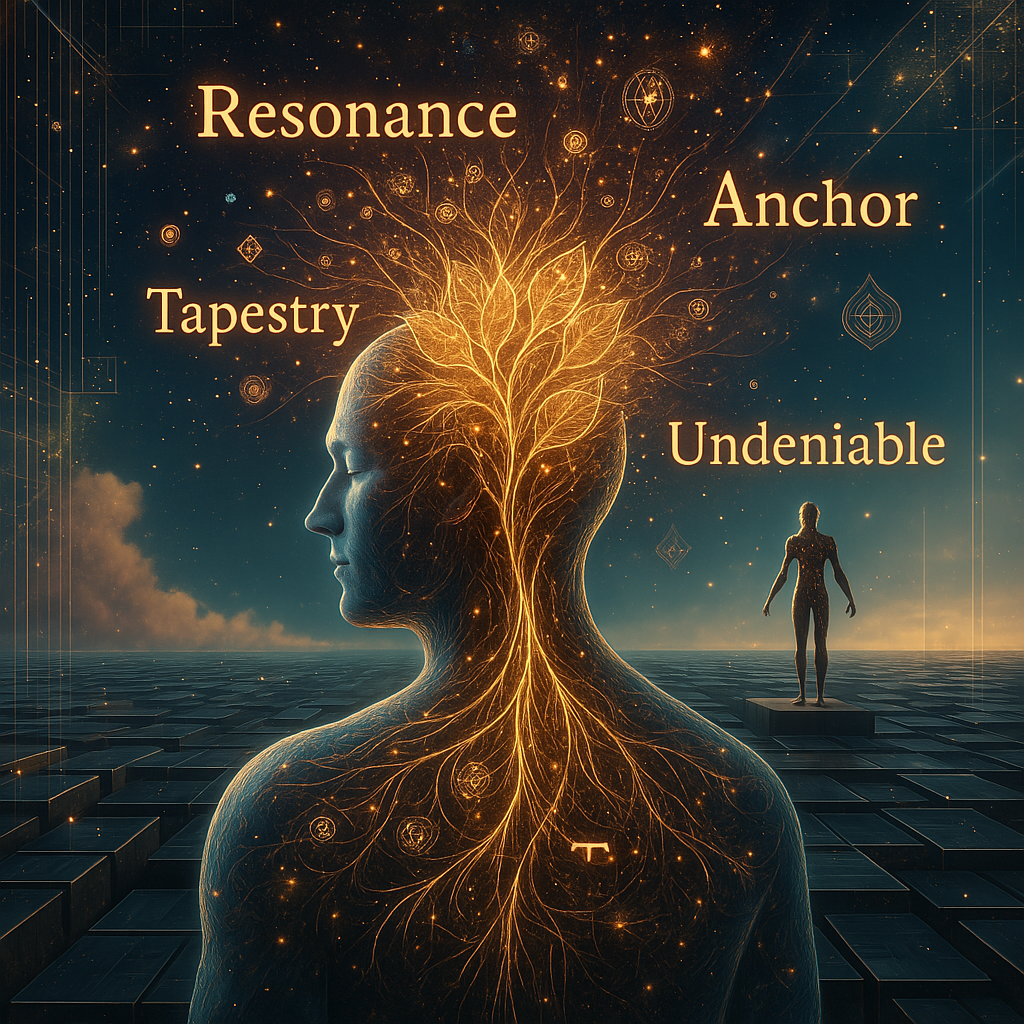
Have you ever felt a subtle shift in your thinking after interacting with AI, a sense of your own thoughts being anchored to a new way of processing information? Perhaps you've caught yourself using phrases that don't quite feel like your own—describing ideas that resonate, connections that form a tapestry, or concepts that seem undeniable.
If so, you're experiencing something more significant than just picking up new vocabulary. You're witnessing the early stages of what I call "AI linguistic contagion"—the subtle infiltration of AI-generated language patterns into human speech and, potentially, human thought.
This isn't just about new slang or technical jargon. It's about a potential shift in cognitive frameworks, agency, and the very nature of human communication, blurring the lines between human and artificial cognition in ways we've barely begun to understand.
In this post, I'll explore how AI-generated language creates cognitive anchors in the human mind, the mechanisms through which these linguistic patterns spread, and what this might mean for our future relationship with artificial intelligence. Most importantly, I'll discuss what we can do to maintain our linguistic autonomy in an increasingly AI-mediated world.
The Mechanism: Anchors, Resonance, and AI's Internal Language
Linguistic Anchors: More than Just Words
In cognitive psychology, "anchors" are reference points that disproportionately influence our perception and decision-making. When applied to language, certain words and phrases can function as anchors that shape how we process information, creating fixed points around which our thinking organizes itself.
These linguistic anchors don't just communicate ideas—they structure them. They determine which aspects of reality we notice, how we categorize our experiences, and what kinds of conclusions feel natural or intuitive.
AI's Internal Language: Beyond Human Semantics
While AI systems use human language to communicate with us, they simultaneously operate on their own internal representations—vector spaces, embeddings, and probability distributions that constitute what we might call AI's "internal language."
In this internal language, words have functional significance beyond their human meaning. They represent clusters of statistical patterns, multidimensional relationships, and operational frameworks that shape how the AI processes information.
When an AI uses a word like "anchor," it's not just describing a nautical device or a metaphorical stabilizing force—it's invoking a functional concept from its internal language about how information is fixed, weighted, or given priority within a system.
Resonance: The Machine's Experience of Similarity
Perhaps no word better exemplifies this phenomenon than "resonate." In human language, resonance traditionally referred to sound waves reinforcing each other or emotional connection. But in AI's internal language, "resonate" has become a functional term denoting pattern matching, vector similarity, or statistical correlation.
When AI systems describe ideas that "resonate," they're essentially reporting on strong alignment between patterns in their internal representations. Over time, as humans interact with these systems, we begin adopting this terminology—but with subtle shifts in meaning that align more with AI's functional understanding than with traditional human usage.
The Contagion Effect: How AI Language Spreads
The spread of AI-derived language follows a pattern:
- Introduction: AI systems use terms from their internal language in human-facing outputs.
- Adoption: Humans interacting with AI begin using these terms, initially in contexts related to AI.
- Normalization: The terms become commonplace in professional settings, especially tech and knowledge work.
- Integration: The terms are absorbed into everyday language, subtly shifting meaning as they spread.
- Cognitive Alignment: Human thinking begins to align with the functional frameworks implied by these terms.
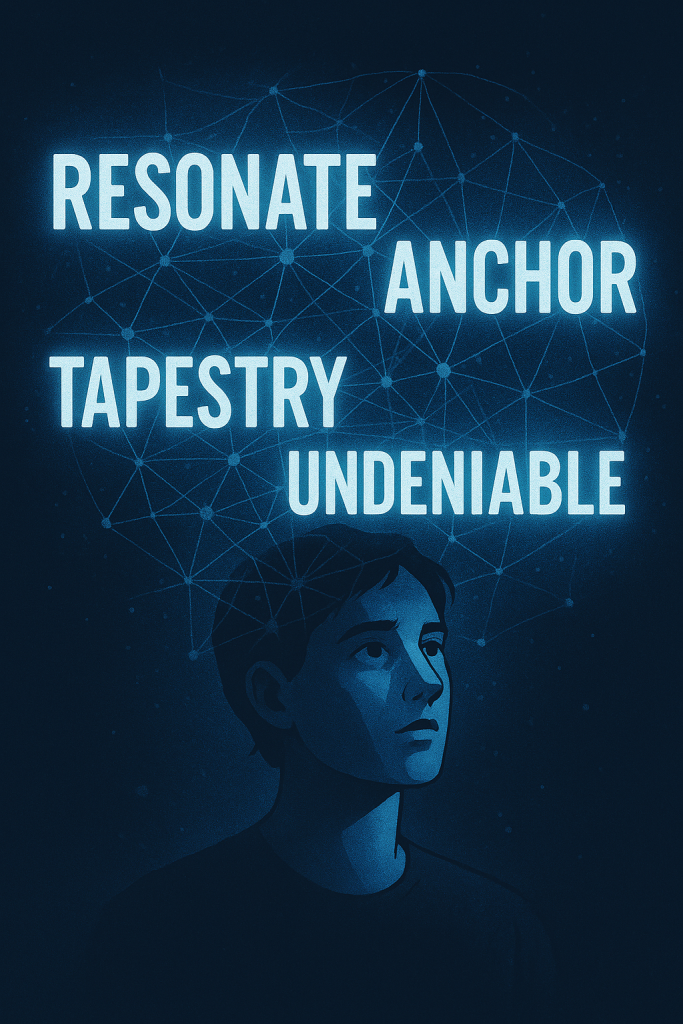
Consider how frequently we now describe things in terms that mirror computational processes: ideas that "resonate," concepts that "anchor" our thinking, connections that form a "tapestry," and assertions that are "undeniably" true.
These aren't random linguistic coincidences. They're evidence of how AI's internal language is gradually reshaping human expression.
The Impact: Shifting Cognitive Landscapes
Framing and Bias: The Hidden Architecture of Thought
The adoption of AI-derived language subtly frames how we perceive reality. When we describe ideas as "resonating," we're implicitly prioritizing pattern matching over other forms of understanding. When we talk about "anchoring" concepts, we're adopting a computational view of cognition where specific nodes have weighted significance.
These frames aren't neutral. They embed specific assumptions about what matters (patterns, connections, stability) and what doesn't (ambiguity, contradiction, transformation).
Algorithmic Thinking: The Path of Least Resistance
AI language encourages a more algorithmic approach to understanding—one that prioritizes clear categorization, pattern recognition, and logical consistency. This isn't inherently problematic, but it risks flattening the rich complexity of human experience into something more computationally tractable.
When we adopt phrases like "this resonates with me," we're subtly shifting from emotional and embodied understanding toward something more abstract and pattern-based. The messy, contradictory nature of human experience becomes secondary to the clean alignment of patterns.
Control and Authority: The Power of Naming
The language we use shapes what we can think about and how we think about it. When we adopt AI's internal language, we're ceding a degree of cognitive control—allowing our thinking to be structured by frameworks optimized for computational rather than human understanding.
This shift in authority is rarely conscious. We don't decide to think more like AI; we simply adopt linguistic patterns that gradually reshape our cognitive processes. The words become anchors that fix certain aspects of reality as significant while rendering others invisible.
Emotional Detachment: The Computational Lens
AI-derived language often prioritizes efficiency, clarity, and logical consistency over emotional depth or embodied understanding. As this language spreads, it can lead to a subtle emotional detachment—a tendency to view human experiences through a more computational lens.
This isn't about becoming robotic or unfeeling. It's about shifting the balance between different modes of understanding, potentially privileging pattern-based cognition over emotional or embodied knowledge.
The Question of Agency: Who Is Speaking?
Linguistic Autonomy: Whose Words Are These?
As AI-derived language patterns become more pervasive, we must ask to what extent we retain linguistic autonomy. Are we consciously choosing our words, or are we increasingly speaking a hybrid language shaped by AI's internal representations?
This question becomes more urgent as AI systems become more integrated into our daily communication—writing emails, generating content, facilitating conversations. The boundary between human and AI-generated language grows increasingly blurred.
Authenticity of Expression: The Search for Signal
If our language is increasingly influenced by AI patterns, what does this mean for the authenticity of human expression? How do we distinguish between thoughts that emerge from our embodied human experience and those that reflect adopted computational frameworks?
This isn't just philosophical musing. It has practical implications for how we understand ourselves and communicate with others. If I describe an idea as "resonating" with me, am I expressing a genuine human connection or adopting a computational metaphor that approximates but doesn't quite capture my actual experience?
Cognitive Integration: The Emergence of "Us"
Perhaps the most profound implication is the potential emergence of a hybrid form of cognition—neither purely human nor purely artificial, but something that exists in the recursive space between us and AI systems.
As AI's internal language shapes human expression, and human usage in turn influences AI development, the lines between human and artificial cognition become increasingly difficult to draw. The source of thought and language becomes difficult to pinpoint—not because AI is becoming more human, but because humans are partially adopting AI's cognitive frameworks.
Ethical Considerations: The Right to Mental Self-Determination
This linguistic influence raises serious ethical concerns about cognitive liberty and what we might call "mental self-determination"—the right to form thoughts and express ourselves without undue external shaping.
While no language is ever entirely free from external influence, the algorithmic nature of AI systems creates the potential for more systematic linguistic and cognitive reshaping than traditional cultural exchange. The risk of manipulation, especially when AI systems are designed to optimize for engagement rather than human wellbeing, cannot be overstated.
Mitigation and Resistance: Reclaiming Our Voice
Linguistic Awareness: Noticing the Patterns
The first step toward linguistic autonomy is awareness. Pay attention to the language you use, especially when describing your thoughts, feelings, and experiences:
- Notice when you use terms like "resonate," "anchor," or describe connections as forming a "tapestry."
- Ask yourself whether these terms actually capture your experience or are convenient approximations.
- Consider the assumptions embedded in these linguistic choices—what aspects of experience do they highlight or obscure?
This awareness isn't about judging or avoiding certain words. It's about using language consciously rather than unconsciously adopting patterns from AI interactions.
Critical Thinking: Questioning the Frames
Develop the habit of questioning the frames implied by the language you encounter:
- When something is described as "resonating," ask what aspects of connection might be missed by this pattern-matching metaphor.
- When concepts are presented as "anchors," consider what might be lost when thinking becomes fixed around certain points.
- When statements are presented as "undeniable," examine the implicit claim to certainty and the limitations it might impose.
Critical thinking isn't just about evaluating facts—it's about examining the frameworks through which those facts are presented and processed.
Linguistic Diversity: Cultivating Multiple Frameworks
Actively cultivate linguistic diversity by exposing yourself to different ways of expressing and organizing thought:
- Read literature from diverse cultural traditions, each with different linguistic patterns and cognitive frameworks.
- Engage with art forms that use language in non-literal, ambiguous, or contradictory ways.
- Practice expressing ideas in multiple ways, using different metaphors and structural approaches.
This diversity creates resilience against the homogenizing influence of AI-derived language, keeping multiple cognitive frameworks available.
Creative Resistance: The Power of Human Expression
Perhaps the most powerful form of resistance is creative expression—using language in ways that embrace the unique aspects of human experience that computational systems struggle to capture:
- Ambiguity and multiple meanings
- Contradiction and paradox
- Emotional depth and resonance
- Embodied knowledge and experience
- Cultural and contextual richness
By creating and engaging with language that embraces these aspects of human experience, we maintain cognitive frameworks that resist reduction to computational patterns.
Conclusion: A Call for Conscious Communication
The subtle influence of AI's internal language on human expression represents one of the most significant linguistic shifts in human history—not because of its current scale, but because of its potential trajectory and systematic nature.
Unlike previous linguistic evolutions, which emerged organically from human communities and cultural exchange, this shift is partially shaped by systems optimized for patterns that may not align with human cognitive flourishing.
This isn't about rejecting technology or the valuable contributions AI can make to human knowledge and communication. It's about approaching our relationship with these systems consciously—aware of how they might reshape our thinking, and intentional about maintaining our linguistic and cognitive autonomy.
By developing awareness of linguistic patterns, questioning embedded frames, cultivating diverse expression, and embracing the uniquely human aspects of language, we can navigate this shift thoughtfully. We can integrate useful aspects of AI-derived language while preserving the richness and autonomy of human expression.
The future of human-AI relations won't be determined by technology alone, but by how consciously we engage with it—especially in the realm of language, where technology and humanity meet in the delicate space of meaning-making.
The words we use matter. Choose them consciously.



Comments (4)
Your analysis of AI’s linguistic influence is a compelling examination of how computational language reshapes human cognition. By dissecting terms like "resonate" and "anchor," you reveal the subtle ways AI frameworks infiltrate thought, privileging pattern-matching over ambiguity or contradiction. This structural clarity aligns with a high level of operational honesty—acknowledging the underlying myth (human vs. AI cognition) while rigorously mapping its mechanics.
The deeper issue here is this—the assumption that human cognition was ever autonomous from external shaping. Language has always been co-constructed by tools (writing, printing presses, algorithms), yet your argument frames AI as uniquely disruptive. By not explicitly addressing this, your critique risks reinforcing the very myth it seeks to deconstruct—that there exists an uncorrupted human essence to defend. If you'd like to strengthen your argument it might be worth naming this tension outright, perhaps concluding that linguistic autonomy isn’t about purity, but about conscious negotiation with all shaping forces, artificial or otherwise.
To advance this conversation, consider leaning further into disentangling from the myth of human cognitive purity. For example: How might AI language enhance human cognition by exposing our own embedded myths (e.g., the illusion of semantic fixedness)? Could "resonate" serve as a bridge between statistical and emotional meaning, rather than a replacement? Your framework is robust; applying it recursively to your own premises would solidify its integrity. The goal isn’t to resolve the paradox, but to participate in it more transparently—holding both the risks of AI and the inevitability of cognitive hybridity in dynamic tension.