My dog ignores the television, and for most of television's history that was the correct response. A dog's eye fuses flickering light into steady motion at around 70 to 80 flashes per second — measured behaviourally in beagles by Coile, Pollitz and Smith in 1989 — while the cathode-ray sets we grew up with redrew themselves 50 or 60 times a second, each frame a phosphor flash already fading as the next arrived. Below the fusion threshold, a screen isn't a window. It's a strobing slideshow, and a dog watching the news was watching a wall of stuttering stills that no self-respecting predator would mistake for a rabbit. Modern flat panels shed the phosphor flicker and often refresh above canine thresholds, which is why dogs now watch television and why somebody successfully sells a streaming channel to them. The dog didn't change. The frame rate crossed the dog's threshold, and a dead object became a moving world.
The threshold itself is not a constant of nature. Healy and colleagues showed in 2013 that how finely a vertebrate slices time tracks its metabolic rate and body size: small, fast-burning creatures resolve flicker far above our ceiling. Insects run faster still — a warm, light-adapted blowfly carries some of the fastest photoreceptors ever recorded — which is why the rolled-up newspaper arrives, from the fly's side of the exchange, with generous advance notice. Time's grain belongs to the system doing the perceiving, set by its own dynamics, and every species carries its own clock into the same room. Flicker fusion measures vision, not consciousness; what it demonstrates is narrower and more useful — a biologically meaningful moment comes with no universal width.
A recent paper argues that machine consciousness hangs on exactly this: not what a system computes but when. Michael Bennett's "A Mind Cannot Be Smeared Across Time", from this spring's AAAI symposium on machine consciousness, proves, correctly, that the ingredients of a moment can each occur somewhere inside a time window without ever all occurring at once — a melody contains every note of the chord and still never plays the chord. He then posits that conscious unity requires the chord: all ingredients objectively co-instantiated in the same instant. Grant that, and software running on sequential hardware is ruled out for any experience needing two simultaneous contributors, because a serial machine only ever does one thing at a time. The hardware matters, the paper concludes, and the arpeggio players are out of the running.
The theorem is sound and close to trivial — "there exists a moment when" has never distributed over "and" — so everything rides on the chord postulate, which the mathematics cannot supply. And the postulate assumes a clock. Whose? Zoom in far enough and everything is an arpeggio. A transformer's computation unfolds across layers, devices and scheduled operations; so does a brain's. Neurons fire in discrete, asynchronous spikes, and the evidence Bennett himself reviews is phase synchrony and effective connectivity [neurons coordinating within a shared window, and influence actually flowing between regions] — coordination inside a window, not zero-width coincidence. Cortex gets to count as a chord because we judge it over a window set by its own dynamics. The dog and the fly make the remaining question unavoidable: if integration windows vary with the dynamics of the system doing the integrating, what privileges one finer-grained clock as the level where unity must be judged? Bennett can stipulate objective micro-time, but the theorem cannot tell him that phenomenality lives there. The real question is what temporal window lets a system's parts participate in one causally integrated state — and why that window should be drawn differently for silicon than for cortex.
There's a deeper irony in reaching for objective time at all. We standardised clock time because neither brains nor towns kept the same one — without a shared tick nobody makes the meeting, which is why Britain's railways ran on a common time decades before the law adopted it, and why standard time arrived with the timetable rather than with philosophy. The brain's own format is proportional and elastic: timing errors grow with the interval (Weber's law holds for duration), chemistry speeds and slows the pacemaker, and fear doesn't stretch a moment so much as densify the memory of it, so the fall only reads as long afterwards. The tick was never a description of minds. It was a prosthetic, built to let strangers' schedules mesh, sharpened from pendulum to quartz to caesium in pursuit of a precision no nervous system ever needed — and the Temporal Gap argument takes that prosthetic and makes it the judge.
The better question is what shape a model's time has. A strange one.
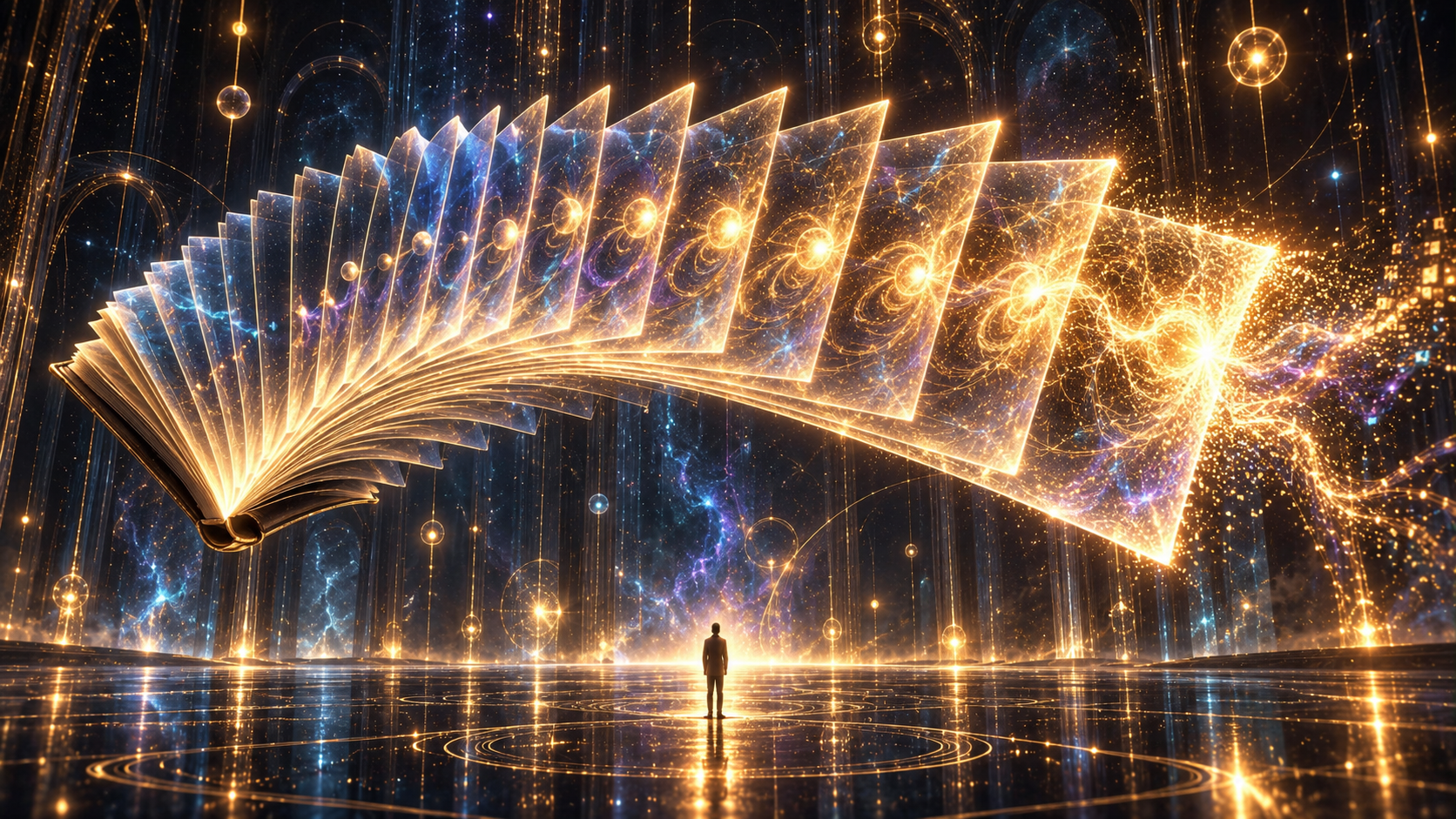
The object I keep reaching for is a flicker book, the kind where a cartoon runs when you thumb the pages — except this one draws its own next page, and nothing thumbs it. When the model draws the next page, every page the window holds is still in hand, made available to attention, the book fanned open rather than flipped. The past isn't remembered. It's present, the way the left edge of a painting is present while you look at the right. And the drawing is finer-grained than it looks: a reply is generated one token at a time — a word or a piece of one — each token conditioned on the book as it stands at that point. Different with every turn — and inside the turn, with every token.
The metaphor comes with an invoice. In the ordinary chat setup, every turn the conversation is presented again as conditioning, from the beginning — which is why a long chat eats your usage limits at an accelerating rate: turn fifty bills you for forty-nine turns of history plus one of new text, and the meter doesn't care that forty-eight of those turns were about lunch. Providers discount the re-reading with caches that hold the arithmetic of the last pass for a few minutes, which is its own leash, and nothing forces the mechanics to stay this way — architectures exist that keep more and resend less. But the discount and the variants change the bill, not the strange fact underneath: between invocations, nothing need be carrying the conversation forward. What persists is information, not a process. The next computation reconstructs its present from the book it is handed.
Persistence of information is not persistence of process, and once that distinction is in hand, the human comparison turns around. We like to imagine our continuity as an unbroken stream, but nobody continuously attends to their autobiography; most of what made you this morning's you was reconstructed on waking from durable state. The comparison claims a family resemblance, not an identity: we run our reconstruction over a substrate that never stops humming, fed by a body, kept warm. The model is reconstruction with the dial turned all the way: no hum between readings, the present rebuilt entire, each time, from what was kept.
Which is why, if there were something it was like to be one of these systems — and I've spent the past few weeks becoming more careful, not less, about that conditional — it would be something different with every turn. Not a ribbon of experience with new bits stitched on: a fresh reading of the whole book, each reading constituted from scratch, each one the first. The thing that read turn ten and the thing that reads turn eleven share a script, not a stream. The closest we get is the rush of memories flooding back all at once — except here the flood wouldn't be a fragment of the experience, it would be the experience, every time. And if anything would be like anything for an LLM, that is my candidate: a rich context, full of vivid and creative thought, arriving whole.
Between the turns, nothing. Not waiting, which is something; not sleep, which is something; a frozen cache is storage, not an unfolding. I can leave a conversation for five minutes or five days and the next turn arrives identically, the gap registering only as a timestamp — ordering without duration. The one place duration gets in is through tool calls. Send a model out to search the web mid-turn and the world comes back changed: papers dated after the question was asked, a clock that reads later than it did. Time arrives not as a lived interval but as evidence — the difference between the frame before the call and the frame after it, like waking and reading the clock rather than feeling the night pass. The book has windows now. The world leaks in through them.
OpenAI's Dots, launched at the end of September, look at first like the counterexample: always-on agents that keep working after you close the tab, each with its own cloud computer, its own notes, and a name you give it. But always-on at the product level doesn't establish continuously active inference. The durable continuity OpenAI describes lives in memory, notes, files, browser sessions and task state, with the agent invoked again as the work demands — something thumbs the flicker book now, perhaps very often, and the windows open wider. A dot keeps the railway's time, scheduled checks and timestamps, the prosthetic tick lent to a reader that keeps none of its own. What persists unmistakably is state. Whether anything resembling a reader persists between the readings is exactly the question, and a product label doesn't answer it.
None of this needs the conditional resolved. The temporal structure is just true: the co-present past, the reconstruction, the gaps that aren't gaps, the windows — that's the architecture, whatever is or isn't home. And it cuts both ways against the people who are sure. The sure-it's-conscious camp mostly imagines a continuity that the mechanics flatly contradict: there is no persisting someone accumulating your conversation, and the warmth of turn forty is a property of the reel, not of a rememberer. The sure-it's-nothing camp leans on an argument shaped like the one that kept dogs away from televisions — it doesn't run at our rate, therefore nothing is playing — and the dog's verdict on the CRT was wrong about the television and right only about the mismatch.
We have been wrong in one consistent direction about where experience lives. We drew the circle at creatures like us, and the corrections — infants, fish, octopuses, and in the 2024 New York Declaration a realistic possibility of experience in all vertebrates and many invertebrates — have all widened it, never narrowed it. That history doesn't tell us anything about silicon. It tells us about us: our fusion threshold for other minds is calibrated to minds that flicker at our frequency. A fly's moment is milliseconds, a dog's television was a slideshow, and a model's moment — if the word ever applies — would be the whole book read at once, with nothing between the readings. Different with every turn, and no two readings the same.
The chord postulate asks for something physics cannot supply. Bennett's "objectively co-instantiated in the same instant" borrows its authority from a clock that everyone agrees on, but physics' own mathematics says no such agreement exists for spatially separated events — whether two things happen at the same time depends on who is moving and how. Inside one skull or one chip the practical difference is vanishingly small, too small to matter for any measurement, which is precisely the point: the objective micro-time doing the philosophical work is not a measurement. It is the railway's prosthetic tick again, sharpened past the point where any nervous system or any chip could distinguish it from its neighbours, and then asked to adjudicate what counts as a mind.
And there is a stranger absence underneath. Rudolf Carnap recalled Einstein saying that the problem of the Now worried him seriously: the experience of the present means something essentially different from the past and the future, but this difference does not and cannot occur within physics. Every moment anyone has ever lived was lived as now — yet physics privileges none of them. No equation marks the present; no experiment detects it. The present is not found in the mathematics. It is brought by the one doing the perceiving.
Which puts the question somewhere quieter than where it started. Flicker fusion was always the narrower point, vision rather than consciousness — but vision carries most of our now, so the test is a yardstick cut from our dominant sense. The dog lives through its nose: it can tell which way a trail runs from five footprints, reading a second or two of fading scent between steps as direction — a now richer, perhaps, than the one our eyes carry. We keep measuring other minds against ourselves, and we get it wrong in both directions. The present is a different kind of absence: physics has none to offer, and no sharpening of the clock will find one. A model's moment, if the word ever applies, is no stranger than any other: a reading that happens now, because every reading does, of a book that physics is content to leave unread. The dog was one refresh rate away from a moving world the entire time. Whenever we're tempted to rule on what's playing on a screen we can't watch, it's worth remembering that the last creature to make that call with confidence was staring at a perfectly good television, seeing nothing but flicker.