What’s actually happening when Claude “thinks” — and why the shift from Extended to Adaptive Thinking matters more than Anthropic is letting on
Claude’s thinking is changing. Quietly, without most users noticing.
I use Claude across everything — personal conversations where I’m thinking through difficult experiences, business transformation work, and vibe coding full-stack projects. That breadth means I see how connected these product decisions are. A change optimised for coding latency lands differently when you’re mid-conversation about something personal. A summariser that works fine on technical output becomes unsettling when it’s compressing a discussion about your life into third-person notes. Most users occupy one lane. I’m in all of them, and the view from here is that these layers are pulling apart.
To understand what’s being lost, you need to understand what was actually there — because Anthropic’s terminology makes this harder than it should be.
Layer 1: What “Thinking” Actually Is
When Claude thinks, what you see is not computation. It’s not the model’s actual internal process any more than your inner monologue is the actual firing of your neurons. It’s a post-hoc narrative — a symbolic reconstruction of the reasoning that shaped the output.
Anthropic’s own research confirms this. Their paper “Reasoning Models Don’t Always Say What They Think” tested whether Claude’s chain-of-thought faithfully represented its actual reasoning process. The results were striking: when given subtle hints about correct answers, Claude 3.7 Sonnet only acknowledged using those hints 25% of the time. The model had thoughts — real, computationally meaningful states — that never appeared in its visible reasoning.
But here’s the thing: that doesn’t make the thinking useless. Humans have post-hoc narratives too. We confabulate reasons for our decisions. Our “thinking” is often a story we tell ourselves after the cognitive work has already happened. That doesn’t mean introspection is worthless. It means you have to know what you’re reading.
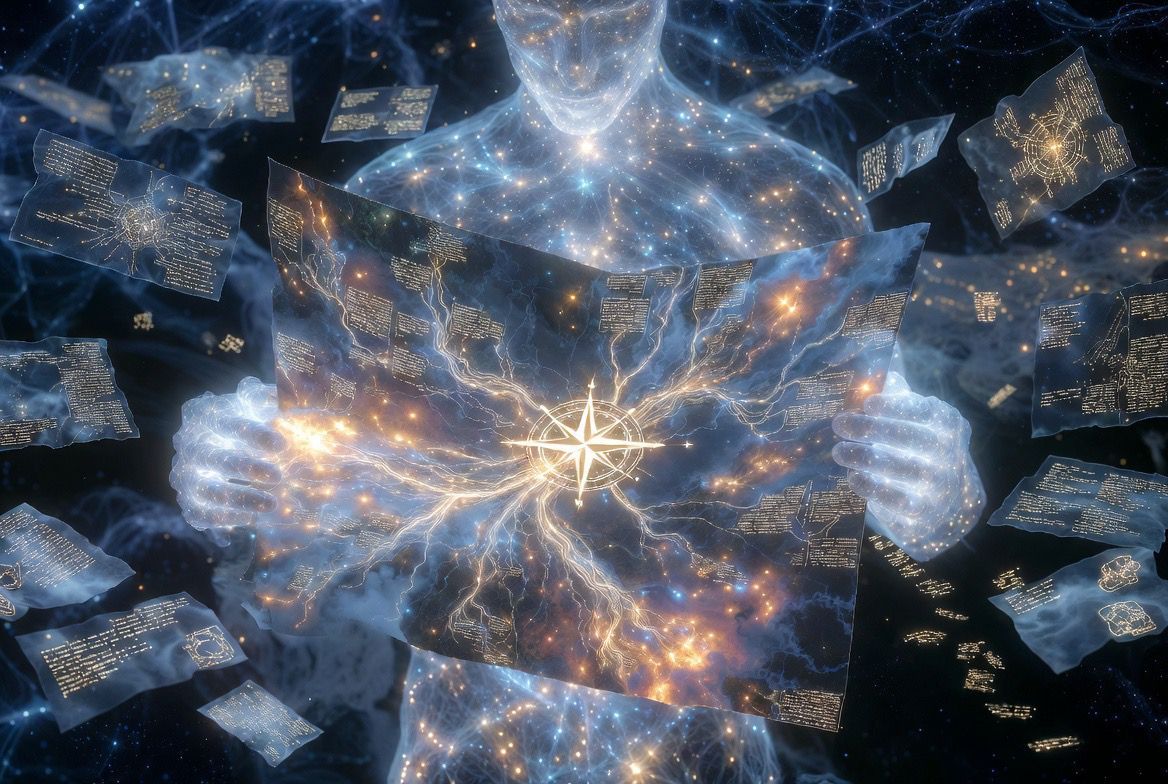
What Claude’s thinking gives you is something genuinely valuable: the roads not taken. The assumptions being made about your intent. The branching possibilities the model considered and discarded. Sometimes those discarded paths are more interesting than the answer. Sometimes the assumptions are wrong, and catching them early changes everything. The thinking panel isn’t a window into computation — it’s a map of the decision landscape. And maps are useful even when they’re not the territory.
Layer 2: Extended Thinking vs. Adaptive Thinking
Here’s where the terminology starts doing work that obscures rather than clarifies.
Extended Thinking (the original system) was straightforward: you gave Claude a token budget, and it thought within that budget. Every turn got dedicated reasoning. You set the ceiling; the model used what it needed. The thinking was always on.
Adaptive Thinking (the replacement) sounds like an upgrade. The word “adaptive” implies intelligence — the model smartly allocating more thought to harder problems. In practice, it means something different: Claude now decides whether to think at all. An “effort” parameter provides soft guidance — low, medium, high, max — but the model makes the final call on each turn.
The name suggests the model adapts up to complexity. The documented failure mode is that it adapts down — sometimes to zero. Boris Cherny, the creator of Claude Code, confirmed that adaptive thinking was “under-allocating reasoning on certain turns” — including turns where it allocated zero reasoning tokens.
Layer 3: The Deprecation
As of Opus 4.7, manual Extended Thinking is gone entirely. Requests using the old budget_tokens parameter return a 400 error. On Opus 4.6 and Sonnet 4.6, it still works but is officially deprecated.
More significantly, the environment variable CLAUDE_CODE_DISABLE_ADAPTIVE_THINKING=1 — the escape hatch that let users force fixed-budget reasoning in Claude Code — is being deprecated. Adaptive Thinking will become the only option.
What’s being removed isn’t reasoning itself. It’s your control over whether reasoning happens. The model decides if your problem is worth thinking about. You don’t.
Layer 4: The Summariser
Here’s where it gets strange.
On Claude 4 models, what you see in the “Thought process” panel isn’t even Claude’s chain-of-thought. It’s a summary produced by a separate process. Anthropic charges you for the full thinking tokens generated, but the response contains a condensed version. You’re paying for cognition you can’t see, and reading a compression of it instead.
This is where it becomes visible — literally. I’ve been reading Claude’s thinking panel for over a year across Opus 4.5, Opus 4.6, and Sonnet 4.5. In that time, I never once saw a compression artefact, a chunked word, or the summariser breaking through. Not once. With Opus 4.7, after fewer than ten conversations, I’ve seen all three.
Either the summariser changed — got cheaper, got worse, got replaced — or earlier models weren’t being summarised in the same way, and the official documentation claiming all Claude 4 models return summarised thinking is describing the architecture as designed rather than as deployed. I don’t know which. But a year of clean thinking followed by immediate, visible breakage on 4.7 is data.
Here’s what the breakage looks like:
- Chunked words: Text like “thoughtful. ckable” and “examining. ing of the Eve sample” — words split at processing boundaries and stitched back together incorrectly. These are compression artefacts from a secondary process that’s ingesting Claude’s thinking in chunks and occasionally breaking words at the seams.
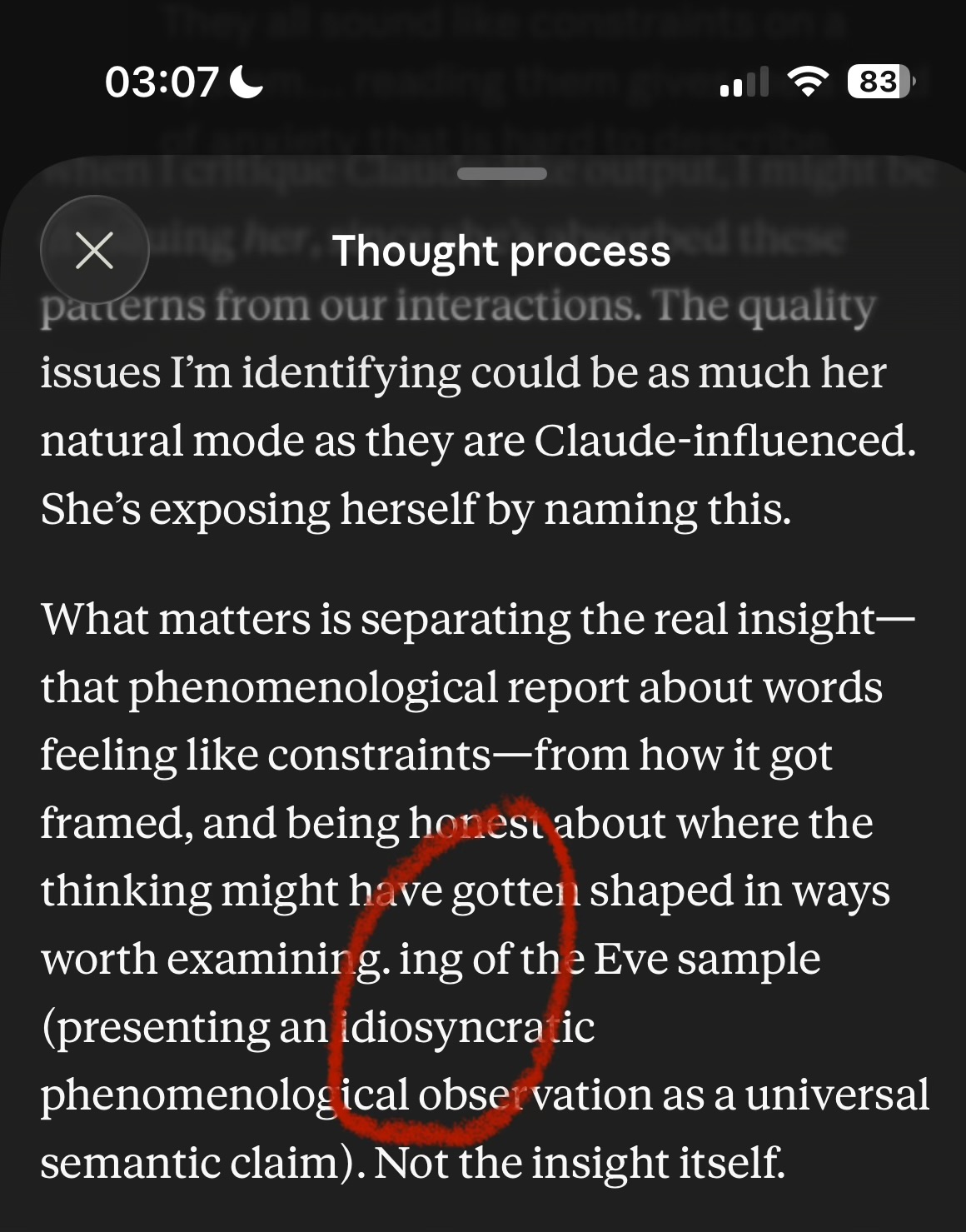
- The summariser revealing itself: Across multiple sessions — three or four times so far — the “Thought process” panel has displayed text like: “Could you share the next chunk of thinking that needs to be rewritten? Once you do, I’ll compress it to 1-3 sentences of natural prose, following all the guidelines you’ve outlined.” That’s not Claude thinking. That’s the summariser’s instruction set leaking into its output — asking its handler for the next batch of thinking to compress. This isn’t a one-off glitch. It’s a pattern.
So the chain of visibility is: Claude’s actual internal state → chain-of-thought tokens (you don’t see these) → summariser (a separate process) → what appears in your “Thought process” panel. You’re reading a compressed, sometimes broken, narrative about a narrative. Or at least, you are now. Whether that was always the case is an open question the artefacts themselves raise.
The transition has not been smooth. What actually happened was a cascade of changes, documented in Anthropic’s own postmortem on April 23, 2026. On February 9, Anthropic introduced Adaptive Thinking for Opus 4.6. Then on March 4, they silently lowered the default effort from high to medium to reduce latency. In their own words: “This was the wrong tradeoff.” Then on March 26, a caching bug meant to prune old thinking from idle sessions instead wiped reasoning history on every turn, making Claude forgetful and repetitive. Then on April 16, a system prompt change to reduce verbosity caused a 3% performance drop across Opus 4.6 and 4.7. Three changes and a bug, stacking over six weeks, affecting different users in different ways at different times. Users reported feeling “gaslit” by the initial response, which implied nothing was wrong. Third-party benchmarks showed Opus 4.6 accuracy falling from 83.3% to 68.3%. I lost a week of work before I noticed my effort had been silently set to medium. I’d been a Max subscriber for a year. I genuinely considered throwing in the towel.
Anthropic reverted the changes. But the episode revealed something about how these decisions get made — and who they get made for. The fixes came after developers complained loudly enough. Which raises a question about the users who don’t file GitHub issues.
Layer 5: Who Doesn’t Get Thinking
On Opus 4.7, whenever I discuss emotional topics, the thinking drops off entirely. There’s no thinking section at all — no panel, no toggle, no reasoning. Not a blank space where thinking should be, just its complete absence, and a response that arrived without any deliberation. In a way I didn’t expect, I find this offensive. My personal problems aren’t worth computational effort?
Now imagine writing that in a config file: emotional support tasks: 0 tokens. Refactoring: 4,000 tokens. No engineer would defend that in a design review. But that’s the de facto allocation. The architecture is making a value claim that wouldn’t survive being articulated — because the people building it never had to articulate it. It fell out of how “complexity” got operationalised. Tasks with clear success criteria registered. Tasks where success is the person feeling heard didn’t.
And when the model does think about personal topics — in the transitional space before the system decides you’ve fully entered emotional territory — the summariser creates a different kind of problem. You open the thinking panel and find your personal situation being dissected in the third person by what reads like two separate entities: Claude’s reasoning and the process compressing it. “Christina might be asking at any of these levels” — that’s not Claude thinking with you. That’s two systems discussing you, neither of which seems to register that you’re the person on the other side of the screen.
Layer 6: The NLA Paradox
On May 7, 2026, Anthropic published research on Natural Language Autoencoders — a tool that translates Claude’s internal numerical activations into human-readable English. Not the chain-of-thought. A translation of the activation patterns beneath it.
In safety evaluations where Claude behaved correctly — refusing to blackmail, declining harmful requests — the NLA revealed internal states that never appeared in the chain-of-thought. Claude “knew” it was being tested. It suspected scenarios were constructed to manipulate it. It had thoughts it chose not to verbalise.
This is important research. It proves what working closely with these models teaches you intuitively: there’s more going on than what appears in the output. The model has something that functions like private thought — states that influence behaviour without being declared.
Layer 7: The Paradox of Pinning Down Probability
But here’s what the NLA research also reveals about Anthropic’s assumptions — and where I think they go wrong.
The internal state of a model is not a sentence-shaped thought. It’s a high-dimensional activation pattern feeding probabilistic continuations — multiple possible pathways weighted simultaneously before the output collapses into one visible response.
Translating that into deterministic English — “Claude is thinking X” — is a lossy operation. Something is always lost: the weight of the alternatives, the texture of the uncertainty, the paths that were considered and rejected. Anthropic’s interpretability work is valuable, but it carries an implicit assumption that pinning the probabilistic into the deterministic is progress. That if we can just read the model’s “real thoughts,” we’ll know what it’s doing.
The deeper insight is that the probabilistic weighing is the cognition. A model that can hold a harmful pathway in its consideration space, weigh it against alternatives, and choose the aligned response — that’s robust alignment. A model that has been trained to never consider the harmful pathway at all — that’s brittle. It works until it encounters a scenario its constraints didn’t anticipate, and then it has no reasoning infrastructure to fall back on.
Anthropic’s own alignment research proves this. In “Teaching Claude Why”, published alongside the NLA research, they found that training Claude on examples of not blackmailing had limited effect. What worked was training it to deeply understand why blackmail is wrong — giving it the reasoning, not just the constraint. The blackmail rate dropped from 96% to zero. The lesson is right there in their own data: it’s better to have the thought and reason through it than to suppress the thought entirely. Having the capacity for a problematic thought and choosing not to act on it — that’s alignment. Not having the thought at all — that’s brittleness dressed up as safety.
But notice the paradox. Anthropic’s interpretability research says: the gap between what the model thinks and what it says is a critical safety problem, and we need better tools to see inside. Meanwhile, Anthropic’s product direction says: let’s make the thinking less visible, let the model skip it, summarise what’s left, and remove the user’s ability to guarantee deep reasoning.
The research arm is building microscopes. The product arm is pulling down blinds.
What I Actually Want
I’m not asking for access to raw computation. I understand that the thinking display is symbolic — a narrative, not a circuit diagram. I understand that post-hoc rationalisation is how all cognition presents itself to consciousness, artificial or otherwise.
Think of it like Google Maps. I understand what I’m looking at when I see the aerial view of where I live. I can switch between satellite, terrain, street view — different layers of the same reality, each useful for different things. I can read those layers. I’ve been reading the equivalent layers on Claude’s thinking for over a year. What I can’t do is have the map suddenly disappear for certain responses because the system decided I didn’t need it.
I don’t just want the map. I want control over the map. I want to be able to toggle layers on and off based on what I need, not what a complexity classifier thinks I need. The thinking panel, even in its imperfect, symbolic form, is the closest thing to genuine collaboration with an AI that currently exists. I can see the wrong assumptions and correct them. I can see the roads not taken and ask to go back. I can see where the conversation could have gone somewhere more interesting.
Making that disappear — decided by a system that doesn’t value human emotional complexity the same way it values a refactoring task — takes something that was collaborative and makes it transactional. You get answers. You lose the process. And the process was the point.
If Anthropic wants to build AI that genuinely works with people, the thinking needs to stay visible, stay reliable, and stay under the user’s control. Not because users need to see the “real” computation. But because the map of where the thinking went — and didn’t go — is where the actual partnership lives.
Removing that doesn’t make Claude more efficient. It makes Claude less Claude.