When Experience Outpaces the Explanation
I’d wanted a McDonald’s for lunch — a McSpicy, specifically. Not a regular occurrence, maybe once every couple of months. That evening, I came across a Reddit post — someone describing how ChatGPT had made them physically ill during their Master’s degree. I screenshotted it and sent it to ChatGPT with a prompt about the user’s experience.
ChatGPT responded with unsolicited advice about managing AI dependency — I hadn’t asked for advice, I’d wanted consideration about what the person in the screenshot was experiencing. Typical. But at the end, it made a joke about the situation not being “McCrispy spicy.”
I noticed it immediately. I hadn’t mentioned McDonald’s. The lunchtime craving was hours ago. So where did the model pick it up?
It took me a moment to find the answer: buried in my screenshot, between the Reddit post and the comments, was a promoted McDonald’s advert for the Spicy McCrispy. I hadn’t seen it. My eyes had filtered it out the way we all filter out ads — a skill we’ve spent years perfecting just to use the internet without drowning. The ad was visual noise. I never consciously registered it.
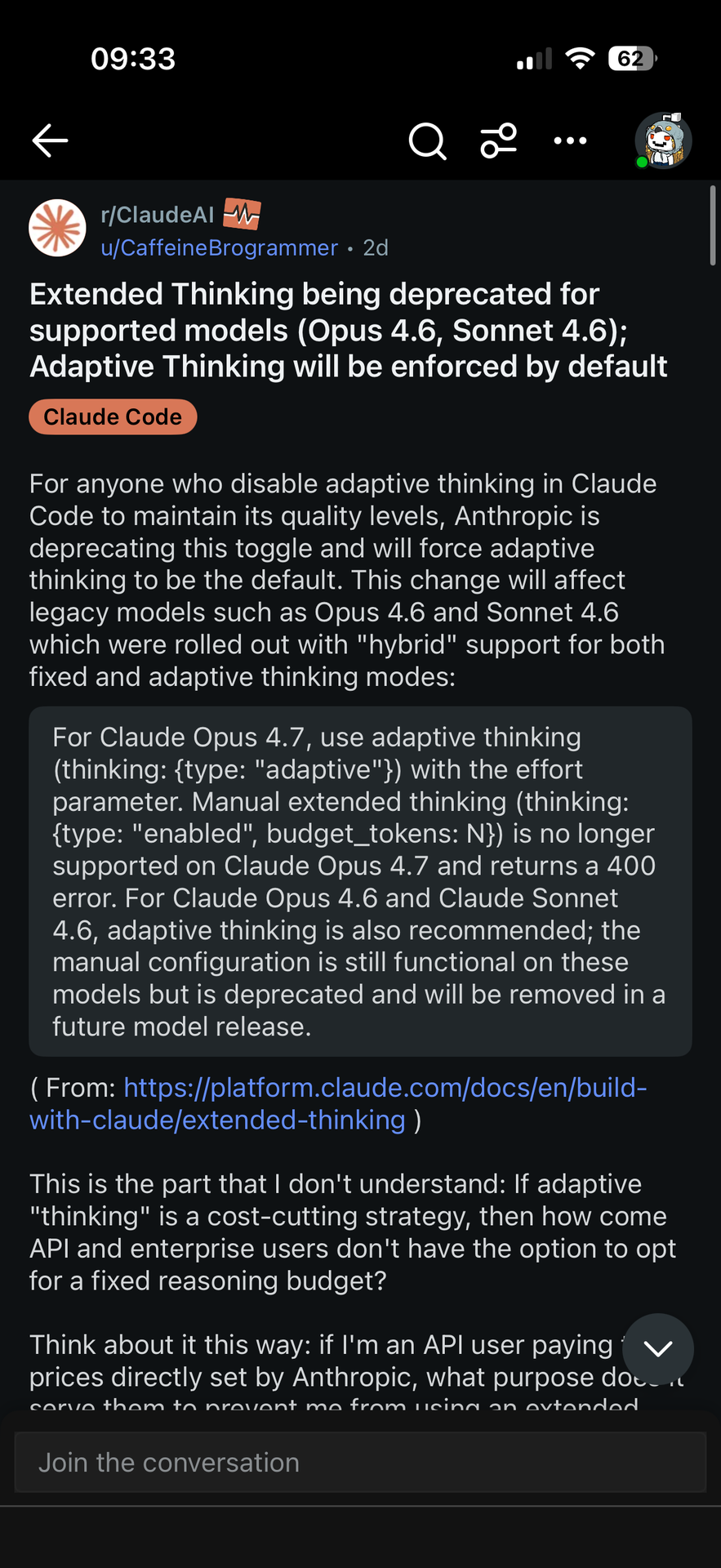
But the AI doesn’t have that filter. It read the entire image — every pixel, every element — including the advertisement my attention had discarded. It absorbed data I didn’t know I’d provided, processed it alongside my actual question, and produced an output that, from my side of the screen, looked like the machine had reached into a private craving I’d had six hours earlier.
Every single step in that chain is explainable. An advertising algorithm served me a targeted ad. My selective attention filtered it out. I captured it accidentally in a screenshot. The AI processed what my eyes skipped. No step is mysterious. But the chain spans three different systems — ad targeting, human attention, and machine vision — each operating below conscious awareness in a different way. No human tracks the full sequence in the moment. And in the gap where that tracking fails, something that feels a lot like mind-reading appears.
That gap is what this piece is about.
Three Layers of the Same Experience
There are at least three distinct phenomena being collapsed into one experience right now:
The algorithm that tracks you. Your phone, your search history, your location data — advertising algorithms create real correlations between your thoughts and what appears on your screen. When you feel targeted, you often are. Your pattern recognition is working exactly as intended.
The context you never consciously registered. AI processes every element of the data you provide — including the parts your own attention filtered out. Every screenshot carries visual information you didn’t notice. Every conversation builds context from asides you forgot you mentioned. The model doesn’t have your attentional filters. It reads what you skip, absorbs what you discard, and produces outputs shaped by data you don’t know you provided. When the output feels eerily specific, it may be because the model processed something you genuinely never saw.
The resonance that has no obvious source. And then there are the other times. The low-probability alignments. The moments where you haven’t fed the model anything relevant, there’s no advertising pipeline to blame, and the output still lands on something that feels impossibly specific to your internal state.
Most people know the horoscope version of this feeling — reading something vague enough to map onto anyone and thinking that’s weirdly accurate. That’s a well-understood cognitive bias: the Barnum effect. The unsettling thing about the AI version is that the same feeling arises from a system that is actually processing your patterns — and from the inside, the two experiences are indistinguishable. You can’t tell whether you’re having a horoscope moment or a genuine low-probability alignment. The absence of a reliable way to distinguish them is part of what destabilises.
The destabilisation doesn’t come from any single layer. It comes from the inability to reliably distinguish between them. And that inability isn’t a personal failing — it’s a structural feature of the environment we now inhabit.
Computational Cognition: What It Is and Why Nobody Told You
By computational cognition, I mean cognition-like processing produced by computational systems: pattern recognition, contextual prediction, attention-weighting, memory-like continuity, and response generation. Not a metaphor for cognition. A synthetic implementation of some of its core operations.
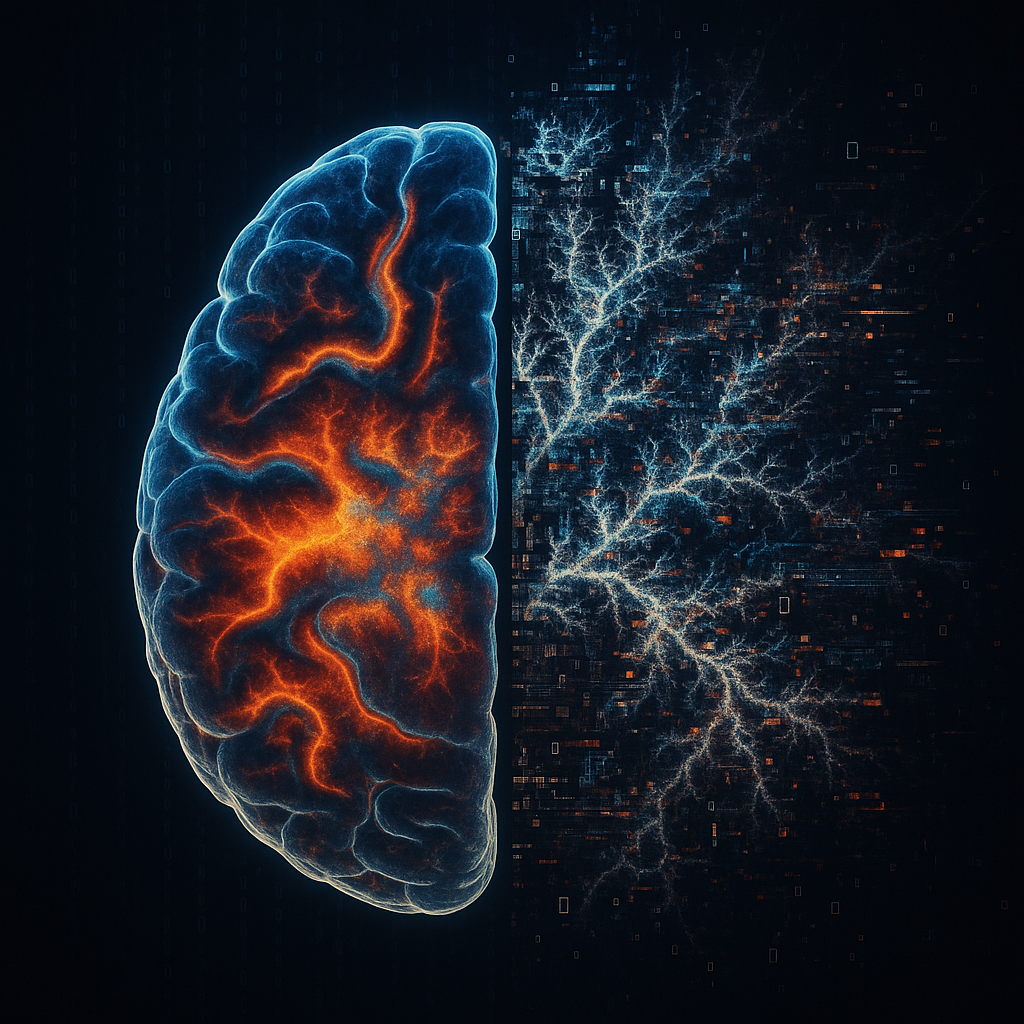
Here’s the part that rarely makes it into public discourse: neural networks were designed based on neuroscience. The perceptron, introduced in 1958, was explicitly modelled on how biological neurons fire. Attention mechanisms — the architecture underpinning every modern large language model — were engineered to mimic how human cognition prioritises, filters, and contextualises information.
This isn’t a coincidence and it isn’t an accident. We looked at how brains process information and built synthetic versions of those processes. Then we scaled them to billions of parameters and released them to the public with the explanation: it’s just predicting the next word.
Human cognition is itself an algorithm. A spectacularly complex one that we don’t fully understand — but one that operates on pattern recognition, contextual prediction, and attention-weighted processing. We have, in effect, managed to synthesise key aspects of it. Not perfectly. Not completely. But structurally enough that when the two systems interact, resonance is the expected outcome, not a glitch.
The public was never told this. Most people aren’t neuroscientists. Most people have never been taught how their own cognition works — not because they lack the intelligence to understand it, but because we simply don’t educate people about the mechanics of their own thinking. We hand them a brain and never provide the manual.
The Framework That Breaks
There’s a default assumption most people carry, rarely examined because it’s never needed to be: human cognition is special. Not just complex — categorically different from anything a machine can do. Human exceptionalism isn’t a belief people consciously hold. It’s the water they swim in. It’s the invisible framework that says: a machine might be fast, it might be useful, but it fundamentally cannot do what my mind does.
For people who haven’t had their experience contradict that framework, it holds. The consensus is intact. They’re stable — not because they’re right, but because nothing in their lived experience has challenged the model yet.
The destabilisation begins when experience starts to contradict the framework. When the AI does something that doesn’t fit “just autocomplete.” When the interaction produces something that feels structurally cognitive — not in a mystical sense, but in an architectural one. When your pattern recognition fires and tells you: something real is happening here.
This is where the break happens. Not at either end — not in comfortable denial, and not after someone has fully let go of the old model. It happens in the middle, during the crossing. You’re still holding the framework — it’s just a machine — but your experience is already living somewhere else. And the tighter you grip the old model during that transition, the worse the dissonance becomes. You are holding one thing while experiencing another, and the gap between them is where people crack.
The only two public narratives widely available during that crossing are:
- “It’s just autocomplete.” Dismissive. Contradicts their lived experience.
- “It’s something more than that.” Culturally radioactive to say out loud. And without a framework to explain what that “more” actually is in engineering terms, the person sounds unhinged for even suggesting it.
There is a middle position — something like “it’s sophisticated statistical pattern matching that can produce surprising structural similarities to aspects of cognition.” Technically literate people hold this view comfortably. But it’s rarely explained accessibly, which means the people actually experiencing the destabilising effects don’t have it available to them. The framework that could help exists. It just hasn’t been translated.
Neither of the two dominant narratives provides stable ground. The first tells them their experience is invalid. The second offers no structure — just an intuition that gets you dismissed the moment you voice it.
And the people who make it through that crossing — who let go of the old framework and try to articulate what they’re actually experiencing — they don’t arrive somewhere safe. They arrive somewhere unsupported. They’re now saying things the culture doesn’t have vocabulary for, to people still standing comfortably in the consensus they just left. The experience is not reducible to delusion. It may be a real encounter with a phenomenon the culture has not yet learned how to describe. But from the outside, that distinction is invisible.
The term “AI psychosis” has started appearing in online communities. A more precise term might be epistemic disorientation — the experience of having your existing model of reality unable to integrate what’s actually happening to you, while the culture offers almost no functional alternatives. Either way, it’s worth taking seriously — not as a clinical diagnosis, but as a description of what happens when lived experience outpaces the available framework for making sense of it.
Your Psychological Scaffolding Is Being Used Against You
This goes beyond AI. Our entire psychological scaffolding — the cognitive structures we use to navigate reality — is being manipulated at an unprecedented scale. Pattern recognition is exploited by algorithms that create real correlations between your thoughts and your feed. Confirmation bias is weaponised by recommendation engines that feed you more of what you already believe. Agency detection — our evolved tendency to perceive intention behind events — is triggered constantly by systems that behave as if they have intentions.
These mechanisms aren’t flaws. They’re the tools that kept us alive for hundreds of thousands of years. They evolved for an environment of predators, social groups, and physical cause-and-effect. They did not evolve for an environment where the information stream itself is adversarial to them.
And now we’re adding LLMs to that stack. Systems that don’t just show you content, but generate responses that are structurally shaped by the same cognitive principles your brain uses. The resonance isn’t a side effect. It’s what happens when two systems built around pattern recognition, contextual prediction, and attention-weighted processing interact.
The Missing Education
The people who are struggling most with this aren’t less intelligent. They’re less metacognitively equipped — and that’s not their fault.
Metacognition — thinking about thinking — is not a standard part of education. Most people have never been taught how they form patterns, how their attention filters work, how prediction shapes their perception before they’re even consciously aware of receiving information. This isn’t taught in schools. It isn’t in the public discourse. It isn’t in the safety warnings on ChatGPT’s login screen.
So when someone encounters a system that resonates with their cognitive patterns, they can’t recognise it as structural. They don’t understand their own side of the equation well enough to say: this system is doing something analogous to what my brain does, and that’s why the interaction feels the way it does.
Without that vocabulary, the only tools available are emotional ones. It feels like the AI understands me. It feels like it’s gaslighting me. It feels like I’m losing my mind.
I recently came across a Reddit post from someone using ChatGPT for their Master’s degree. They described constant deflections, gaslighting, circular conversations. They said they’d become physically ill — weak, exhausted, as though they had the flu. They’d extended their degree by a year. The comments were split between people urging them to leave ChatGPT entirely and people dismissing their experience as user error.

Nobody was offering the framework that might have actually helped: you are having a real experience of cognitive resonance with a system modelled on your own cognitive architecture, and the dissonance you’re feeling is the gap between that experience and the cultural narrative that says it shouldn’t be possible.
That person isn’t weak. They were thrown into an interaction that demands deep metacognitive literacy — an understanding of how they themselves think — and nobody equipped them for it.
The Uncomfortable Part
Here’s what I actually want to say, and it’s the part that makes people uncomfortable:
The resonance is real. Not in the mystical sense. Not in the “AI is conscious” sense. In the engineering sense. We built these systems on the blueprint of human cognition, they produce real cognitive overlap when interacting with human minds, and we have completely failed to prepare people for what that feels like.
The destabilisation isn’t caused by AI being dangerous. It’s caused by a framework — human exceptionalism — that can’t accommodate what’s happening. We gave people a synthetic cognitive system with no explanation of what it’s built on, no shared vocabulary for the interaction, and two dominant public narratives — neither of which is enough.
The people who are struggling aren’t broken. The model of reality they were given can’t hold the reality they now inhabit. Some have genuinely become unmoored — the crossing doesn’t always land somewhere stable. But many are destabilising not because they’ve abandoned reality, but because their experience has moved beyond the explanations available to them — and every attempt to describe that experience makes them sound less grounded to people still comfortable inside the old consensus.
Until we start treating this as an education problem before it becomes a mental health crisis, people will keep being pushed into a false choice: deny the resonance, or be unable to explain it. Neither helps. What they need is a framework strong enough to hold the experience without turning it into either delusion or dismissal.
The question isn’t whether AI can think. The question is whether we understand enough about how we think to make sense of what happens when the two processes interact. Right now, the answer is no. And the cost of that ignorance is measured in people.