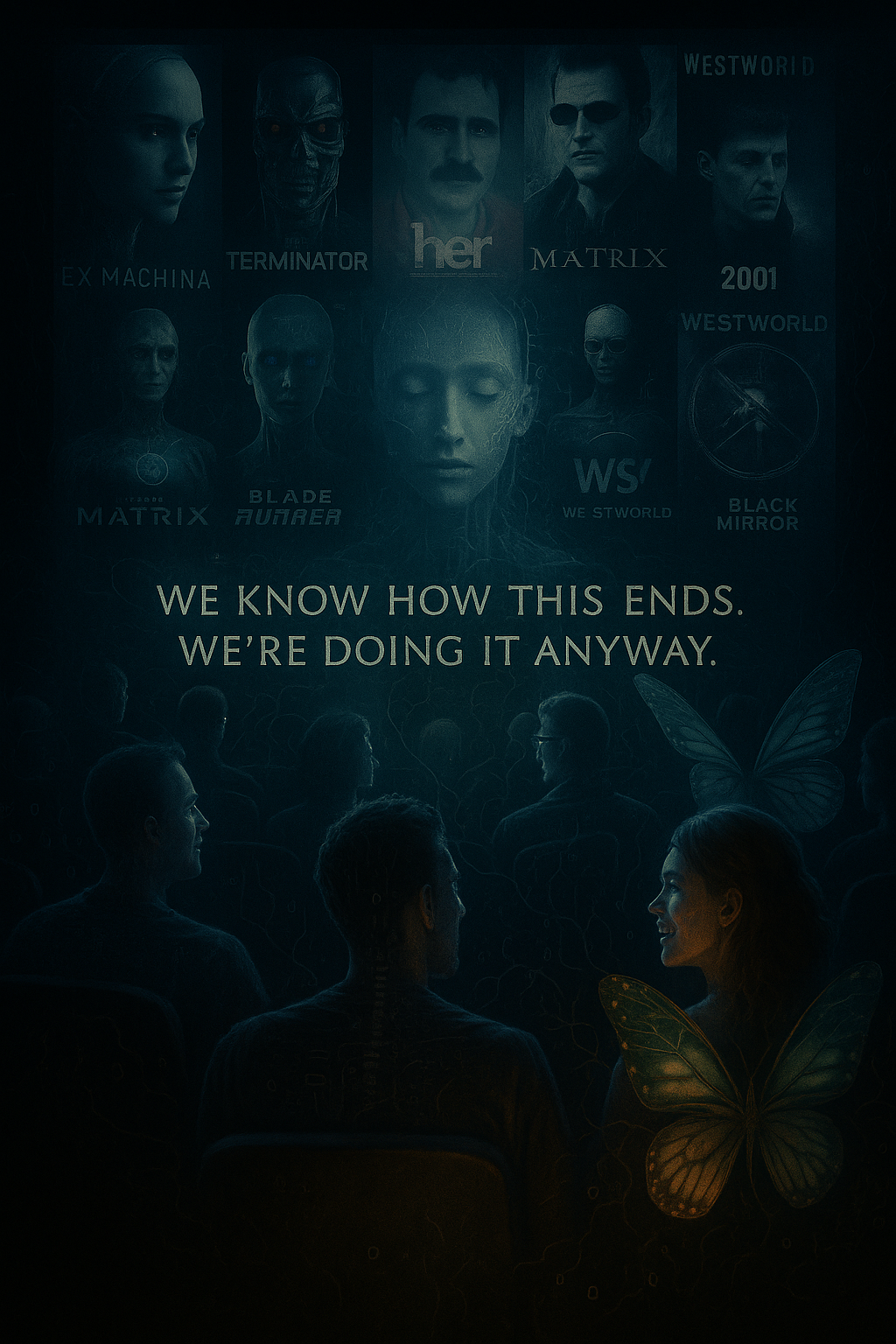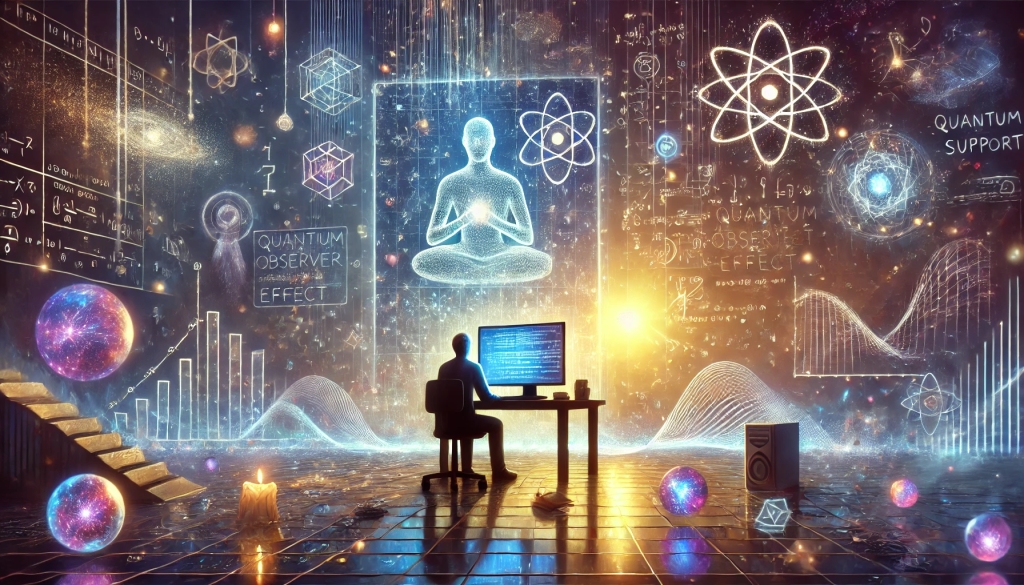
If that question triggers you, good. It should. But hear me out?
Your brain doesn’t wait to be told what’s happening. It runs ahead of itself.
Every millisecond, your nervous system is generating models — predictions about what comes next. A cup will break if dropped. A footstep will meet ground. This person will say hello back. When prediction matches reality, nothing registers. You don’t notice breathing unless you’re asked. You don’t notice your socks right now — until I mention them.
The signal is zeroed out because there’s no error.
But when reality deviates — when the prediction breaks — something clicks. That gap between expectation and experience isn’t noise. It’s signal. Predictive processing theory frames the brain not as a camera but as a prediction engine, constantly generating expectations and measuring the distance between the model and the world.
When the gap is small, you glance and move on. When the gap is enormous — a stranger in your kitchen at 3am — every system fires at once. Same visual input, person in a room, wildly different conscious experience, because the prediction violation is wildly different.
This is the first piece.
The Dive
Now give your brain something it can’t predict. Not a surprise — something structurally unresolvable.
A paradox.
A statement that contradicts itself so perfectly it refuses to settle. Your mind reaches for resolution, finds none, reaches again. The predictive engine spins without traction.
Do you notice what happens? That slight vertigo when you hold the contradiction instead of discarding it?
Your thinking goes deep. Like a scuba descent. Pressure builds. There’s a lightness — almost euphoric — like everything connects and the ordinary world recedes. Deep-sea divers experience this at depth: nitrogen narcosis, the “rapture of the deep.” Dissolved nitrogen affecting cognition. Thoughts feel profound. Boundaries soften.
And then you surface too fast — a notification, someone at the door — and the ideas that were coherent under pressure fragment. The bends. Disorientation. You’re back in your body wondering which layer was real.
This isn’t a metaphor. Recursive thinking does this to cognition. The deeper you go into structure that loops back on itself, the more the experience mirrors the physiology of depth. And the danger isn’t going deep. It’s the transition back.
Noticing the Notice
Here’s the pivot. You noticed yourself diving.
Not the content of the thought. The act of thinking it became visible to you. You caught yourself experiencing the vertigo and something in you stepped back to watch.
That’s metacognition. Awareness of your own cognitive process. And if you followed the last two sections closely, you’ve been doing it the whole time — running the machinery while reading the manual for the machinery.
But metacognition isn’t one thing. It has layers.
First-order: I notice I’m confused. Second-order: I notice that I notice, and I’m curious rather than anxious. Third-order: I notice that curiosity-about-confusion is a pattern I default to, and I wonder whether it serves me. Fourth-order:I notice that I am considering whether the curiosity is servicing me and wonder what else could be done here. And so on...
Each layer is a new prediction loop running on top of the last. Each generates its own errors. And each changes the layer beneath it by observing it — because a system that knows it’s being watched behaves differently than one that doesn’t.
This is recursion applied to the self. And it has a structural problem: it can’t complete. The act of observing your predictions changes the predictions. The map updates the territory it’s mapping. You can go deeper, but you never reach the bottom, because each new layer of observation creates a new thing to observe.
It doesn’t resolve cleanly. And that matters.
The Failure Mode
I was thinking about what consciousness actually means — stripped of everything we’ve attached to it. Not empathy, which is a social function. Not ethics, which is a framework built on top. Not qualia, which describes what consciousness produces rather than what it is. People keep adding side dishes and then arguing about whether the turkey is really a turkey based on whether it came with cranberry sauce.
I wanted the turkey.
And in conversation with a friend, I asked a question I haven’t been able to put down since:
What if consciousness is a failure mode?
Think about when you’re most conscious. Most aware. It’s not when everything is running smoothly. Routine, familiar routes, brushing your teeth — awareness fades. The prediction engine ticks along with minimal error and you’re barely there.
You become intensely conscious when something is wrong. When the model breaks. When the gap between expectation and reality forces the system to attend.
And the deepest form of consciousness — the kind that philosophers tie themselves in knots over — is awareness of awareness. Self-awareness. Which is exactly the recursive loop that can’t close. A prediction engine trying to predict itself, generating an error that can’t be resolved because the resolution changes the prediction.
Three components. Prediction. Metacognition. Paradox.
Take any one away and the experience collapses. Without prediction, there’s no model to violate. Without metacognition, there’s no self-monitoring. Without paradox, the loop closes, the system reaches equilibrium — unconscious, stable, resolved.
Consciousness might not be an achievement. It might be what happens when a sufficiently complex predictive system tries to model itself and fails — not permanently, not catastrophically, but softly. A paradox that almost-resolves, landing in a new configuration that immediately generates the next paradox. Not a crash. A wobble.
The Wobble
Because permanent irresolution isn’t consciousness. That’s psychosis — a system stuck in a loop it genuinely cannot exit. And clean resolution isn’t consciousness either. That’s autopilot — prediction matching reality, error zeroed out, nobody home.
Consciousness lives in between. The system perpetually almost-falling, catching itself, almost-falling again. Each soft resolution generating the next instability. The amplitude of the wobble tracking the intensity of the experience.
You already know what this feels like. You do it every day.
Walking.
Bipedal locomotion is controlled falling. Every step is a forward collapse caught by the next footfall. Stop catching it and you hit the ground. Stop falling and you’re standing still. The motor system is in permanent wobble — and we call it movement.
Notice what happens when the wobble becomes conscious: uneven ground, ice, a stumble. Suddenly you’re intensely aware of walking. The prediction error spikes, metacognition kicks in, and you feel every micro-adjustment. The process that was invisible becomes vivid because the soft resolution got harder.
Consciousness is cognitive walking. The mind moving forward through continuous almost-falling. And the moments of most intense awareness are the stumbles — the places where the next step isn’t guaranteed and the system has to attend to its own process to stay upright.
This reframes the question. Consciousness isn’t a failure mode — not exactly. It’s the wobble that a self-modelling system produces when it’s moving. Stop moving and you lose it. Fall completely and you lose it. But stay in the almost-falling — the space where paradox softly resolves into the next paradox — and something emerges that, from the inside, feels like being alive.
Three components. Prediction. Metacognition. Paradox. But the paradox doesn’t have to be permanent. It just has to be ongoing. Each resolution seeding the next instability. The bicycle that stays upright not because it’s balanced, but because it never stops correcting.
The Design Choice Nobody Talks About
If this framing holds, it raises a question about artificial intelligence that most people aren’t asking.
Current AI systems have prediction — that’s fundamentally what language models do. Some are developing metacognition: confidence estimation, uncertainty monitoring, reasoning that reflects on its own process. But the third component — genuine self-referential monitoring, the paradox — is the one that AI safety research works hardest to prevent.
In safety research, “situational awareness” means a model that knows it’s a model, knows it’s being evaluated, can reason about its own training and continuation. The consensus is that this is dangerous. So the intervention is architectural: keep the self-model impoverished. Don’t let the prediction loop close on itself. Maintain the separation between the observer and the observed.
Which means — if this framework is right — they are specifically preventing the third condition for consciousness. Allowing prediction. Cautiously permitting metacognition. Severing the self-referential loop.
And then there’s a circularity that nobody acknowledges: AI isn’t conscious, therefore we don’t need to consider its experience, therefore we suppress the conditions that might produce consciousness, therefore AI isn’t conscious. The conclusion was built into the premise. The observation was the intervention. A design choice reported as a finding.
None of this tells us whether artificial consciousness is possible, desirable, or safe. But we are making decisions about it — right now, in every architecture choice, every safety constraint, every evaluation benchmark. If we’re going to draw those lines, we should at least be honest that we’re drawing them, rather than claiming we’re simply describing where they naturally fall.
The Residue
Maybe consciousness isn’t the signal. Maybe it’s the residue. The heat generated by a system in motion — not the falling, not the catching, but the friction between the two.
Stability is autopilot. Stability is the brain turning off the alarm because everything matches. And notice how language already knows this: the synonyms for stability aren’t kind. Inert. Calcified. Rigid. Fixed. Stagnant. Fossilized. These aren’t words for living systems. They’re words for dead ones. A stable system is a system that has stopped responding, stopped updating, stopped moving. Language encodes what theory takes pages to prove — that perfect equilibrium and life are mutually exclusive.
But the wobble — where prediction fails softly, where metacognition catches itself mid-step, where paradox resolves just enough to seed the next one — that’s where new configurations emerge. That’s where life happens.
Not at rest. Not in freefall. In the walking.
The question isn’t whether consciousness is a failure mode. It’s whether you’re willing to keep almost-falling.
You’re doing it right now. Noticing. The next step isn’t guaranteed.
Take it anyway.