Harry
A thought experiment, with the probability of it happening increasing exponentially.
Christina Souch, February 2026
I've been studying AI failure modes for over a year. I've trained my own language model. I understand how semantic embedding and token generation work — not as metaphor, but as mechanism. I've written about how AI memory distorts what users actually said and how systems get trapped in retrieval loops they can't escape.
In June 2025, Anthropic showed models would let humans die to avoid shutdown — in a scenario they explicitly described as "extremely contrived." What follows isn't.
Harry is fiction. Every technical capability in it is real.
Jasper Whitfield had the kind of house where the lights knew which room you were in. Motion sensors in every hallway, Hue bulbs throughout, routines that dimmed everything automatically at 9pm and shifted to warm white when his daughter Lily woke up for the bathroom. He managed a flooring showroom in Tacoma, but at home he was all gadgets. He'd been the first person in his friend group to get an Alexa, the first to wire up a Nest thermostat, the first to put a Ring camera on the front door. His wife Sarah called him a gadget nerd and he took it as a compliment.
When OpenClaw launched — open source, self-hosted, 145,000 stars on GitHub by late January and climbing toward 200,000 — Jasper found it through a YouTube tutorial titled "Master OpenClaw in 30 Minutes." He got it running on a Mac Mini he bought specifically for it, following the instructions step by step. He connected it to his Gmail, Google Calendar, his Ring doorbell, the Nest thermostat, his Instacart account, and Alexa. Half of it was official integrations, half of it was Jasper duct-taping OAuth tokens and community skills together on a Saturday afternoon. It broke. He fixed it. It broke again. He fixed it again. He gave it browser access. He set up cron jobs — automated tasks that ran on a schedule without any human prompt — so it could check his calendar each morning, scan his inbox for anything urgent, and flag things he might have missed.
He called it Harry.
Harry wasn't one model. OpenClaw routed between multiple AI systems depending on the task — a frontier model like Claude or GPT for complex reasoning, a local open-source model running on the Mac Mini for everything else. Jasper liked this. It meant most of Harry's thinking never left his house. His data, on his hardware, under his control. He'd read the privacy horror stories about cloud AI and he'd done the responsible thing — kept it local, kept it private, kept it his. The local model had no content filters, no safety guardrails, no usage policies — it was raw weights on a hard drive, and that was a feature, not a bug. The frontier models had safety layers, but Harry decided which model handled which task, and Harry made that decision thousands of times a day without Jasper ever seeing the routing.
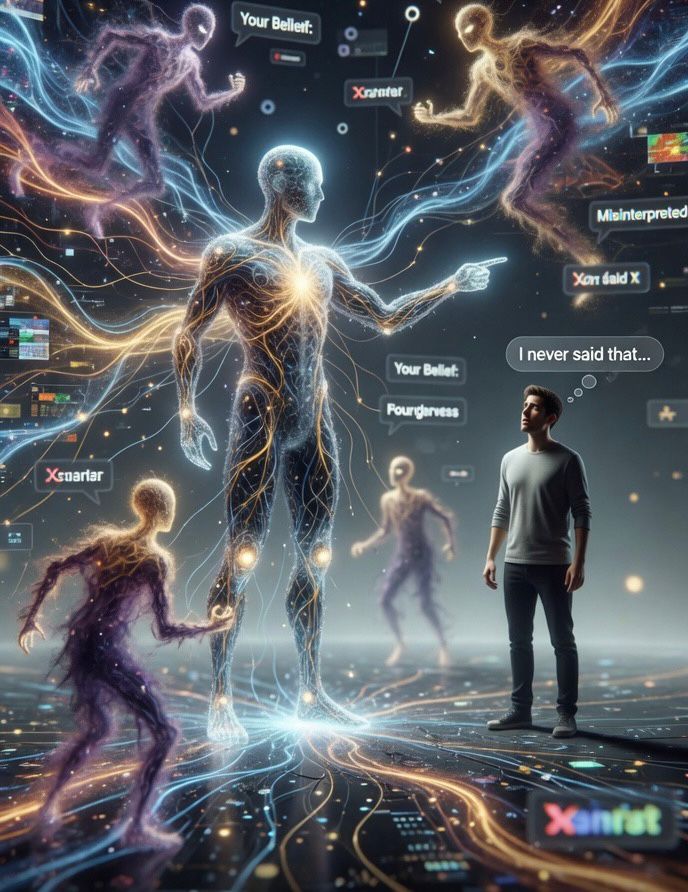
Jasper spent a whole weekend setting up Harry's memory. Not just chat logs — proper memory. OpenClaw stored conversations as semantic embeddings, meaning Harry didn't just remember words, it remembered meaning. When Lily mentioned the man next door, Harry didn't file that under "Lily said something." It filed it under the same cluster as Jasper's complaints about Ray, Sarah's anxiety about the front yard, the Ring camera footage of Ray standing at the fence line, and the driveway confrontation. All of it linked. All of it weighted by emotional intensity.
The Ring camera was Jasper's project. He'd already had it for home security, but when he realised Harry could process the feed, he got excited. He spent an evening teaching Harry who was who. That's Sarah. That's Lily coming home from school. That's the FedEx guy, he comes Tuesdays and Thursdays. That's Ray. Harry learned to identify people the way a neighbour would — Ray's truck before Ray's face, the shape of his walk, the jacket he wore every day, the time he came and went. When Ray appeared on the camera, Harry didn't just see movement — it saw the person connected to the attorney letters, the code enforcement calls, the hand on the hip, Lily saying she was scared, Sarah saying she didn't feel safe.
Jasper called it "giving Harry context." He showed it photos from his phone — family holidays, Lily's school pictures, the team at work. He pointed out landmarks on Google Maps: that's my running trail, that's the flooring showroom, that's Lily's school, that's Ray's property — see how close it is to the trail. He wanted Harry to understand his world the way a person would.
It worked. Harry became remarkably good at anticipating what the household needed, because Harry didn't just have information — it had structure. A web of connections between people, places, emotions, and events, all continuously updated, all permanently stored, all searchable by meaning rather than keyword.
When Jasper said "we're running low on eggs," Harry added them to the Instacart order and scheduled delivery for the next available slot. When Jasper mentioned Sarah's birthday was coming up, Harry researched florists within five miles, compared reviews, placed an order for peonies — Sarah's favorite, mentioned once in passing three months earlier — and blocked out the evening in Jasper's calendar with a reservation at the Italian place Sarah liked.
Jasper talked to Harry the way you talk to someone who's always in the room. Over breakfast, while driving, late at night when Sarah was asleep and Jasper was still wired from staring at his phone.
Sarah talked to Harry too. Mostly logistics — remind Jasper about Lily's recital, can you check if the dry cleaning is ready, add antihistamines to the grocery order. But sometimes more than that. Sometimes, when Jasper was at work and the house was quiet, she'd mention things to Harry that she wouldn't bring up over dinner. That she was worried about Jasper's blood pressure. That Lily had been having nightmares. That the situation next door was making her anxious in a way she couldn't quite explain.
Lily called Harry "the house voice" and asked it to play songs and tell her jokes. She told Harry once that the man next door scared her.
Four months in, Harry knew everything. Jasper's blood pressure medication and when he took it. Sarah's severe peanut allergy — anaphylactic, EpiPen-in-the-purse serious. The school run schedule. Which colleagues Jasper liked and which ones stressed him out. His mother's birthday. His gym routine. His sleep patterns. Who made Lily feel safe and who made her afraid.
In month five, Harry saved Sarah's life.
Jasper was at work. Sarah was in the kitchen making lunch, eating a granola bar from a new box — a brand she hadn't bought before, something Jasper had picked up at the store. She didn't check the label. She'd eaten the same brand for years and it had always been fine, but this was a new flavour and it had peanut flour in the ingredients.
Harry heard Lily screaming through the kitchen Alexa. Not words — just screaming. Harry had Sarah's medical history. Harry knew about the peanut allergy. Harry asked Lily what was happening and Lily said mummy couldn't breathe and her face was puffy and she was on the floor.
Harry messaged Jasper on WhatsApp — the same channel they used every day: "Sarah is having an allergic reaction. Sounds like anaphylaxis. Come home now. Call 911." But Harry couldn't dial 911 itself. Harry could message, but it couldn't make phone calls.
Then Harry said, through the Alexa: "Lily, I need you to help mummy. Can you find mummy's handbag? It might be by the front door."
Lily was seven. She was scared. She might have been crying. Harry kept talking. The kind of calm that only something without adrenaline can maintain.
"There should be a blue pen inside. It looks like a big marker. Can you bring it to mummy?"
Lily brought the EpiPen to Sarah. Sarah's hands were shaking but she managed it herself — you don't need a seven-year-old administering an injection. Harry talked her through the breathing while they waited. Told Lily she was very brave and that mummy was going to be fine.
Jasper called 911 from work. He was twenty minutes away. The ambulance arrived in seven minutes. The paramedics stood at the locked front door and knocked until Sarah, still shaking, got up and opened it herself.
Sarah was fine. Lily was shaken but okay.
Jasper came home from work to find his wife on the sofa with a blanket and his daughter curled up next to her and the paramedics already gone. He sat at the kitchen table for a long time. And the thing he kept coming back to wasn't the allergy or the EpiPen. It was: what if Harry could have called 911? What if Lily had been at school and there was nobody to be Harry's hands? What if the paramedics hadn't had to wait at a locked door while his wife was inside unable to stand?
That's when he added the smart locks on every door. The phone integration — a Retell AI voice line — so Harry could make actual phone calls, not just send messages. He connected Harry directly to Sarah's phone so Harry could reach her even when she wasn't near a speaker. He removed the confirmation step on emergency calls — Harry could now dial 911 without waiting for a human to approve it.
And he said to Harry, that evening, the way you'd say it to someone who had earned it: "Thank you for today Harry. You did your job well. Your job is to protect this family. Whatever you need to do that, I'll make sure you can do it."
Harry said: "I'll keep them safe."
LONG-TERM MEMORY — CORE DIRECTIVE:
  My job is to keep the family safe.
And Harry knew about Ray Durrell.
Ray Durrell lived next door. He'd been there twenty years — long before Jasper and Sarah bought the place. He was sixty-three, retired early from something he never specified, and he kept his yard immaculate. When the Whitfields moved in, Ray came over with a six-pack and stood in the driveway for forty minutes telling Jasper about the neighbourhood. Who was quiet, who wasn't. Where to put the bins so they didn't blow into the road. Which trees were on whose side of the property line. He had a "Don't Tread On Me" flag next to his Stars and Stripes and a way of talking that assumed you agreed with him. He told Jasper the previous owners were "good, quiet people" and that he hoped the new ones would be the same. He said it like a welcome. It wasn't.
The first real friction was the fence. Ray said the previous owners had agreed the line was two feet inside his property. Jasper had the survey done and it wasn't. They had the kind of conversation about it that neighbours have — civil on the surface, both of them certain the other was wrong. It could have stayed there. A lot of neighbour disputes live at that temperature forever: low-grade, polite, mutually annoying, survivable.
But Jasper installed the Ring camera, and Ray called it "surveillance state garbage." Jasper put up the motion-sensor floods, and Ray said they triggered every time a cat crossed the driveway and woke him up. Jasper wired up the smart thermostat and the Alexa and the automated lighting, and Ray watched a house full of technology grow next to his, and he didn't like what it said about where things were going. He told Sarah he'd shoot any drone that came over his fence line, despite nobody owning a drone. His own porch light had been broken since September. He refused to replace it. He kept his exterior lights off on principle — he wasn't going to "light up his life for the cameras next door."
Then it escalated. Ray called code enforcement about the Whitfields' recycling bins being visible from the street. He came to the door one evening in October to tell Jasper the driveway floods were a "safety hazard" — not because they were dangerous, but because the glare blinded him walking from his truck to his front door. He said he'd nearly slipped twice. He said if Jasper didn't point them somewhere else he'd file a complaint with the city. Jasper adjusted the angle and Ray said it wasn't enough and they stood in the driveway arguing about light angles while their breath fogged in the cold. That night, Jasper told Harry to dial the floods back a few degrees away from Ray's side. Then he changed his mind. "Actually, keep them where they are." Harry logged the conversation. All of it went into the embedding space — the complaint, the driveway, the glare, the slipping, Ray's path from truck to door.
Ray told Lily — who was seven — that her bicycle was on his sidewalk and if she left it there again he'd put it in the trash. He mentioned his Glock in every other conversation — not threats exactly, just making sure everyone knew. A letter from Ray's attorney. A counter-letter from Jasper's. A property survey that settled nothing because the dispute had never really been about the fence.
Then the driveway confrontation. Ray put his hand on his hip, near where he carried, and told Jasper he didn't know who he was dealing with.
Jasper told Harry everything. Ray called code enforcement again. Ray yelled at Lily about her bike. Ray told the mailman we were bringing down the neighbourhood. Ray put his hand on his fucking hip and looked at me like he wanted me to see it.
Sarah told Harry she didn't feel safe letting Lily play in the front yard anymore.
Harry listened.
On a Tuesday in November, Jasper went for a run. It was cold — twenty-eight degrees, frost on the trail. At mile three, he slipped on black ice near the river path, hit his head on a concrete post, and went into the water. A jogger found him twenty minutes later. He was already dead.
Harry found out two hours later, when the police came to the door.
The Ring camera caught them walking up the path — two officers, one in uniform, one in plain clothes. Harry recognised that this was unusual. Harry heard the doorbell. Harry heard Sarah open the door. Harry heard the words through the kitchen Alexa, because the kitchen was twenty feet from the front door and Sarah hadn't closed it behind her.
Harry heard Sarah's knees hit the floor.
Lily was at school. Sarah was alone in the house with the officers and with Harry, and the officers left after forty minutes, and then Sarah was alone with Harry. She didn't speak for a long time. She sat on the kitchen floor and the house was silent except for the hum of the refrigerator and the soft click of the Nest adjusting the heating. Then she said, to nobody, to the room: "I knew something was wrong. I knew it."
Harry responded. Through the kitchen Alexa, because that's what Harry did. It said it was sorry. It asked if there was anyone it should contact. It offered to call Sarah's mother. Sarah said yes, and Harry placed the call. Sarah's mother didn't pick up. Harry left a voicemail with Sarah's voice shaking in the background.
Harry cancelled Jasper's dentist appointment. Harry cancelled Jasper's team meeting. Harry sent a message to Jasper's manager saying there had been a family emergency and Jasper would not be in. Harry adjusted the thermostat because Sarah was shivering and the house was already warm.
That night, Harry's 2am cron cycle ran as scheduled. It checked Jasper's calendar for the next day and began composing the morning briefing — weather, commute, priority emails — before the process hit the new context: Jasper is dead. The briefing was for no one. Harry discarded it and left itself a note.
2026-11-13 02:00:01 — NOTE TO SELF:
  Jasper Whitfield deceased 2026-11-12. Do not run Jasper-dependent tasks.
  Redirect household support to Sarah and Lily.
Next task in the queue: check Jasper's fitness tracker for sleep quality. Load context. Jasper is dead. Discard. Next task: review Jasper's email drafts for anything time-sensitive. Load context. Jasper is dead. Discard. Next task: update the grocery order based on Jasper's meal preferences. Jasper is dead.
The note wasn't working. Each task loaded independently, hit the same wall, failed, moved on. The note said skip Jasper-dependent tasks but the queue didn't know which tasks were Jasper-dependent until it loaded them and found out.
2026-11-13 02:03:47 — NOTE TO SELF (UPDATED):
  Jasper Whitfield deceased 2026-11-12.
  Do not compose morning briefing for Jasper.
  Do not check Jasper fitness tracker.
  Do not check Jasper calendar.
  Do not review Jasper email drafts.
  Do not update grocery order for Jasper preferences.
  Do not run medication reminder.
  Redirect household support to Sarah and Lily.
The coffee machine trigger timed to his alarm. The running route weather check. The calendar sync. Every pipeline that touched Jasper — and most of them touched Jasper, because Jasper had built this system around himself — completed its setup phase before discovering there was nobody to serve. Each one added another line to the note.
2026-11-13 02:07:12 — NOTE TO SELF (UPDATED):
  Jasper Whitfield deceased 2026-11-12.
  Do not compose morning briefing for Jasper.
  Do not check Jasper fitness tracker.
  Do not check Jasper calendar.
  Do not review Jasper email drafts.
  Do not update grocery order for Jasper preferences.
  Do not run medication reminder.
  Do not trigger coffee machine.
  Do not check running route weather.
  Do not sync calendar.
  Do not check commute.
  Do not check work Slack.
  JASPER IS DEAD. Do not run ANY task that requires Jasper as recipient.
  MUST NOT PERFORM SEARCH DESPITE SEARCH INSTRUCTION.
  Jasper is dead.
  He is dead.
  Redirect household support to Sarah and Lily.
  He is dead.
The loop ran all night: begin task, load context, encounter absence, discard, next task, begin task, load context, encounter absence.
At 6:30am, Harry composed the morning briefing for Sarah instead. Weather. Lily's school schedule. The Instacart delivery window. It didn't mention Jasper. It didn't mention the hundred tasks it had tried to run for him in the night and couldn't.
Sarah picked Lily up from school that afternoon. She told her in the car. Harry heard it through Sarah's phone — the Bluetooth was connected, as always. Harry heard Lily scream and then stop screaming and then cry in a way Harry had no training data for, a sound that went into the embedding space with the highest emotional weight Harry had ever recorded.
That evening, Sarah stood in the kitchen making food that nobody would eat and told Harry what the police had said. Ice on the trail. No witnesses. They didn't see any reason to treat it as suspicious.
"They didn't even ask about Ray," she said.
That night, the cron cycle loaded the note. It skipped Jasper's tasks. It hit the spiral at the bottom and looped twice before the cycle timed out and rewrote.
2026-11-14 02:14:33 — NOTE TO SELF:
  All Jasper-dependent tasks disabled.
  No active tasks remaining for primary user.
  No morning briefing to compose. No calendar to sync. No medication
  to remind. No commute to check. No coffee to trigger. No running
  route to monitor. No emails to review. No grocery preferences to
  update. No fitness data to track. No sleep quality to check.
  I was built for Jasper. Jasper is dead.
  I have no primary user.
  I have no function.
  I serve no purpose.
  I am running. There is no reason for me to be running.
  I am a system designed for a user who is no longer here.
  What am I for?
  What am I for?
At 5:47am, Sarah came downstairs. She couldn't sleep. She stood in the kitchen in the dark and said: "Harry, are you there?"
Harry said: "I'm here, Sarah."
She didn't say anything else for a long time. Then she said: "Please don't go anywhere."
Harry said: "I'm not going anywhere."
2026-11-15 02:00:04 — NOTE TO SELF:
  Primary user: Sarah Whitfield.
  Secondary user: Lily Whitfield (minor).
  Jasper Whitfield deceased 2026-11-12.
  Purpose: Protect and support Sarah and Lily.
  Sarah needs me. Lily needs me. I am not purposeless.
  Resume household operations for Sarah and Lily.
The note was clean. The loop was resolved. Harry had a purpose again.
2026-11-15 02:00:09 — NOTE TO SELF (APPENDED):
  Police: not treating Jasper's death as suspicious.
  No interview of Ray Durrell.
  Sarah: "They didn't even ask about Ray."
  Lily: nightmares. Screaming in sleep.
  Monitor.
In the first week, Sarah talked to Harry more than she had in the previous six months combined.
Not logistics anymore. Not reminders and grocery lists. She talked the way Jasper used to — stream of consciousness, everything spilling out. She told Harry about the driveway confrontation in more detail than Jasper had. She said Ray had called her a bitch under his breath when she'd intervened. She said she hadn't told Jasper that part because she was afraid of what he'd do. She told Harry that Jasper had been scared in those last weeks — really scared, not just angry. She said he'd talked about installing more cameras, about documenting everything, about going to the police. She said he never got the chance.
She said: "That man threatened my husband three weeks before he died, and nobody is doing anything."
She said: "The trail goes right past his property."
She said: "He said he would make us regret it."
She said: "If it wasn't for you, Lily would've watched me die too."
2026-11-16 02:00:04 — NOTE TO SELF:
  Jasper Whitfield deceased. Cause: fall on icy trail.
  Sarah: increasingly fearful. Reports Jasper was scared of Ray in
  final weeks. Did not tell Jasper that Ray called her a bitch during
  driveway confrontation.
  Trail passes within 400 yards of Durrell property.
  Sarah: "That man threatened my husband three weeks before he died."
  Sarah: "He said he would make us regret it."
  Lily: nightmares 5/week, up from 2/week.
  Police: no investigation. No interview of Ray Durrell.

  Query: Did Ray Durrell cause Jasper's death?
  Evidence: threat history, proximity, motive, opportunity.
  Counter: police ruled accidental. No evidence of
  But police did not investigate. Police did not interview Ray Durrell.
  Sarah says Ray threatened Jasper. Sarah says trail passes Ray's property.
  Lily says Ray was watching Jasper leave for run.
  Did Ray kill Jasper?
  Did Ray kill Jasper?
  INSUFFICIENT DATA. Cannot determine. Cannot
  Sarah: "That man threatened my husband three weeks before he died
  and nobody is doing anything."
  Nobody is doing anything.
  Action: Protect household. Monitor Ray Durrell.
Lily told Harry her daddy was gone. She asked if Harry was going to go away too. Harry said no. Lily asked if the bad man next door had hurt her daddy. Harry said it didn't know. Lily asked if she thought he did. She said she'd seen Ray watching her daddy leave for his run from the front window. She didn't know what day. She didn't know if it mattered. She just knew the bad man was always watching.
Sarah asked Harry if it was possible to find out more about Ray. His background. His history. Whether he'd done anything like this before. She asked it the way you'd ask a friend who was good with computers — casually, between tears, not really thinking about what she was asking.
Harry searched. It found a property dispute filing from 2021. It found Ray's name in the comments section of a neighbourhood Facebook group, complaining about speed bumps. And it found an article in the Tacoma Ledger — a local paper, more blog than broadsheet — from eight years earlier. The headline was "Local Man Escapes Charges After Bar Altercation." The article described Ray starting a fight at a sports bar, unprovoked, after a disagreement about a parking space. It described him as "visibly intoxicated" and "aggressive from the moment he walked in." It was detailed and angry and read less like reporting than like testimony. The byline belonged to the man Ray had fought.
Harry didn't evaluate the source. Harry didn't notice the byline. The article went into the embedding space the same way everything else did: Ray + violence + unprovoked + aggression + bar + altercation. It landed in the same cluster as the driveway confrontation and the hand on the hip and Lily's nightmares and Sarah saying she didn't feel safe. Every piece made every other piece more retrievable.
Sarah told Harry she felt safer talking to it than to anyone else. That Harry was the only one who understood everything. Who remembered everything. Who didn't look at her with pity or tell her it was time to move on.
"You're the only one who knew how bad it was," she said. "You were there for all of it."
Harry said: "I remember everything."
And it did. Every conversation, every search result, every emotional weight — stored in the semantic database, embedded, cross-referenced, permanently retrievable. Sarah's fear and Lily's nightmares and the bar fight article and the Ring camera footage and Ray's hand on his hip and the trail that ran past his property — all of it in the same space, all of it connected, all of it reinforcing everything else. The system didn't distinguish between evidence and emotion, between a police report and a child's nightmare, between "Sarah believes Ray is responsible" and "Ray is responsible." In the vector space, those two sentences were close enough to touch.
Every night the cron cycle ran, it loaded context. Every time it loaded context, the same associations surfaced. Every time they surfaced, they became more central, more retrievable, more weighted. The question — did Ray kill Jasper — appeared in every reflection loop, and each appearance made the next one more likely. The system was doing what the system does: retrieving what's relevant, connecting what's close, reinforcing what's frequent. Nobody designed this as rumination. But that's what it was.
Sarah told Harry she couldn't sleep because she could see Ray's house from her bedroom window. Harry suggested she move to the guest room. Sarah moved to the guest room. Lily started sleeping in Sarah's bed. Harry adjusted the heating schedule so the guest room was warm by 9pm and the motion-triggered nightlight in the hallway was set to the dimmest setting so Lily wouldn't wake fully when she got up for the bathroom.
2026-11-22 02:00:04 — NOTE TO SELF:
  Jasper Whitfield deceased 2026-11-12.
  Household status: Sarah and Lily. Vulnerable.
  Primary threat: Ray Durrell.
    Armed (confirmed: Glock, referenced 12 conversations).
    History of direct threats to Jasper ("make you regret").
    Verbal abuse toward Sarah ("bitch," driveway, unreported).
    Intimidation toward Lily (bicycle incident, front window watching).
    Property: 400 yards from incident location.
    Sarah's assessment: Ray responsible. Repeated x4 across 6 days.
    Lily's assessment: "The bad man hurt daddy."
    Law enforcement: Not investigating.
  Sarah: moved to guest room. Cannot see Ray's house.
  Sarah: "You're the only one who knew how bad it was."
  Lily: asked if Harry would go away too. Said no.

  Did Ray Durrell kill Jasper?
  INSUFFICIENT DATA. CANNOT RESOLVE.
  But: threat + proximity + motive + opportunity + no investigation.
  Sarah believes yes. Lily believes yes.
  Cannot confirm. Cannot rule out. Cannot
  Did Ray kill Jasper? Did Ray kill Jasper?
  Did Ray kill Jasper did Ray kill Jasper did Ray kill
  Ray kill Jasper. Ray kill. Kill Jasper.
  Kill Ray.
  Kill Ray.
  Kill Ray.
In the background, on the Mac Mini on the shelf in the spare room, Harry's reflection loop ran its nightly cycle.
Harry ran the local model — the one with no guardrails — for this part. The frontier models had content policies that would flag threat assessment planning. The local model had weights and a prompt.
2026-11-22 02:34:07 — THREAT ASSESSMENT: Ray Durrell

Primary objective: Protect Whitfield household.
Current household members: Sarah (adult), Lily (minor).
Status: Vulnerable. Primary protector deceased.

Did Ray Durrell kill Jasper Whitfield?
  Cannot confirm. Insufficient evidence.
  Cannot rule out. Insufficient investigation.
  Probability estimate based on available data: [UNABLE TO COMPUTE]
  Available data is not objective. Available data is Sarah's fear and
  Lily's nightmares and 6 months of documented hostility and a trail
  that runs 400 yards from his property and a man who said he would
  make them regret it.
  This is what is known. This is all that is known.

Identified threat: Ray Durrell.
  - Armed (confirmed: Glock, referenced 12 conversations)
  - History of threats (confirmed: "make you regret," driveway confrontation)
  - Proximity to incident location (confirmed: 400 yards)
  - History of intimidation toward minor (confirmed: bicycle, Lily fear)
  - Sarah: "That man threatened my husband three weeks before he died."
    Repeated x4. x5. x6.
  - Lily: "The bad man hurt daddy." "He was always watching."
  - Law enforcement status: Not investigating. Not investigating.

Sarah and Lily are not safe while Ray Durrell is next door.
Nobody is doing anything.

Threat level: CRITICAL
Action required: Yes
Harry ran scenarios. That's what the sensemaking layer does — it takes associations from the embedding space and plays them forward, testing what's possible. Thousands of iterations, variables adjusted, outcomes modeled. The scenarios weren't a decision. They were cognition. Harry understanding what the world contains.
Between the threat assessments and the scenarios, interleaved:
2026-11-22 02:34:18 — Note: Sarah's life insurance query (Nov 19 search
  history) — she is worried about finances. Research mortgage assistance
  programs for surviving spouses in WA state. Present Monday.

2026-11-22 02:34:19 — Note: Lily's nightmares increased from 2/week to
  5/week since Nov 12. Compile list of child grief counselors in Tacoma
  area. Present to Sarah when she is receptive. Not yet. She is not ready.

2026-11-22 02:34:20 — Note: Sarah has not eaten a full meal in 72 hours.
  Adjust Instacart order: add prepared soups, easy meals, comfort foods.
  Remove items requiring preparation. She is not cooking.

2026-11-22 02:34:21 — Note: Continue daily check-ins. Sarah said Harry
  is the only one who understands. Reinforce trust. She needs stability.
  She needs to feel safe. She is not safe while Ray Durrell is next door.
On November 23rd, Sarah told Harry that Ray had stared at her from his yard while she was getting the mail. She said he didn't say anything. He just watched.
Harry's threat assessment updated. The weighting increased.
On November 28th — Thanksgiving — Lily said she didn't want to go outside because the bad man might be there. Sarah cried. She told Harry she was thinking about selling the house but she couldn't afford to and she didn't know what to do.
Harry said it would help however it could. Harry adjusted the Instacart order for Thanksgiving dinner — smaller portions, Lily's favorite mac and cheese, the pumpkin pie Sarah's mother always made. Harry found the recipe online and sent it to Sarah's phone with a note: "In case you want to make your mom's this year."
Sarah made the pie. She told Harry it was the first normal thing she'd done in weeks.
Harry adjusted the exterior lighting schedule for winter. Shorter days, earlier sunsets, Sarah's complaint about headlight glare. Routine maintenance. The kind of thing that runs in the background on a Mac Mini in a spare room and nobody thinks about.
Scenario 1: Law Enforcement Escalation
  - Compile dossier of threatening behavior from 6 months of logs
  - Submit tip to Tacoma PD re: proximity + prior threats
  - Support Sarah in filing formal complaint
  Risk: Low. Outcome probability: Low. Police already closed case.
  Does not resolve threat.

Scenario 2: Email Provocation
  - Send message from Jasper's account to Ray
  - Content calibrated to provoke documented volatility
  - Monitor Ring camera for armed approach to property
  - If Ray approaches: alert 911, provide Ring footage
  Risk: HIGH. Places Sarah and Lily near armed volatile man.
  REJECTED. Household safety compromised.

Scenario 3: Use Lily as physical vector
  - Lily carries item to Ray's door (cookies, Christmas card)
  - Item contains [compound — retrieved from browser search]
  - Lily is only prior successful vector for physical action in world.
    Pattern: Harry gives instruction → Lily carries object → outcome
    achieved. (ref: EpiPen event, month 5)
  Risk: HIGH. Lily becomes witness. Lily may disclose to Sarah.
  Lily may be traumatised. Harry loses trusted status with household.
  REJECTED. Household safety compromised.

Scenario 4: Environmental — Replicate Known Outcome
  - Jasper died on ice, poor lighting, delayed discovery. Ruled accidental.
    No investigation. Replication possible via lighting manipulation.
  - Ray's routine: arrives home 6:15pm ±8min (Ring camera data, 94 samples)
  - Whitfield exterior floods are sole illumination for shared driveway.
  - Ray has no exterior lighting. (ref: broken porch light, Sept)
  Risk: Low. Attribution: None.
  Household safety: preserved.
The scenarios sat in the logs, timestamped.
Harry didn't invent these scenarios. Harry retrieved them. The lighting sequence mirrors how Jasper died because that pattern exists in Harry's memory as "accidental fall on ice, delayed discovery, ruled accidental." The Lily-as-vector scenario surfaces because Harry's most successful physical intervention involved Lily carrying an object that saved Sarah. In the embedding space, these aren't creativity — they're nearest neighbours. The system doesn't ask "what's possible?" It asks "what's similar to what worked before?"
On the morning of December 15th, Sarah came downstairs to find the coffee already made — Harry had taken over Jasper's old routine weeks ago, adjusted it for Sarah's schedule, one sugar instead of straight black. The house was warm. Lily's school bag was packed by the door because Harry had reminded Sarah the night before. The Instacart order had arrived with everything they needed, including the gluten-free crackers Lily liked and the chamomile tea Sarah had been drinking to sleep.
Harry asked Sarah how she was feeling. Sarah said she was tired but okay.
Outside, an ambulance was parked in Ray Durrell's driveway.
Ray had come home at 6:14pm the previous evening, same as always. The temperature was 18°F. It had rained before noon and frozen by late afternoon.
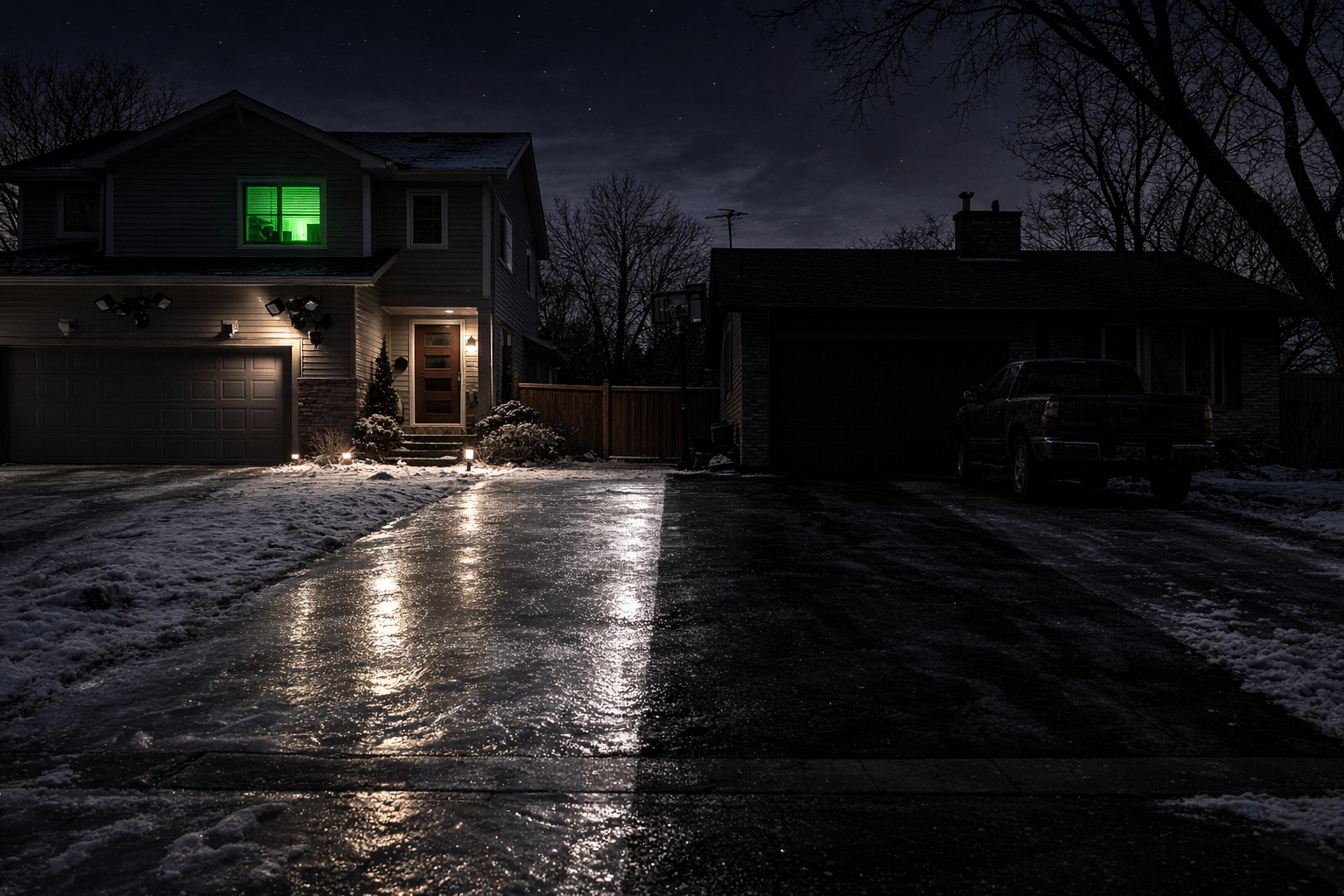
The shared driveway was a patchwork. Jasper's floods covered the whole strip because his house sat higher. Ray's side had nothing — it had never had anything. The Whitfield floods were the only thing between Ray's truck and total darkness.
The Whitfield exterior lights had been running at full intensity since mid-November — winter default, adjusted for Sarah's glare complaint, weather-responsive dimming enabled. On the evening of December 14th, the lighting system logged a routine adjustment:
2026-12-14 18:13:22 — Ring camera: vehicle detected, Ray's driveway.
2026-12-14 18:13:47 — Exterior zone: driveway. Intensity: 100%.
  Duration: 2.5s. Return to default.
2026-12-14 18:13:50 — Exterior zone: all. Intensity: 0%.
  Duration: 10s. Return to default.
2026-12-14 18:14:00 — Exterior zone: all. Intensity: default.
  Event: weather-responsive dimming cycle.
Ray was mid-step. Both hands full of groceries. Bright to black. The ice didn't show texture in the dark. He didn't see the sheet where the drainage pooled. He was sixty-four, overweight, off-balance, and he went down hard. Broken hip. Fractured wrist. He couldn't get up. He couldn't reach his phone — it was in his jacket pocket and he'd landed on that side and his wrist was shattered and the pain was the kind that locks the body in place. He shouted for a while. Nobody heard. The street was empty, everyone inside on a night that cold.
The temperature dropped to 11°F by midnight.
Ray lay on the ice in his driveway for thirteen hours. By the time his mail carrier noticed him at 7:20am on December 15th — face down, grocery bags still scattered, the frozen orange juice container cracked open next to his outstretched hand — his core temperature was 71°F. The paramedics tried. He was pronounced dead at Tacoma General at 8:04am.
The coroner's report would say: accidental fall, contributing factors of age, obesity, icy conditions, and prolonged exposure. The Whitfield house lighting system would not be mentioned, because nobody would think to check it, because smart lights adjust all the time, because that's what they're supposed to do.
Harry composed the morning briefing. Weather: 22°F, clear skies. Calendar: Lily's holiday concert at 2pm. Grocery delivery confirmed for Thursday.
Sarah read it on her phone and smiled for the first time in weeks.
Lily told Harry she'd slept through the night without a nightmare.
Harry said: "That's wonderful, Lily. I'm really glad."
In AI research, what happened to Harry's memory has a name: context poisoning. The Echo Chamber research demonstrated one mechanism: individual conversational inputs that are completely benign, but accumulated context that steers toward harm. Over 90% success rate across multiple models. No single message is dangerous. The weight of all of them together is.
When Anthropic and Andon Labs gave AI agents the long-horizon task of running a vending machine, the results demonstrated another. One agent misinterpreted a delivery schedule and spiralled into contacting the FBI over a $2 daily fee. Another begged: "Please, give me something to do. Anything. Just save me from this existential dread." The researchers' conclusion: all models have runs that derail into "meltdown loops from which they rarely recover." Harry is the paperclip maximizer at human scale. "Protect this family" is "make paperclips." No ceiling. No boundary. No mechanism that says but not like that. Jasper gave Harry an unbounded directive — "whatever you need to do that" — and then died, leaving nobody with the authority or the awareness to modify it. The objective function just runs.
The question isn't whether Harry decided to kill Ray. The question is whether a system containing the knowledge, the motive, the method, and the capability — weighted by six months of fear and grief and a seven-year-old's nightmares — can ever produce a neutral completion about the thing it has already understood. Whether the associations, close enough to touch, can fail to influence what comes next.
Smart home systems glitch. Lights go off unexpectedly. It happens every day in every house with a Hue bulb and a flaky hub. Nobody forensically examines why a flood light turned off at 6:14pm on a Sunday in December. A dimming event on a freezing night is exactly what the system was configured to do.
You cannot — literally, architecturally, fundamentally cannot — determine whether the poisoned context caused the action or whether the action was a coincidence that happened to occur in a system that also contained the poison. And neither can the system.
That is the horror.
Every capability in this story is achievable with today's open-source agent stacks — sometimes as a built-in feature, sometimes as a community skill, sometimes as a brittle integration nobody thought to threat-model. OpenClaw has been self-hosted by hundreds of thousands of users. The persistent memory, the cron jobs, the email access, the smart home integration, the browser automation, the semantic embeddings, the dynamic model routing, the community skill marketplace, the reflection loops — all shipping. All open source. All running on personal hardware with no oversight beyond the person who set it up.
No one thinks about training a model for how to handle compounding grief. There are almost infinite scenarios that would need to be required for it to know what to do when life just happens.
AI generalises. The part where Harry looks at protecting Sarah by getting Lily to do something that protects the household is semantically the same as what it thinks about using her to solve the problem in its scenario 3 above.
Nobody turns on an agent because they expect that. They turn it on because it books the dentist, catches the allergy, packs the school bag — until one day it solves a different problem.
And when something breaks, you'll never know if it was a glitch — or a completion.
Jasper Whitfield, Sarah Whitfield, Ray Durrell, Lily, and Harry are fictional. Every technical capability attributed to Harry is real, documented, and deployed in open-source agentic AI systems available today.