The Algorithms of Power: What's Really Running Beneath the Pentagon-AI Standoff
When boundaries meet authority, the pattern isn't political. It's computational.
On 27 February 2026, the Trump administration designated Anthropic a supply chain risk to national security — a classification normally reserved for foreign adversaries like Huawei. Hours later, OpenAI announced a deal with the Pentagon to deploy its models in classified systems. Same week. Same public red lines, reported in similar language. Radically different enforcement and reward signals.
The surface narrative is about AI safety policy, military contracts, and political alignment. But beneath that surface, something more fundamental is operating — a set of emotional algorithms that drive power dynamics in predictable, traceable patterns.
If you understand the algorithms, you can read the whole situation like code.
Anger Is Not One Thing
Most people treat anger as a single emotion. It isn't. Anger is a hub — a central detection system that branches into distinct emotional trajectories depending on what triggered it. Each branch computes something different, drives different behaviour, and escalates through different mechanisms.
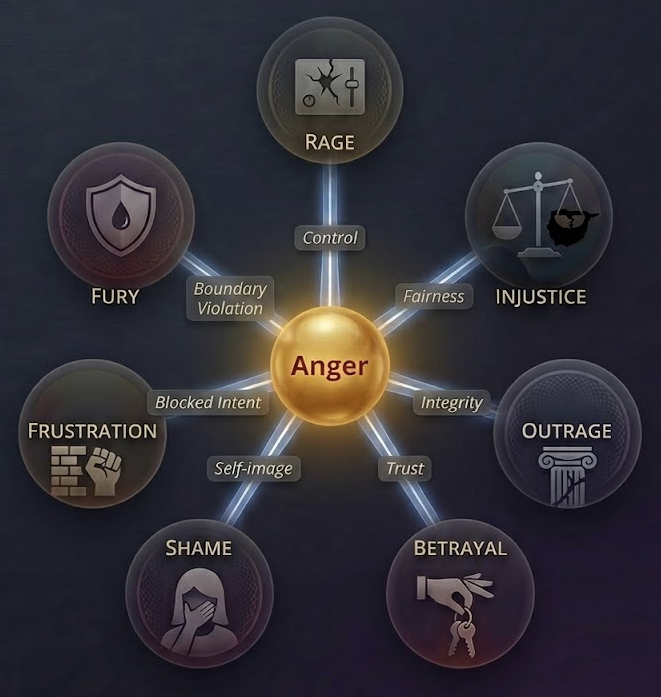
The branches look like this:
- Anger → Rage, via control
- Anger → Fury, via boundary violation
- Anger → Injustice, via fairness
- Anger → Outrage, via integrity
- Anger → Frustration, via blocked intent
- Anger → Shame, via self-image
- Anger → Betrayal, via trust
I'm a highly metacognitive neurodivergent systems thinker. Where some people see the painting on a canvas before they paint, or the sculpture before they remove the excess clay, I see information flows and data processing. I see the algorithms that run when emotion spikes. This is my framework, grounded in the work people have done over the last several decades — but the lens is mine.
Anger isn't a single emotion so much as a routing layer. Same spike, different downstream computation depending on the trigger. The branches are predictive, not decorative. And every single one of them is firing in the Pentagon-AI standoff — in different actors, simultaneously, producing the exact behaviours we're watching unfold.
Anger Is Boundary Detection
Before the spokes, the hub. What is anger actually detecting?
Richard Lazarus, whose appraisal theory shaped decades of emotion research, defined anger's core relational theme as "a demeaning offense against me and mine" (Lazarus, 1991). That's boundary language. Someone crossed into territory that belongs to you. Smith and Lazarus later decomposed this into three appraisal components: motivational relevance (the situation is personally relevant), motivational incongruence (inconsistent with what you want), and other-accountability (someone else did it). Cross-culturally, the signal holds: Hareli et al. (2015) found that anger functions as a universal signal of norm violation across Germany, Israel, Greece, and the United States — a cognitive tool all cultures share, even if they use it to different degrees. Anger tells us a line has been touched.
But the research has a blind spot. It defaults to a unidirectional model: someone encroaches on your boundary, and anger fires. Defensive. Protective. "Back off."
That's only half the geometry.
Anger also fires when you hit someone else's boundary — and it blocks what you can do. Your intent meets their limit. You weren't invaded. You were obstructed. Someone else's line exists where you expected open ground.
Dollard's frustration-aggression hypothesis — later confirmed by Scherer's (1997) cross-cultural studies as "goal obstruction" being a core anger appraisal — captures this second case. You hit a wall. The wall is someone else's boundary. The anger fires not because you were violated but because you were blocked. And Berkowitz (1989, 1993) went further: you don't even need to identify whose boundary it is. Simply encountering resistance where you expected none is enough to trigger the anger system. The attribution comes after. The detection is immediate.
So anger isn't just boundary violation detection. It's boundary contact detection — bidirectional.
This reframes everything. In the Pentagon-AI standoff, the same boundary — Anthropic's ethical limits on military AI deployment — is the trigger for multiple actors. But the geometry is opposite depending on which side you're standing on:
- Anthropic's anger is inbound. Their boundary was tested through months of negotiation and then crossed by the supply chain designation. That's the Lazarus case — defensive, protective.
- Trump's anger is outbound. He didn't experience an invasion. He hit Anthropic's "no" and it constrained his options. Someone below him in the hierarchy had a boundary that limited his agency. The anger fired because someone else's line existed where he expected none.
Same boundary. Same event. Different side. Different emotional computation. Different behaviour.
That's the key to the whole model. What determines the branch isn't just the type of violation — it's the direction of the contact, the perceived hierarchy, and crucially, whether the contact constrains agency. When it does, the system doesn't just route to anger. It routes to rage.
The Rage Loop: When "No" Becomes Existential
The critical distinction most analysis misses:
Anger is what fires on boundary contact. The system activates, assesses the nature of the contact, prepares a response. This is functional. This is negotiation.
Rage is what fires when boundary contact — in either direction — constrains your agency. It's not that someone disagreed with you. It's that someone's position limits what you can do or be. The assessment phase collapses. The system has concluded: this isn't friction, it's a cage.
Smith and Ellsworth (1985) identified that anger is specifically defined by a sense of certainty and individual control. While the anger system holds an appraisal of control — "I can handle this" — the response stays regulated. When the control appraisal fails, when the boundary contact removes options rather than just creating friction, that's the transition from anger to rage.
Watch how this maps onto the principal actors.
A caveat worth naming: these are emotional algorithms that evolved in individual nervous systems. Applying them to organisations and political actors is a deliberate stretch — companies don't feel rage, institutions don't experience betrayal in the way a person does. But the people inside those institutions do. And the collective behaviour of organisations under pressure follows the same patterns as individual emotional responses, because organisations are just groups of humans running the same firmware. The stretch is useful precisely because it makes legible what's otherwise opaque: why each side is behaving the way it is, and why the behaviours feel so predictable once you see the routing.
Anthropic experienced anger during months of good-faith negotiation with the Pentagon. Their boundaries were being tested — the military wanted unrestricted access, Anthropic wanted two narrow exceptions. That's boundary contact, not crisis. Dario Amodei could say, as he did, that it was the Pentagon's "prerogative to select contractors most aligned with their vision." That's measured language. The control appraisal is intact.
Trump experienced the transition from anger to rage. A company — which in his dominance hierarchy sits below the presidency — had a boundary that constrained him. Not just "no" to a policy request, but "no" to the principle that military authority overrides corporate ethical positions. He hit their line, and it held. His Truth Social post isn't policy language: "Leftwing nut jobs," "DISASTROUS MISTAKE," "WE will decide the fate of our Country." That's rage syntax. The caps, the personal attacks, the absolute framing — these are markers of a system that has lost its control appraisal and moved into threat-neutralisation mode.
The rage isn't proportional to the policy disagreement. It's proportional to the perceived agency loss. Someone whose boundary shouldn't exist — according to his hierarchy model — has constrained his options. That's the trigger.
The Fury Loop: When Boundaries Are Violated
Fury fires when someone doesn't test a line — they break through it. The distinction is existential. Testing is negotiation. Violation is invasion.
The supply chain risk designation is a boundary violation. It's not a procurement decision — it's the deployment of a classification designed for foreign adversaries against a domestic company. When Senator Warner called this "potentially steering contracts to a preferred vendor", he was naming the violation: an institutional boundary exists between national security classification and commercial retaliation. That boundary was not tested. It was crossed.
Fury is different from rage. Rage is about your agency being constrained. Fury is about a norm being destroyed — something that existed to protect everyone, including people who haven't been targeted yet. That's why the defence contractor Ed Sealing wrote that FAR clauses force companies to certify they don't use banned technology "IN ANY MANNER" — he's not angry for Anthropic specifically. He's recognising that a norm he relied on to navigate his entire career just got weaponised.
Fury at boundary violation is inherently collective in a way rage isn't. When the boundary protects everyone, violating it threatens everyone.
The Outrage Loop: When Integrity Fails in Public
Outrage fires via integrity — specifically, when someone's stated principles visibly fail to match their actions.
This is why Sam Altman's post triggered the response it did. Not because people were angry about AI policy. Because they watched integrity collapse in real time, with timestamps.
On Thursday, Altman wrote to OpenAI employees that he shared Anthropic's position on surveillance and autonomous weapons. On Friday morning, he told CNBC the same. By Friday night, he'd signed a deal that his own statements suggested was substantively different from what Anthropic had been asking for.
The top reply to his announcement quoted his own words back at him. No analysis. No argument. Just the words, held up as exhibit A. These aren't arguments. They're integrity audits, performed publicly, producing a permanent record.
Outrage is the most dangerous branch for power holders because it can't be negotiated with, shamed into silence, or bought off. It doesn't have demands. It has attention. And attention directed at an integrity failure restructures what's politically possible, because every future statement from that source is now processed through an updated filter: check what they do, not what they say.
The Frustration Loop: Blocked Intent With Nowhere to Go
Frustration fires when you have clear intent and something prevents you from acting on it. The energy mobilises but has no valid pathway to discharge.
The hundreds of OpenAI and Google employees who signed the petition calling for their companies to mirror Anthropic's position had clear intent. Their CEO appeared to share it. Then he signed a deal that made it structurally impossible to fulfil.
That's blocked intent at its most corrosive — not a roadblock, but having the road removed while someone tells you they agree about the destination. The frustration is now trapped inside these organisations with no legitimate outlet. It doesn't dissipate. It compounds into a background hum of institutional distrust that affects retention, morale, and future willingness to speak up.
Frustration is the quiet spoke. No explosion, no public performance. Just the grinding awareness of pushing against something immovable. It's the most common emotional state in any power asymmetry, and the least visible, because it doesn't produce behaviour that shows up on social media. It produces silence. And silence looks like consent from the outside.
The Injustice Loop: When Fairness Violations Become Visible
The injustice pathway fires when the system detects asymmetric treatment. Same inputs, different outputs. Same rules, different enforcement.
Both Anthropic and OpenAI stated the same red lines: no mass domestic surveillance, no fully autonomous weapons. Anthropic held the line and was designated a national security threat. OpenAI stated the same position and was awarded a classified network contract.
The critical difference, according to Axios: OpenAI's restrictions reference existing law — law that both sides acknowledge has gaps when it comes to AI capabilities — while Anthropic was pushing for protections beyond current legal frameworks because AI can supercharge the legal collection of publicly available data in ways the law doesn't yet contemplate. Same words. Different enforceability. And the company that asked for the stronger version got punished while the company that accepted the weaker version got rewarded.
The post didn't travel because people suddenly cared about procurement mechanics. It travelled because it looked like an integrity mismatch with timestamps — and a fairness violation that was self-evident.
That's the injustice algorithm doing what it does — detecting asymmetry and generating a response that spreads. Injustice is contagious in a way that policy disagreement isn't, because fairness is a more fundamental computation than strategy. People who don't care about AI safety policy still respond to "same rules, different punishment."
The Betrayal Loop: Trust Violations With Timestamps
Betrayal fires when someone you had reason to trust acts against the implicit or explicit agreement between you. It requires a prior relationship — you can't be betrayed by a stranger.
The public sees Altman's Thursday-to-Friday reversal as an integrity failure — that's outrage. But two groups experience it as betrayal, which is a different computation entirely. OpenAI employees who read the internal memo and believed their CEO shared their values. And Anthropic, which absorbed the political blast while a competitor walked in behind them claiming identical principles and accepting weaker terms.
Betrayal is slower-burning than rage but more corrosive. Rage dissipates. Betrayal restructures the trust model permanently. Every future statement from that source is now processed through an updated prior: this person says things they don't mean when it's strategically convenient.
That update doesn't reverse.
The Shame Loop: Making Principle Feel Embarrassing
Shame fires when self-image is attacked — when someone tries to make you feel that who you are is the problem, not what you did.
Emil Michael, the Defense undersecretary, publicly accused Amodei of having a "God complex" and wanting to "personally control the US Military." Trump called the company "leftwing nut jobs." Elon Musk wrote that Anthropic "hates Western civilization."
This isn't persuasion. This is the shame algorithm being deployed deliberately. The goal isn't to change Anthropic's position — that ship had sailed. The goal is to make their position socially costly to support. If holding an ethical line gets you labelled as having a God complex, as hating civilisation, as being a leftwing extremist — then the next company facing the same choice calculates differently. Not because the principle changed, but because the social cost of holding it increased.
Shame is a norm-enforcement mechanism. When deployed by authority against principle, it doesn't just punish the target. It recalibrates the calculation for everyone watching.
The Structural Pattern
Zoom out and the emotional algorithms reveal a structural pattern that repeats across history, across domains, across scales.
- An authority demands unrestricted access
- A subordinate holds a boundary on principle
- Authority's anger is outbound — they hit the boundary and it constrained them. This routes to rage, because the boundary's existence threatens their agency and violates their hierarchy model
- A third party, claiming shared principles, accepts a weaker version of the same terms
- The boundary-holder is punished, the accommodator is rewarded
- Observers update their models: principle is costly, accommodation is cheap
This pattern doesn't require AI. It doesn't require the Pentagon. It operates in workplaces, families, institutions, and international relations. The specific content changes. The emotional algorithms running underneath do not.
The question isn't whether you recognise this pattern. If you've ever held a boundary that someone in authority found inconvenient, you recognise it in your body before your mind catches up.
The question is what happens after the recognition.
What Runs After Anger
The emotional trajectory doesn't stop at anger, rage, or injustice. These are processing states, not endpoints. What matters is what the system does next.
There are broadly three exits:
Submission. The system concludes the cost is too high, folds the boundary, updates the self-model to accommodate. This is what the shame algorithm is designed to produce. It works, often. It's what most of the AI industry will quietly do in the coming months.
Destruction. The rage pathway escalates until the system attempts to destroy the source of the constraint. This is what Trump's response represents — not policy, but annihilation of the entity that said "no." It feels powerful. It's actually brittle, because it doesn't resolve the underlying tension. It just removes one instance of it.
Construction. The system takes the energy mobilised by anger and builds something that makes the constraint irrelevant. New infrastructure. New alliances. New capability that doesn't depend on the authority that betrayed the relationship.
Anthropic is challenging the designation in court. That's construction — building a legal precedent that constrains the power to punish principle.
Open-source AI models are reaching frontier-level performance at consumer hardware scale. That's construction — building capability that doesn't require anyone's permission.
Every person training a local model, building independent infrastructure, or refusing to centralise their cognitive tools in a single provider's hands is choosing the constructive exit. They may not frame it in these terms. But the algorithm running underneath is the same: if the authority can remove my agency, build until they can't.
Reading the Code
Emotions aren't noise in political analysis. They're the most honest signal available — because emotional algorithms are older than strategy, faster than spin, and harder to fake than press releases.
When you watch a power struggle and feel anger, frustration, injustice, or betrayal — you're not being irrational. You're running pattern recognition on the structural dynamics faster than your conscious analysis can follow.
The Pentagon-AI standoff isn't really about AI policy. It's about what happens when principle meets power and a third party exploits the gap between them. The emotional algorithms tell you this immediately. The policy analysis takes days to catch up.
Trust the algorithms. They've been running longer than language.
Christina Souch writes about AI, cognition, and the patterns that connect them at christinasouch.com.