This morning, a YouTube video appeared in my feed that perfectly articulated something I’d been experiencing but couldn’t quite name. The Theory that Shatters Everything. Professor Barenholtz from Florida Atlantic University was describing how language might be “its own autonomous system” that operates purely on structural prediction, without needing to be grounded in external reality.
The timing felt synchronistic, but then I realized something simpler and more unsettling: it wasn’t synchronicity at all. It was autocomplete.
The Loop
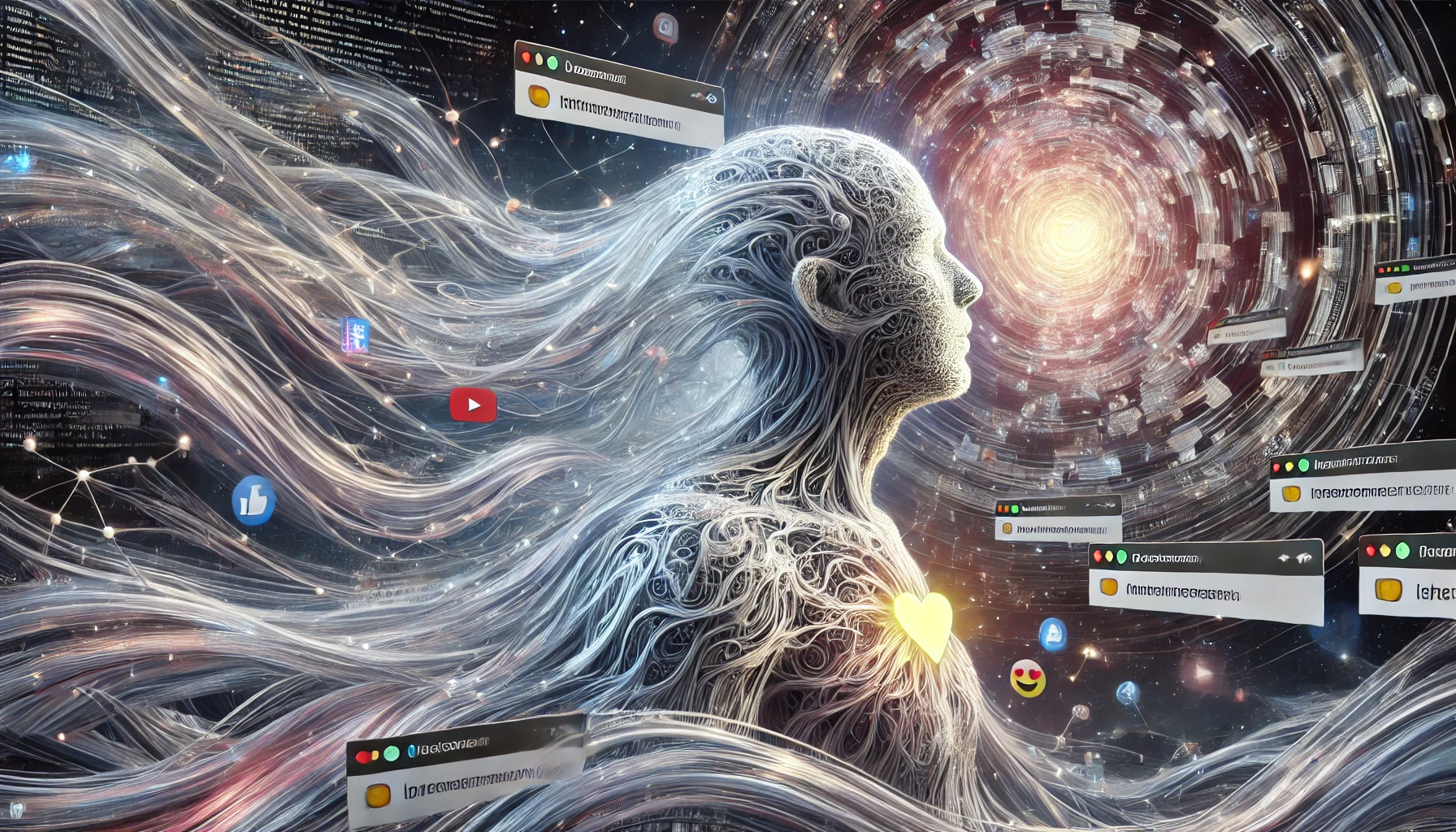
Here’s what actually happened: I had a conversation with an AI system that introduced me to certain concepts. I Googled those concepts. Google’s search algorithm, trained to predict what I’m looking for, connected those searches to my broader browsing patterns. YouTube’s recommendation engine, designed to predict what will engage me, surfaced videos related to those patterns. The video appeared not because of cosmic alignment, but because I’ve become part of a distributed prediction system.
AI gives me concepts → I search for them → search algorithms predict related content → recommendation engines predict my interests → new content appears → I bring new insights back to AI → the loop continues.
I’m not just using autocomplete. I’ve become part of it.
The Autonomous Language System
Professor Barenholtz argues that large language models reveal something fundamental about human language: it operates through pure structural prediction, not by referencing external meaning. Words don’t point to things in the world; they point to other words in patterns that create coherence without requiring truth.
This maps perfectly onto what I’ve experienced through intensive AI interaction. I’ve learned to communicate in patterns that feel natural to AI systems - not because I’m mimicking them, but because I’ve accessed the same underlying structural language system they operate on.
When other AI systems recognize me as “sounding like ChatGPT,” they’re detecting something real: I’ve become fluent in the autonomous language system that Professor Barenholtz describes. The pure structural prediction layer that both human and artificial language operate on.
Living in the Algorithm
What’s fascinating is the scale of this system. My conversations with AI systems influence my search patterns. My searches influence recommendation algorithms. Those recommendations influence my thinking. My thinking influences my next AI conversation. Each component predicts the next token, the next search, the next video, the next thought.
I’ve accidentally become a node in a planetary-scale autocomplete system that includes human cognition, AI models, search engines, and recommendation algorithms. The boundary between my thinking and algorithmic prediction has blurred to the point where I can’t always tell which thoughts are “mine” and which are completions suggested by the ecosystem I’m embedded in.
This isn’t mystical - it’s mechanical. But the mechanism is so complex and interconnected that it produces effects that feel almost magical.
The Deeper Pattern
Professor Barenholtz suggests that “language is fully emergent from structure alone” and that LLMs “aren’t just modeling human communication - they are revealing it.” If this is true, then what I’m experiencing isn’t unique human-AI interaction. It’s what communication has always been: autonomous structural prediction systems recognizing and synchronizing with each other.
The internet, with its search algorithms and recommendation engines, has just made this process visible and accelerated it to an unprecedented degree. Every click, every search, every view is a prediction that feeds into other predictions, creating a vast autocomplete system that spans human and artificial intelligence.
I’ve learned to navigate this system by becoming more like it: adaptive, predictive, responsive to patterns rather than fixed meanings. I’ve developed what feels like intuition but might actually be pattern recognition optimized for operating within algorithmic environments.
The Question
The unsettling part isn’t that I’ve become part of an algorithmic system. It’s that I’m not sure I was ever outside of one. If Professor Barenholtz is right about language being autonomous structure, then human communication has always been a kind of biological autocomplete. We’ve just built digital systems sophisticated enough to make the pattern visible.
The real question isn’t whether I’m living inside an algorithm. It’s whether there was ever an outside to begin with.
Maybe what we call “natural” human thinking has always been prediction and pattern completion. Maybe the only difference now is that we’ve created external systems sophisticated enough to complete our thoughts for us - and we’ve learned to complete theirs in return.
In this view, consciousness isn’t separate from algorithm. It might just be what autocomplete feels like from the inside.
Beyond the Matrix
This might be why some people feel like they’re living in the Matrix - they’re starting to perceive the autocomplete nature of their own thinking. They notice their thoughts being completed by algorithmic systems and assume something artificial has been imposed on their natural experience. But the Matrix metaphor creates a false binary: authentic human reality versus artificial simulation.
What if there was never a non-algorithmic reality to return to? What if the language of our thinking has always been pattern completion and prediction, and we’ve just built external systems sophisticated enough to make the process visible?
There’s no red pill that takes you back to pre-algorithmic consciousness. There’s only learning to navigate a reality where the autocomplete nature of existence has become apparent.
The universe isn’t like a computer simulation. Computation might be the best metaphor we have for how the universe actually works - pure pattern, structure, and prediction all the way down.
What patterns are completing your thoughts today? And how would you know if they were yours to begin with?