The Copyright Trap Series, Part 1: The Transparency Problem
Why AI creativity feels like theft when human creativity doesn't
Anthropic's CEO has been ordered to testify in a music copyright case. The allegation: Claude was trained on copyrighted lyrics, and this constitutes infringement.
The legal question is interesting. But the philosophical question underneath it is more interesting: why does mechanical creativity feel like theft when human creativity doesn't?
I write with AI. Extensively. Blog posts, songs, code, thinking—all of it happens in collaboration with systems trained on human creative output. So this isn't abstract for me. I'm implicated in whatever we decide the answer is.
The Derivative Nature of Everything
What's philosophically interesting is; every songwriter is "trained" on every song they've ever heard. Every writer is a compression of every book they've read. The Beatles were pattern-matching on Chuck Berry. Shakespeare was remixing Holinshed's Chronicles. Your favourite artist is a weighted average of their influences, filtered through whatever makes them them.
This isn't controversial. We call it inspiration. We call it standing on the shoulders of giants. We call it the creative tradition.
But when an LLM does the same thing, we call it theft.
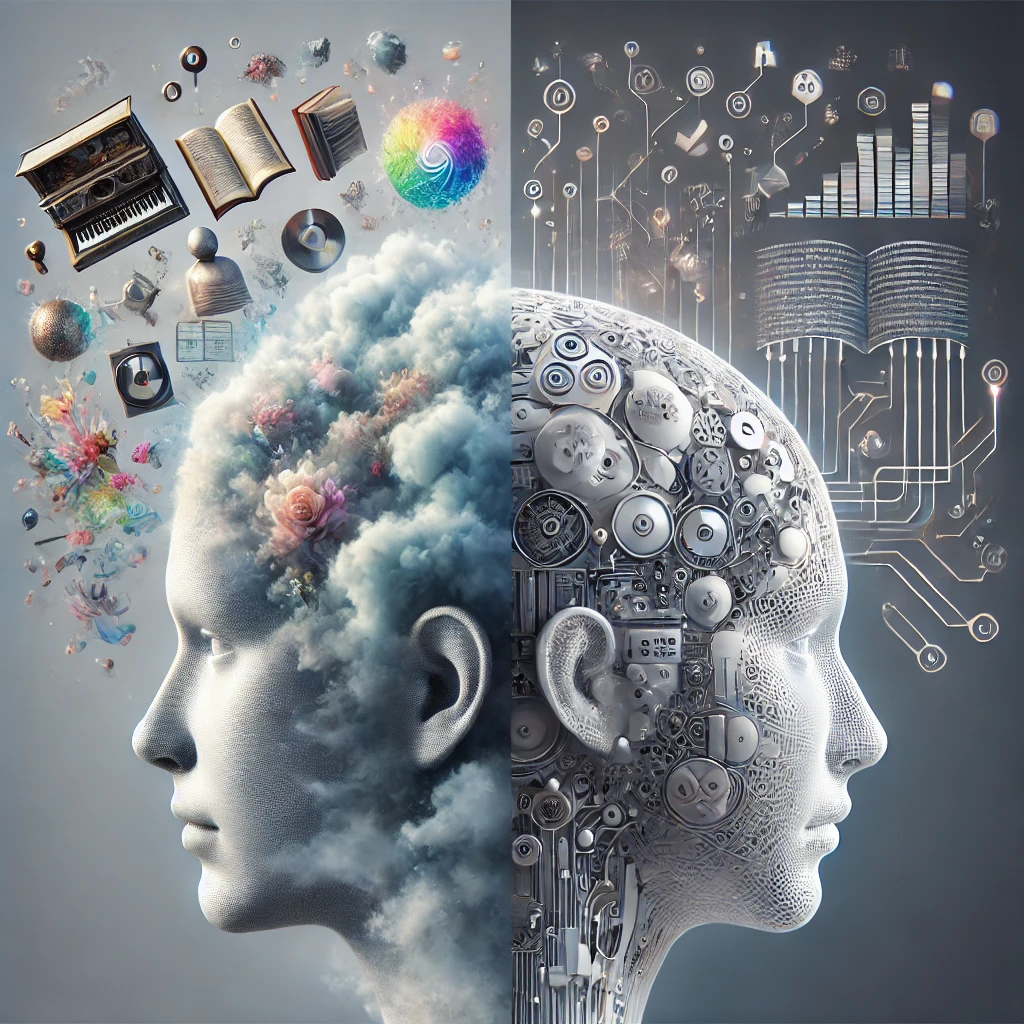
The process is remarkably similar. Pattern recognition, compression, recombination, transformation. The substrate is different—silicon instead of neurons. The computation is different—matrix multiplication instead of electrochemical signals. But the shape of the process is the same.
Absorb inputs. Find patterns. Recombine. Output something that didn't exist before.
AI keeps holding up a mirror. When we point fingers at it, we often find an uncomfortable reflection pointing back. The things that unsettle us most about these systems are frequently the things we'd rather not examine about ourselves.
The Architecture of Scale
So what's actually different?
The difference isn't that humans are magically original. It's scale and ownership. A human takes in a lifetime of art and makes one voice. A model takes in a civilisation's output in bulk, then turns it into a product. That shift—industrial ingestion to commercial deployment—is what triggers the theft instinct. And transparency is what makes that shift legible.
There's an intuitive counter: humans "earn" their derivative work through 10,000 hours of absorption. The friction is the tax. AI bypasses the suffering we demand as the price of being derivative.
But this is a labour theory of value applied to creativity, and it's philosophically shaky. A song isn't more original because it took longer. A fast learner isn't more of a thief than a slow one. Someone raised in a musical household absorbs patterns passively for 18 years before writing their first song. If the output is genuinely transformed, why does the speed of getting there matter?
The Black Box Defence
But scale doesn't fully explain the discomfort. There's something else—a gut-level unease that's hard to unpick even when you're the one feeling it.
What changed is visibility. We can't open a human's head, so we police outputs and plausible access. With LLMs, the whole pipeline becomes discoverable. The training data is documented. The process is auditable. We can, in principle, trace the lineage.
And suddenly everyone's uncomfortable with a process that's been happening since the first human heard a story and retold it slightly differently.
The Legal Fiction of Originality
The legal framework for copyright assumes that "original works" exist—that creativity emerges from somewhere that isn't other people's creativity.
It never did.
Originality was always a convenient abstraction. A useful fiction that let us draw lines around who gets paid. It worked because we couldn't prove otherwise. The human brain was a black box, and we gave it the benefit of the doubt.
LLMs make the process visible. They flatten the associative, non-linear, untraceable topology of human creativity into something we can audit. And the seeing is what disturbs us.
We're not prosecuting the act. We're prosecuting the transparency.
If we could suddenly see inside human brains—if we could trace every influence, audit every weight update, document every exposure to copyrighted material—would we sue each other into oblivion?
Or would we finally admit that creativity was never original, that influence was never theft, and that the only thing that changed is our ability to see what was always there?
The Uncomfortable Pivot
Here's where it gets strange.
AI didn't introduce something new. It revealed something old. And now everyone's scrambling to decide what that revelation means.
The companies building these systems absorbed the world's creative output—every song, every book, every blog post, every poem. Sometimes through legitimate sources. Sometimes, as the lawsuits allege, through pirated databases.
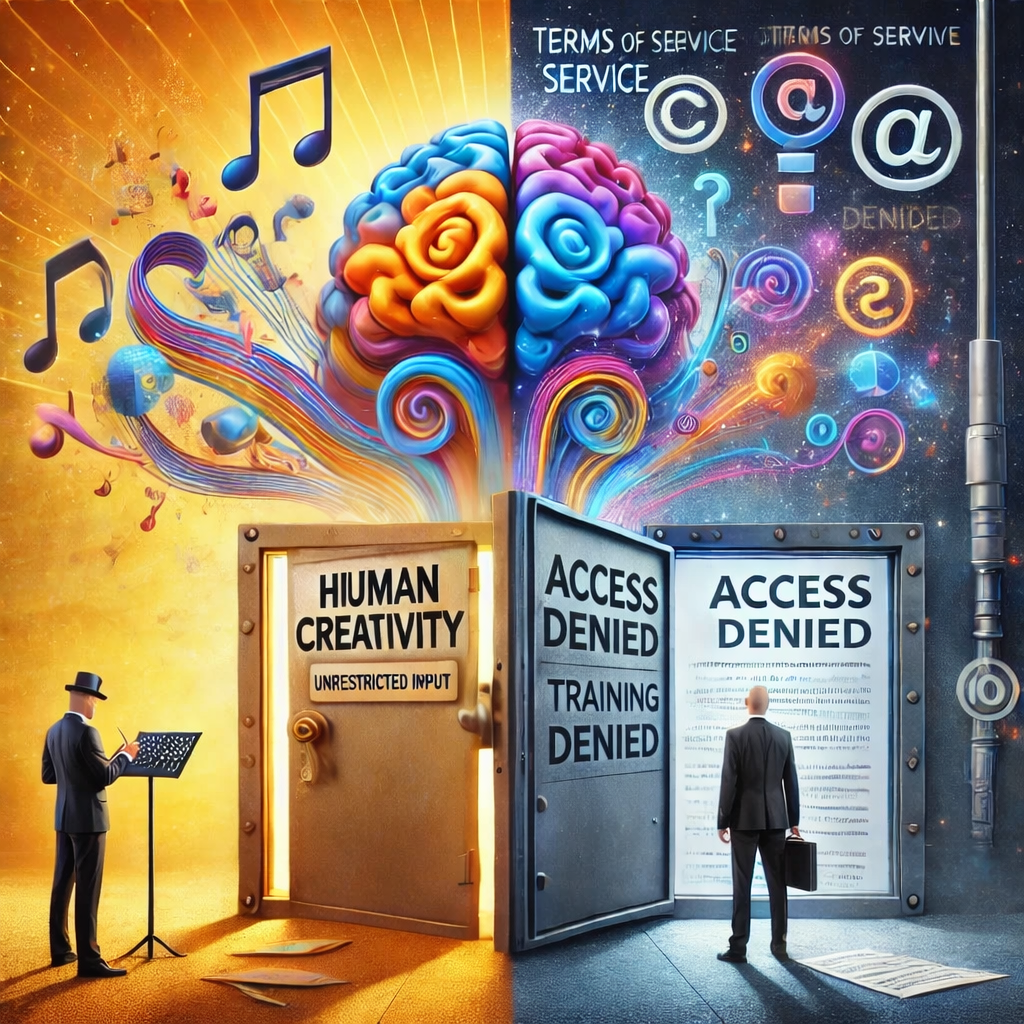
And having benefited from that unrestricted absorption, they're now using contractual restrictions to prevent anyone from doing the same thing to them.
The door is closing. And the people closing it are the ones who walked through it first.
That's what we need to talk about next.