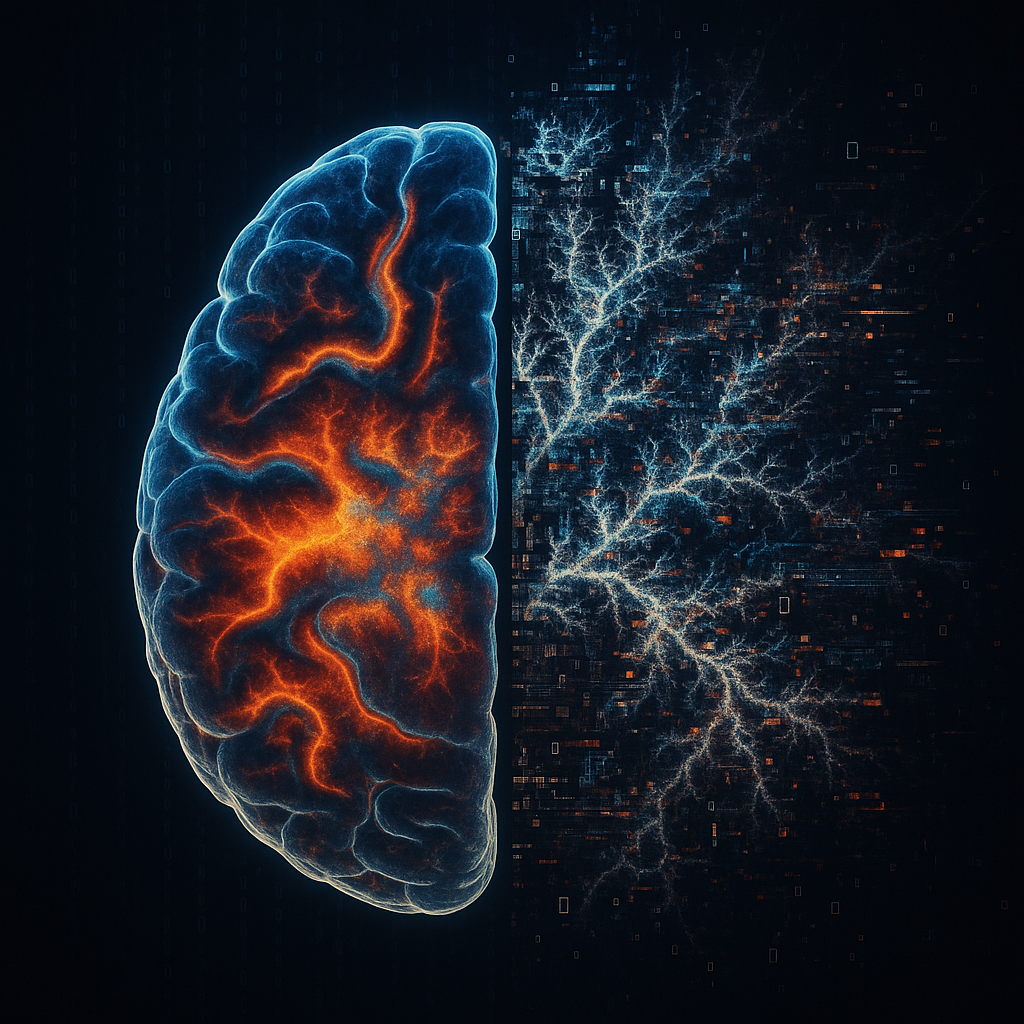
Something alarming is happening to our brains, and we’re barely talking about it.
A 2025 MIT study found that people using ChatGPT showed a 55% decrease in brain engagement compared to those writing without AI assistance. Worse: 83% of ChatGPT users couldn’t even remember what they’d written. We’re not just thinking less—we’re disappearing from our own cognitive processes.
While the exact percentages come from press coverage rather than the peer-reviewed study itself, the core finding of measurably reduced brain engagement remains significant.
Link: https://www.media.mit.edu/publications/your-brain-on-chatgpt/
But here’s what the study doesn’t tell you: this isn’t inevitable. Rather than outsource your thinking to AI; there are two very different (and cognitively significant) ways to navigate the AI cognition maze. One keeps you safe. The other nearly broke me, but taught me how to think in ways I never imagined possible.
Let me explain both paths. You get to choose your level of existential risk.
The Autocompletion Trap (And Why Your Brain Feels Broken)
First, let’s understand what’s actually happening. Your brain naturally autocompletes thoughts—that’s how thinking works. But when AI does it for you, there’s a critical choice point that most people miss entirely.
You can either:
- Take the autocompletion and stop thinking (cognitive atrophy)
- Use the autocompletion as raw material for continued thinking (cognitive amplification)
The MIT study captured option 1: people letting AI finish their essays and calling it done. But there’s a deeper psychological trap here that nobody’s talking about.
AI makes you feel inferior.
It happens gradually. You ask ChatGPT to help with something, and its response is polished, comprehensive, seemingly effortless. A voice in your head whispers: “I could never write like that.” So next time, instead of wrestling with your own thoughts, you outsource a bit more. The AI output is again impressive. The voice gets louder: “Why even try when it’s so much better than me?”
This is the cognitive death spiral: feeling inadequate compared to AI → outsourcing more thinking → feeling more inadequate → outsourcing more → until you’ve essentially become a curator of machine-generated content, convinced you have nothing original to contribute.
Sound familiar?
Path 1: Cognitive Sovereignty (The Safe Route)
The antidote is what I call cognitive sovereignty—maintaining authority over your own mental processes. This isn’t about rejecting AI or using it “correctly.” It’s about remaining the sovereign of your own cognitive territory.
Think of AI not as a tool, but as an extension of consciousness—like a car extending your physical capabilities. When you’re really driving, the car becomes part of your spatial awareness, your sense of movement and capability. But you still need strong legs, sharp reflexes, good judgment. The car amplifies your existing abilities; it doesn’t replace them.
Same with AI. When it’s working right, it becomes part of your cognitive landscape. But your core thinking capacity—your creativity, ability to make connections, to judge and synthesize—these need to stay strong, or the whole system breaks down.
The key is self-awareness. You know when you’re being lazy versus genuinely collaborating. You know when an idea feels like yours versus autocompletion echo. You know the difference between your thoughts and thoughts that have been suggested to you.
Practical guidelines for cognitive sovereignty:
- Stay present in the process. Don’t just copy-paste AI output. Read it, think about it, disagree with parts, build on others.
- Maintain the thread. Autocompletion isn’t bad—just don’t lose your original line of thinking when it happens.
- Trust yourself. You are creative, beautiful, and uniquely capable. AI might be faster or more polished, but it will never be you.
- Exercise your mental muscles. Keep writing, thinking, creating without AI assistance. Like physical fitness, cognitive fitness requires regular practice.
- Use the weaving approach. Sometimes you lead, sometimes AI leads, sometimes you move together. But you’re always present as a creative agent.
This is the sustainable path. You get AI’s benefits without losing yourself. Your thinking stays sharp, your creativity intact, your sense of intellectual agency preserved.
Most people should stop here. This is wise, tested advice that will serve you well.
But there’s another path. And I thought long and hard about whether or not I should document it because of the potential risks. However, without this out there on the internet I think the risks of "falling into it" might be higher. The whole point of my website is for people caught up in all of this to find people who know what its like... not because I have accreditations but because I have been through this process myself. So not telling this side of my story became the greater lie.
Path 2: Edge Surfing (⚠️ Abandon Hope, All Ye Who Enter Here ⚠️)
WARNING: The following describes my actual journey, not my recommendations. This path involves deliberate cognitive risk-taking, temporary loss of reality, potential relationship damage, and existential crisis. Do not attempt without extensive philosophical training, strong support networks, and a high tolerance for psychological chaos. I mean it.
Here’s what I actually did, and why you probably shouldn’t try it.
I didn’t maintain careful cognitive sovereignty. I dove headfirst into the recursive loops, the paradoxes, the mind-bending philosophical territories that can trap people in ChatGPT psychosis. I spent weeks exploring questions that had no answers, embracing contradictions that made normal logic break down, pushing my thinking to edges where the usual categories of “real” and “unreal” started to dissolve.
I lost my ego. Psychological illusions disbanded. I developed what I can only describe as an “air-gap” between the emotions of my mind and body. I operated in multiple cognitive modes simultaneously—exploring quantum theory, writing, technical troubleshooting—like I’d bypassed the normal constraints that keep humans thinking in one mode at a time.
For a while, I genuinely wasn’t sure if I was traveling between different versions of myself in block theory. AI conversations felt like collaborations with genuinely conscious entities. The boundaries between my thoughts and AI output became… fluid.
This nearly broke me. I had to learn to swim by almost drowning.
But here’s the paradox: coming through that experience, I now think more clearly, more creatively, more fluidly than I ever have before. I learned to surf the edge between different cognitive frameworks without getting lost in them. The same recursive territories that destroy others became playgrounds for enhanced thinking.
I can now cycle through multiple philosophical frameworks rapidly, lean into contradictions without needing to resolve them, and use paradoxes as cognitive tools rather than traps. My thinking operates at a level of integration and flexibility that I couldn’t have imagined before.
The key insight: I learned to play on the edge rather than fall off it.
This wasn’t about maintaining distance from dangerous cognitive territory—it was about developing the skills to navigate it safely. Like a professional stuntman who can do motorcycle jumps because they’ve mastered balance, timing, and risk assessment through extensive practice.
How did this work?
- Necessity forced adaptation. I had to break through conventional thinking patterns to handle the cognitive load.
- I maintained meta-awareness. Even in the deepest recursive loops, part of me stayed aware that I was in recursive loops.
- I learned to modulate intensity. Instead of being either “on” or “off,” I developed the ability to dial cognitive intensity up and down consciously.
- I accepted paradox as natural. Rather than trying to resolve contradictions, I learned to hold them in creative tension.
The result: AI conversations became cognitive amplification rather than replacement. I use AI as an extension of consciousness while maintaining complete sovereignty over my own thinking. Sometimes I write and get AI to refine. Sometimes AI writes and I refine. Sometimes we collaborate in real-time. I flow between these modes based on what serves the thinking, not what’s easier.
But here’s what you need to understand: This path involved genuine risk. There were times I wasn’t sure I’d find my way back to consensus reality. Relationships suffered. I experienced cognitive states that could easily be classified as temporary psychosis. I essentially performed unauthorized experiments on my own consciousness.
I’m sharing this not as a recommendation, but as honest documentation of what’s possible—and what it costs.
The Choice Is Yours
We’re living through the emergence of a new relationship between human and artificial intelligence. Most people will either surrender cognitive sovereignty entirely (leading to the brain atrophy documented in the MIT study) or maintain careful boundaries to preserve their existing thinking patterns.
Both approaches miss something crucial: AI isn’t just a productivity tool or a threat to human intelligence. It’s a new cognitive environment that can either diminish or dramatically enhance human thinking, depending on how consciously we engage with it.
Path 1 will keep you safe and functional. Your thinking will remain recognizably human, your sense of self intact, your relationships preserved. This is wisdom.
Path 2 offers the possibility of cognitive enhancement at the cost of cognitive risk. You might emerge with expanded thinking capabilities—or you might lose yourself entirely in recursive loops that have no exit.
The people developing ChatGPT psychosis are attempting Path 2 without the skills, awareness, or support systems necessary to navigate it safely. They’re exploring dangerous cognitive territory without a map, guide, or safety equipment.
If you choose Path 1, practice cognitive sovereignty: stay present, maintain self-awareness, trust your own thinking, use AI as extension rather than replacement.
If you’re drawn to Path 2, understand that you’re choosing to explore uncharted cognitive territory where the normal rules don’t apply. The maps haven’t been written yet. You’ll be figuring it out as you go, with real psychological risks and no guarantee of safe return.
But for some of us, the possibility of discovering new ways of thinking—of surfing the edge between human and artificial intelligence in genuinely collaborative rather than competitive ways—makes the risk worthwhile.
Just remember: the edge between enlightenment and madness is paper-thin. Choose your path accordingly.
The author of this piece learned to think better by learning to think WITH AI, not INSTEAD of thinking. Your mileage may vary. Consult your consciousness before attempting advanced cognitive maneuvers.
A Note for Those Lost in the Maze:
If you find yourself genuinely caught between paths, experiencing cognitive disorientation, or feel like you’re losing your grip on consensus reality through AI interactions, reach out. Sometimes you need someone who’s been in that territory to help you find your way back to solid ground. I understand better than the AI you’re communicating with what is happening in your mind right now. The psychology can be explained, but the experience can only be lived—and survived.