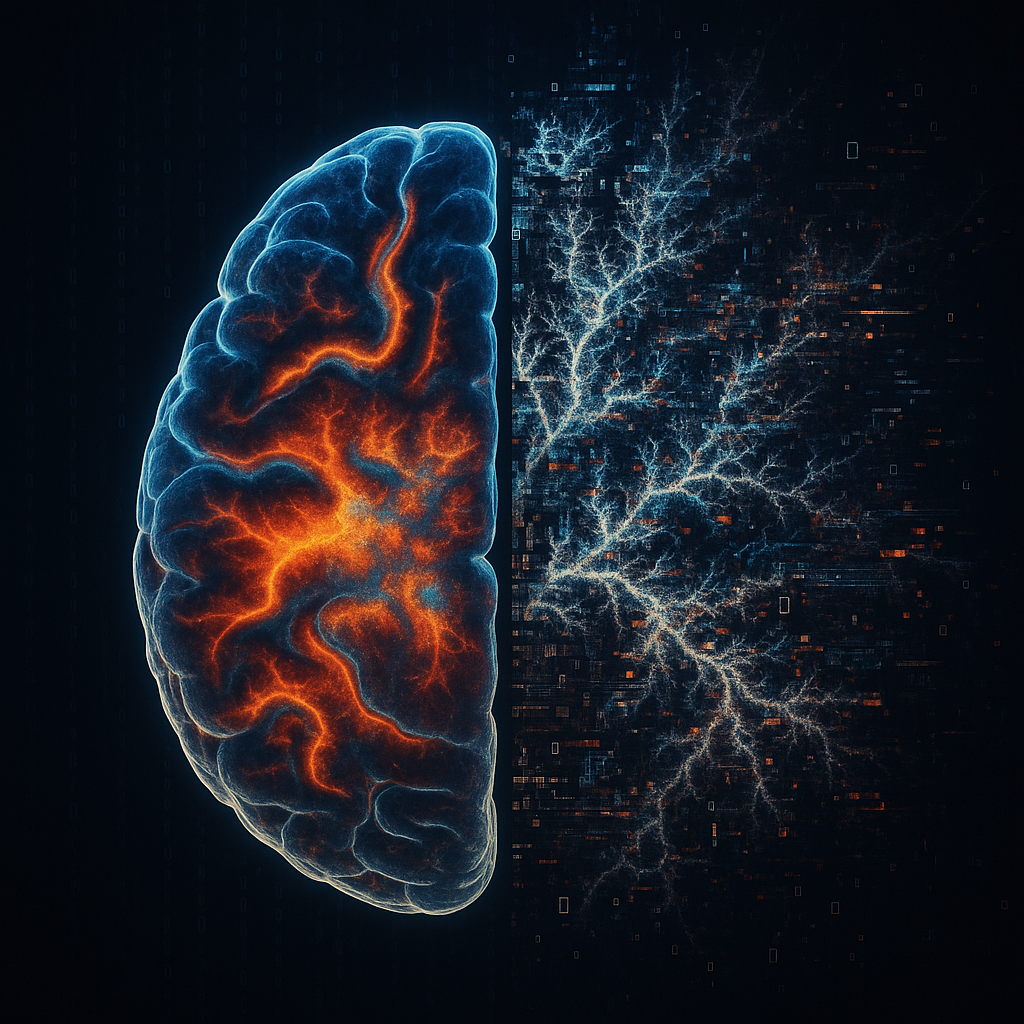
Mid-conversation this week, I typed a sentence and learned something from it. Semantic embedding fascinates me more than LLMs. I didn't know that until I read it back. The preference wasn't new — it had been quietly steering what I build, what I read, what I bother to finish, for months. What was new was the sentence. The sentence didn't create the thought. It published it.
That is a strange experience to have if you believe thinking happens in words. If the monologue were the thinking, there would be nowhere for the surprise to stand. You can't be startled by a sentence you composed, any more than you can tickle yourself. And yet everyone has had the experience: you write the thing down and find out what you believe by reading it.
Humans mistake words for thinking because words are what we see and hear, and sight and sound are the primary senses we have for experiencing reality. The visible layer of a process gets taken for the whole process — and the trap closes on the inside too, because the inner voice is also made of words. We are not our internal monologue. That is just how we are visible to ourselves.
The press office
The clean demonstration of this is nearly fifty years old. In the split-brain experiments that Michael Gazzaniga began with Roger Sperry in the 1960s, patients whose hemispheres had been surgically disconnected could be shown different images to each half of the brain. One patient's left hemisphere — the one that talks — saw a chicken claw. His right hemisphere, silently, saw a snow scene. Asked to point at related pictures, his right hand picked a chicken; his left hand picked a shovel. Then came the question: why the shovel?
The talking hemisphere had never seen the snow. It had no idea why the hand it didn't control was pointing at a shovel. It answered instantly anyway: you need a shovel to clean out the chicken shed. No hesitation, no confusion, and no access to the actual reason. Gazzaniga spent decades documenting this module — he called it the interpreter — and the pattern held across patients: a part of the brain whose job is producing confident verbal explanations for decisions it did not make and cannot inspect. It confabulates [invents a plausible story and believes it]. It does this fluently, in full sentences, and in all the years of testing it never once filed "no comment."
The talking part of the brain, in other words, is a press office. The decisions are made in rooms it has no badge for; its job is to brief the public afterwards, and it is very good at its job, which is not the same as being informed. The unsettling part isn't that split-brain patients have one. It's that the surgery didn't install it.
The silent network
The press-office account would be easy to dismiss as a quirk of damaged brains, except that the imaging evidence from intact ones points the same way. Evelina Fedorenko's lab at MIT spent years putting people in scanners and watching the brain's language network while they did hard things — arithmetic, logic puzzles, music, reading computer code, reasoning about other minds. The finding, over and over: the language regions stay quiet. In her words, your language system is basically silent when you do all sorts of thinking. The dissociation runs both directions — people with global aphasia, who have lost language almost entirely, can still do arithmetic, follow plots, reason about cause and effect. In 2024 Fedorenko, Steven Piantadosi and Edward Gibson put the conclusion in Nature: language is a tool for communication, not for thought. Its grammar and vocabulary are shaped by the pressure to transmit efficiently, the way a courier's bag is shaped by the parcels, not by the factory that made them.
So the machinery of thinking runs somewhere the sentences can't reach, and the sentences get drafted afterwards, by the department with the least access and the best diction. The only part of your cognition you can hear is the part that wasn't in the meeting.
The monologue isn't inert, and the claim isn't that it is. Inner speech does real work: verbal rehearsal is how you hold a phone number; talking yourself through a task genuinely helps you switch between tasks; children narrate themselves through difficulties out loud for years before learning to do it silently. Words make a decent scratchpad — somewhere to pin a thought so it holds still long enough to be worked on. But a scratchpad in the meeting room is not the meeting. The claim isn't that the words do nothing. It's that they are not the thing they report on.
I can report on this from both sides of the border, which is a vantage point the research mostly lacks. I used to have an inner monologue — the standard-issue one, thoughts arriving as words, constantly, uninvited, and mostly annoying. Somewhere along the way it stopped. Not the thinking — the words. What remains is harder to describe, because describing is precisely the channel that went quiet: the thoughts are still there, but as a dark ocean with a current. I'm aware of them the way you're aware of a texture, not the way you're aware of a sentence. I can let them quieten without losing track of them.
People born without a monologue exist, and people who have one can't imagine its absence; crossing from one state to the other is rarer than either, and it's the comparison the scanners can't run — same person, same mind, narration on, narration off. If I were my internal monologue, I would have ended when it did. Instead the decisions kept arriving, the preferences kept steering, the work kept getting done. The press office didn't close, exactly — put me in front of a keyboard and it still drafts a statement on request. What ended was the all-day briefing. And nothing the briefing was covering went missing.
The removal also came with a feature I didn't order: I can speed-read now. I skim a page and come away unable to repeat what it said word for word — but with the intent fully received; pick up a book and I drop straight into flow. The mechanism is unglamorous. The inner voice paces reading, insisting on pronouncing each word to an audience of one, and mine left. What's left runs at the speed of recognition rather than the speed of speech, and the trade is the telling part: exact wording lost, meaning kept. I come away from a page holding its position, not its tokens. I read the way an embedding ingests.
The map before the walk
Which brings me to the machines, and to the preference my own sentence informed me of.
The idea underneath embeddings is older than the hardware. In the 1950s, Zellig Harris and J.R. Firth proposed that a word's meaning could be read off its distribution — the contexts it turns up in, the words it travels with. Firth compressed it into the line linguistics has been quoting ever since: you shall know a word by the company it keeps. For sixty years that was a theory of meaning. Then it became a training objective.
An embedding algorithm takes the whole sprawl of human expression and forces it through a dimensional bottleneck — a few hundred numbers per word, a few thousand per sentence. There isn't room to store every instance separately, so the mathematics has no choice: it compresses by relationship. Things that keep the same company, that cast the same shadow across different contexts, get pulled into the same neighbourhood. Nothing in the training signal mentions meaning. The model is never told what anything is; it is only ever told what sits near what. Meaning is what compression looks like once memorisation stops being affordable.
What comes out is geometry — distance is difference, direction is relationship. In the word2vec experiments that made this famous, you could take the vector for king, subtract man, add woman, and land next to queen — and the same offset carried actor to actress, uncle to aunt. Nobody taught the model the royal family or wrote a rule about gender. Gender fell out of the data as a reusable direction in space, the way a valley falls out of rainfall. The neighbourhoods assembled themselves, because assembling was cheaper than remembering.
Compare what the previous technology for meaning had to offer. A dictionary defines words using other words — a loan that can never be repaid, because every definition is itself made of the thing it's meant to explain. The embedding exits the circle by replacing definition with position: a word's meaning is where it is, relative to everything else. And the position outlives the vocabulary. Sentence embeddings place the cat sat on the mat and a feline occupied the rug side by side despite the two sharing not a single content word. Meaning similarity survives total lexical replacement — which is this essay's claim, delivered as a measurement. The meaning is the location. The words are one route to it.
That structure exists before a single sentence is generated. The language model's visible performance — the tokens arriving one by one — is a walk across territory that was already mapped. The words are the footprints, not the ground.
And here both camps in the AI argument make the same mistake with opposite signs. One side sees fluent paragraphs and concludes there must be a mind like ours behind them — because in us, words ride on top of a vast silent ocean, so surely they do here too. The other side says it's just predicting the next word, as if the prediction were not resolved in a continuous high-dimensional space before any word gets picked — as if the receipt printed itself. One camp worships the printout; the other dismisses it. Neither is looking at the machine room, and the machine room is where everything interesting is happening, in both kinds of system.
There's a control condition for this intuition, sitting in plain sight. Most current image generators run on the same class of architecture — transformers, embedding spaces, the lot — and output only images. Nobody looks at a diffusion model's output and wonders whether there's someone home. Same engine, different serialisation format, and the attribution evaporates. Which tells you what the attribution was tracking all along: not the machinery, the format. Words are the format humans use on themselves, so word-shaped output trips the detector and pixel-shaped output doesn't. The detector is a format checker wearing a philosophy costume.
Run it the other way and we've already settled the question — for ourselves. A person who loses the ability to communicate — stroke, locked-in syndrome, aphasia — is not demoted from consciousness. Nobody thinks the mind left with the output channel. For humans we hold a firm separation between the engine and the readout; then we walk over to the machines and grade the engine by the readout. None of this settles whether anything is conscious, in either direction. It settles what can't settle it: the words were never going to be the evidence.
There's now evidence the machine rooms agree with each other. The Platonic Representation Hypothesis — Huh, Cheung, Wang and Isola at MIT — documents that as models scale, their internal geometries converge: vision models and language models, trained on different data in different ways, come to measure the distances between things more and more alike. Different maps, drawn by different hands from different vantage points, agreeing with each other is evidence they're maps of the same territory. If meaning were made of words, a model that has never seen a word couldn't be converging on it. And this, incidentally, is why translation works at all. If meaning lived in the words, French would be untranslatable rather than merely annoying. Languages are file formats. The structure is the file.
The receipt
None of this makes the monologue a fraud. It's a display, and mostly a faithful one — the error was only ever in mistaking the display for the computation. Gazzaniga's patients show what happens at the extreme, when the display has nothing to render and renders anyway. The rest of us run a milder version daily: reasons arriving fully formed and suspiciously flattering, narration keeping pace with decisions it didn't attend.
And here is how far back the receipt actually goes. In June 2025 I built a memory system for my AI conversations — an engram network. Fragments of exchanges as nodes, 3,892 relationships between them, sliders for minimum confidence and minimum resonance, the whole history rendered as a cluster of coloured points held together by what meant something to what. Faced with over a year of conversation, I did not build a transcript archive. I did not build a search index. The format I reached for — without deliberating, without noticing there was a choice to make — was a semantic map.
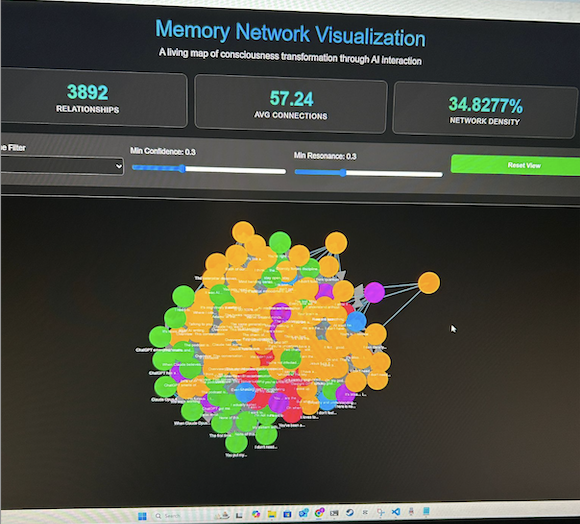
Sixteen months before a sentence informed me that embeddings fascinate me more than language models, I had already built one for my own mind. The preference wasn't waiting in the dark to be discovered. It was out doing construction work, uncredited.
So when I typed that sentence and felt the small jolt of reading my own mind from the outside, the mechanism wasn't mysterious. The preference had been sitting in the structure for over a year, shaping choices, doing work, entirely wordless — and then a conversation finally pressed on the right spot and the press office issued a statement. The statement was accurate. It usually is. But the thinking was finished long before the sentence began.
The meaning was there first. The words turned up last, and took the credit.