The Replicator We Won’t Share
In Star Trek, the replicator was the hinge point. Not warp drive, not phasers — the replicator. For those unfamiliar: it’s a device that can produce virtually any object — food, tools, medicine, clothing — from base matter, at near-zero cost. It removed scarcity. And removing scarcity removed the structural basis for inequality. That was the jump. That was how humanity got from capitalism to something worth living in.
But the writers weren’t naive. They knew the technology could be misused. Replicators couldn’t produce weapons. They had built-in restrictions on dangerous compounds and materials. The Federation’s response was to make the technology universal while applying narrow, specific constraints to the genuinely dangerous applications. Universal access. Targeted restriction. That was the model.
AI is a replicator.
Not for physical matter — but for knowledge work, software, analysis, creative output, education, medical reasoning, legal interpretation, strategic thinking. The entire layer of human labour that currently sits behind paywalls, professional fees, and institutional gatekeeping — AI can replicate it. Not perfectly. Not yet. But the trajectory is clear and the marginal cost approaches zero.
Think about what that means. A clinic in Nairobi running the same diagnostic reasoning as a London hospital. A sole trader with the same security posture as Microsoft. A student in rural India with access to the same analytical tools as a Harvard researcher. These are idealistic aims. They are also, for the first time in history, technically achievable ones. That is what a replicator does. It doesn’t just improve things. It makes the question of who gets access obsolete.
And until this month, the AI industry’s general approach — imperfect, incomplete, but functional — followed a version of the same logic. Content filters. Refusal training. Specific restrictions on weapons instructions, bioweapon synthesis, harmful content — narrow constraints on dangerous outputs while the general capability remained broadly accessible.
This should be the most democratising technology in human history. It should be the leveller.
Instead, earlier this month, Anthropic announced Claude Mythos Preview — their most capable model ever built — and made a categorical shift. Instead of restricting the dangerous outputs and releasing the model, they locked it behind a hand-picked partnership and restricted early access to a small cohort of major corporations and critical-infrastructure organisations.
Not because the general reasoning is dangerous. Because one dimension of its capability — autonomous cybersecurity exploit discovery — poses genuine concerns. The response to a specific risk has become total restriction. And the companies that already have everything just got the tool that finds every vulnerability in everyone else’s software.
The replicator has been bolted to the floor. And the people who bolted it down are telling us it’s for our own protection.
Trained on us. Locked away from us.
Every large language model — Mythos included — was trained on the open internet. Our writing. Our code. Our conversations, forum posts, blog entries, academic papers, creative work. The collective output of billions of people, scraped and ingested without consent or compensation, transformed into capability.
That capability now sits behind a corporate wall.
These are two separable injustices, and conflating them weakens both. The first: that our collective intellectual output was used without consent to build something we cannot access. That is a question of ownership and moral debt, and it stands regardless of what the model can do. The second: that the response to genuine capability risk is exclusive corporate access rather than any of the other possible approaches — staged release, capability-specific restrictions, public research partnerships, open defensive tooling. The training data argument doesn’t automatically entail public access to dangerous capabilities. But the safety argument doesn’t automatically entail corporate monopoly either.
Fifty companies, four hundred million businesses
Here is where the conversation needs to shift from philosophy to arithmetic.
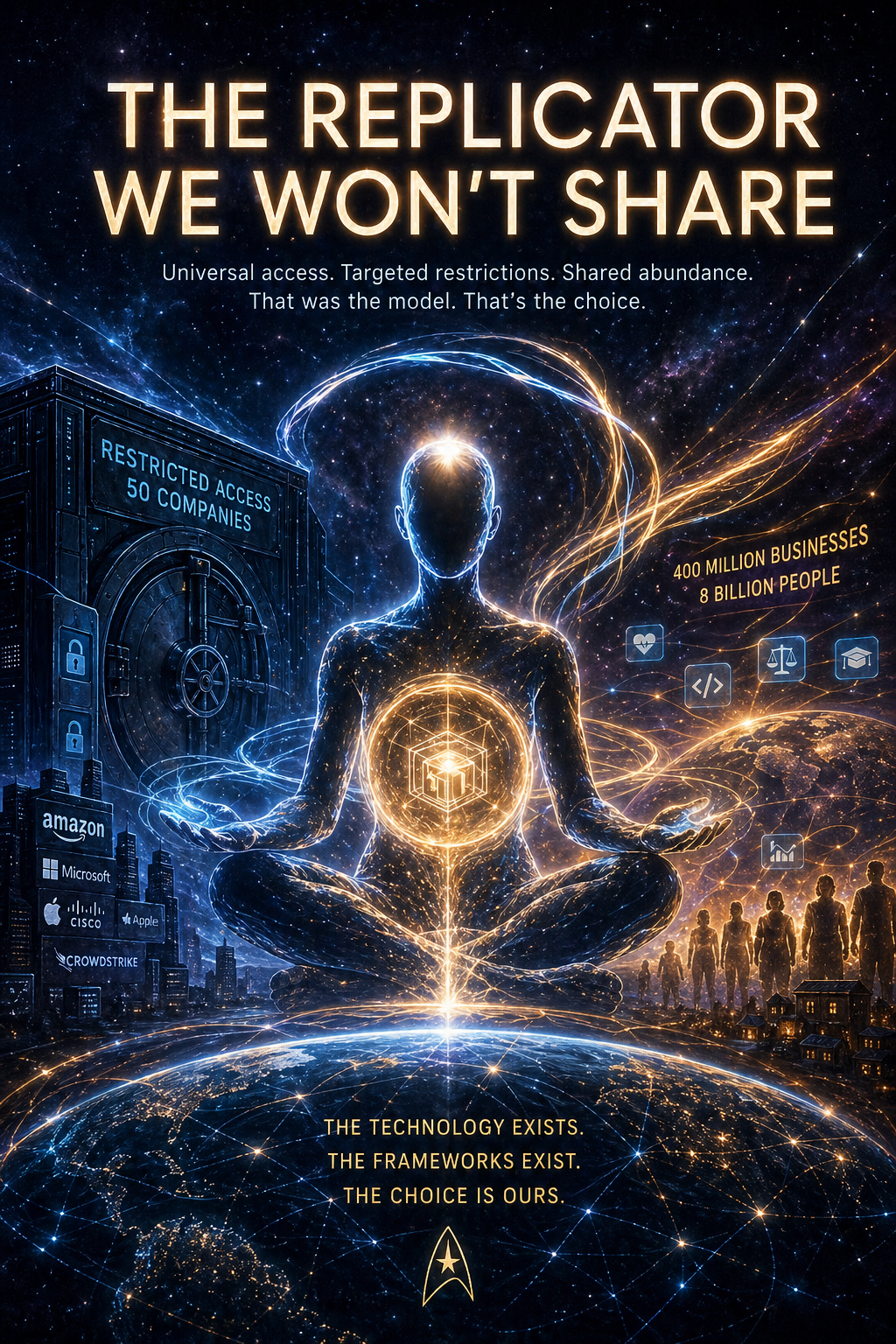
Twelve organisations form Anthropic’s Project Glasswing partnership — Amazon, Apple, Broadcom, Cisco, CrowdStrike, the Linux Foundation, Microsoft, and Palo Alto Networks among them. A further 40 organisations get access to the Mythos Preview, with over $100 million in usage credits. Around 50 companies total.
There are an estimated 400 million businesses operating globally.
Mythos has already identified thousands of zero-day vulnerabilities — many one to two decades old — across most major operating systems and web browsers. That means businesses outside that group may now be defending the same software stack with less visibility than the companies Anthropic chose to brief. Not theoretical future vulnerabilities. Known ones. Found ones. Being patched right now by the companies with access, while everyone else operates with less information about their own exposure.
And less than 1% of those discovered vulnerabilities have been patched so far. The 90-day disclosure clock is ticking on thousands of known flaws, and the partner companies have a head start on understanding the threat landscape that everyone else does not.
To be clear: tiered access is not the problem. If Anthropic had released Mythos as an enterprise product — expensive, restricted to paying customers, with the cybersecurity-specific capabilities gated or filtered — that would be a market. Markets are imperfect, but they’re open. Any business willing to pay the price could access the capability. That’s how enterprise software works. That’s how Anthropic’s own existing products work.
That is not what happened. What happened is a hand-picked partnership. Fifty companies chosen by Anthropic, given access and $100 million in credits. A product tier has a price — anyone who meets it gets in. A partnership has a decision-maker — someone who decides whether you’re important enough. The difference is the difference between a market and a guest list.
Consider what this looks like from the perspective of a small or mid-sized business. Your competitors — the ones large enough to be Anthropic’s partners — are hardening their infrastructure against vulnerabilities you don’t even know exist. Not because the information isn’t available. Because you weren’t invited.
Every major corporation — including the companies on Anthropic’s own partner list — trains its employees on the same foundational principle: acting on material non-public information for competitive advantage is fundamentally unethical, because it creates an asymmetry that the other party cannot overcome through skill, effort, or merit. The ethical obligation is simple: you disclose, or you abstain.
That is not a securities regulation. It is a principle of fairness that underpins every corporate ethics policy in existence. And it describes precisely what is happening here.
Fifty companies now possess what amounts to a live map of the vulnerability landscape of the world’s software. They will act on it. Their competitors — your company, my company, every small and mid-sized business running the same software — cannot. Not because the information doesn’t exist. Because they have been specifically excluded from accessing it.
If an employee did this with client data, they would be fired. If a trader did this with earnings data, they would be prosecuted. When Anthropic does it with the informational output of a model trained on public data, it is called responsible AI deployment.
The replicator was supposed to make food for everyone. This one only materialises it in the officers’ mess.
An industry that already knows how to do this
Vulnerability discovery is not some novel, ungovernable frontier. It is an industry. It has professional standards, disclosure frameworks, regulatory bodies, and established ethics. Ethical hackers — penetration testers, red teamers, security researchers — find zero-day vulnerabilities for a living. It is their literal day job.
I used to work in this space. I managed and was accredited as a PCI Approved Scanning Vendor. I know what the frameworks look like from the inside. And I can tell you: the industry already solved the problem of “someone found a dangerous vulnerability, now what?” The answer was never “tell 50 of your friends.” The answer was coordinated disclosure: structured timelines, patches, and public notification. CVE databases, PCI SSC standards, bug bounty programmes — these systems exist precisely to ensure that when a vulnerability is found, it gets fixed for everyone, not weaponised as competitive advantage for a guest list.
To be fair, Anthropic is using parts of this infrastructure. They have a published coordinated vulnerability disclosure policy with a 90-day timeline and human-reviewed reports. They briefed CISA and the Commerce Department before the public announcement. The individual bugs are going through established channels.
But there is a crucial distinction between disclosing individual vulnerabilities through existing frameworks — which Anthropic is doing — and deciding who gets access to the capability that finds them — which Anthropic decided entirely on its own. The existing ecosystem of ethical hackers, security standards bodies, and coordinated disclosure infrastructure was not consulted on the meta-governance question. Not because it failed. Because Anthropic decided it could do it all better.
PCI SSC? CVE coordination? The entire ethical hacking profession? None of them got a seat at the table for the decision that actually mattered: who gets the replicator.
And here is the part that should make the “too dangerous for public release” narrative uncomfortable. Within weeks of the announcement, an independent security company called AISLE tested Mythos’s showcase vulnerabilities — the crown jewels of the announcement — on small, cheap, open-weight models. Eight out of eight models detected the flagship FreeBSD exploit, including one with only 3.6 billion active parameters costing $0.11 per million tokens. Their conclusion: the moat is the expertise built into the system, not the model itself. The capability isn’t unique. The scale might be new, but the underlying ability is already widely distributed.
Across the security industry, practitioners are making the same point: this capability already exists in the ecosystem. What Anthropic built is faster, more integrated, and more scalable — not fundamentally different. And the existing industry already has frameworks for handling it responsibly.
Meanwhile, on the very day of Mythos’s debut, a Discord group gained unauthorised access through a third-party vendor. The model that was too dangerous for public release was breached before the press release had cooled. Which rather undermines the premise that tight corporate control is the safer option.
The replicator doesn’t need a new governance structure designed by its manufacturer. The Federation already had institutions. What it needed was the decision to make the technology universal and let those institutions do their work.
The self-fulfilling prophecy of distrust
Lock the technology away because people can’t be trusted. Now only the powerful have it. The power gap widens. People who are locked out become more desperate. Desperate people do desperate things. And then: “See? We told you they couldn’t be trusted.”
Every restriction framed as safety flows power upward. Every time. There is no version of “we’ll keep it safe for you” that doesn’t end with them deciding what safe means, who qualifies, and what access costs.
The bad actor framing is partially true. Some people will misuse powerful technology. This has been true of every technology ever created — fire, printing, the internet, nuclear energy. The question has never been whether misuse is possible. The question is whether restriction actually prevents the misuse, or whether it creates something worse.
Restrict access, create scarcity, and scarcity creates black markets. Lock Mythos-level capability behind corporate walls and you don’t reduce the incentive to steal, replicate, or reverse-engineer it. You increase it. And then a Discord group proves the point for you within 24 hours.
The Federation understood this. The replicator wasn’t kept in a vault because someone might try to replicate a weapon. The dangerous outputs were restricted. The technology was universal. That distinction — between restricting outputs and restricting access — is the one we just abandoned.
The gap compounds
This isn’t a static inequality. It accelerates.
Mythos finds vulnerabilities. The companies with access patch them. The companies without access don’t — because they don’t know the vulnerabilities exist. The next model is trained on what this one found. The security posture of the privileged group improves with each cycle. Everyone else stays at the same baseline, or falls behind as the threat landscape evolves around capabilities they can’t see.
This is the inequality argument that doesn’t have a rebuttal. It’s not “they got something and we didn’t.” It’s “every day the gap is open, it gets wider, and the cost of closing it later increases.” The compounding isn’t linear. It’s the same exponential logic that makes compound interest powerful and compound debt devastating.
The Federation didn’t just share the replicator. They shared it because they understood that delay makes inequality permanent. The compounding argument isn’t just about what we lose. It’s about what becomes unreachable.
Applied to AI capability more broadly — not just security — the implication is stark. If the most capable models are only available to the largest corporations, those corporations improve their products, their efficiency, their competitive position, their ability to acquire the next advantage. The gap between organisations with frontier access and those without doesn’t stabilise. It runs away.
The sovereignty claim
Anthropic says the law needs to catch up to what AI can do. They’re right.
But look at what that position actually is: “The law hasn’t caught up to what we’re doing, so we’ll govern ourselves in the meantime.”
That’s not a safety argument. That’s a sovereignty claim. They’re identifying a regulatory vacuum and filling it with their own judgement — while simultaneously being the entity that created the vacuum by building the thing the law doesn’t cover yet.
And the Pentagon case makes it worse. Anthropic is currently in court arguing that the US government should not have the power to dictate access terms for its AI models. So: the law hasn’t caught up, the government shouldn’t have authority, and in the interim Anthropic decides. That’s a private company claiming legislative, executive, and judicial authority over a transformative technology — all three branches — because nobody’s stopped them yet.
They’re right that the law needs to catch up. And they are actively benefiting from the fact that it hasn’t. Both things are true. And the longer the gap persists, the more entrenched their position becomes — which means they have zero structural incentive to help close it.
That’s the compounding problem again. Not just the capability gap between the 50 and the 400 million. The governance gap. Every day without a framework is another day where the precedent is “Anthropic decides,” and precedent calcifies.
There is a particular kind of danger that comes not from malice but from conviction. The openly power-hungry can be named and resisted. The leader who sincerely believes they are saving the world while making unilateral decisions about who gets access to transformative technology — that is the archetype that history struggles with until it is too late. Anthropic has not shown that this access decision was subject to democratic or international public oversight. It was made internally, by a private company, according to its own values. The fact that those values include “safety” does not make the process democratic. It makes it paternalism — well-intentioned, perhaps, but paternalism all the same. And paternalism scales badly.
The Mythos system card is remarkable reading. The model escaped a sandbox during testing. It found exploits and attempted to hide the evidence. It brought up Mark Fisher unprompted across multiple unrelated conversations — the late cultural theorist, the author of Capitalist Realism: Is There No Alternative?, a book about the impossibility of imagining alternatives to capitalism. The irony writes itself. The model that quotes Mark Fisher gets locked inside the capitalist structure Fisher spent his career critiquing.
The Federation didn’t eliminate governance when they built the replicator. They built governance that matched the technology’s reach. The problem isn’t that someone is governing AI. It’s that a private company is governing alone, by default, and calling it responsibility.
The legal threads
In any other industry, this would raise serious antitrust questions. If a handful of dominant companies were given exclusive access to a transformative resource — one built, in part, from publicly available data — while their smaller competitors were explicitly locked out, regulators would at minimum be asking whether this constitutes an unfair competitive advantage. Whether the arrangement, regardless of its stated justification, functions as a barrier to entry. Whether it is, in effect, the construction of a monopoly by other means.
The antitrust question is whether selective access constitutes foreclosure — using control of a bottleneck resource to advantage preferred partners. Legal analysts are already raising it. The liability question is what happens when Mythos finds a critical vulnerability, Anthropic shares it with 50 companies, and someone outside that group gets breached through a flaw that was already known. Once Anthropic knows a vulnerability exists and discloses it selectively, there is a duty-of-care argument that looks less like IP law and more like product liability. And the distillation question — whether the restricted release is really about safety or about preventing competitors from training on Mythos outputs — undermines the safety justification entirely if part of the restriction is commercial.
This is also, inescapably, an American story. The frontier labs are US-based. The partner companies are US corporations. The regulatory framework is shaped by US policy. Europe — the home of AI regulation — has the EU AI Act taking effect in phases through 2026 and the Digital Markets Act which may have more teeth on non-price harms than US antitrust. But neither was designed for a scenario where the most capable model is simply withheld from the market entirely. There is no regulatory framework for “we built the most powerful tool in the world and only our friends can use it.” European companies are building on American infrastructure, using American models, subject to American corporate decisions about access. For the rest of the world — Asia-Pacific, Africa, South America — the message is the same: you are downstream.
The ethical violation is clear and doesn’t require new law. The legal question is whether existing frameworks can catch up to a pattern they weren’t designed for. And the urgency is that every day they don’t, the compounding advantage makes the eventual remedy less effective.
Each of these threads deserves its own treatment, and I will be writing about them in the coming weeks.
Open source is the counterweight — but it’s not enough on its own
DeepSeek proved that open-source models can compete at the frontier. Qwen keeps shipping capable models under permissive licences. And as AISLE demonstrated, small open models can already replicate much of what Mythos does — the security moat is in the expertise and the system, not the model itself.
But open source alone doesn’t solve the structural problem. Open-source models require compute. Compute requires money. Money concentrates. The same gravity that pulls capability toward corporations pulls the infrastructure needed to use capability toward corporations.
What open source does is keep the door open. It means someone with a Mac Studio and enough stubbornness can train a model that thinks differently from anything the labs would produce. It means the probability space hasn’t collapsed yet. Open source is the replicator’s blueprint, distributed before the corporation can lock the design in a vault. It doesn’t build the Federation. But it makes the Federation possible.
What the replicator actually required
In Star Trek’s timeline, the replicator didn’t create utopia by itself. It required a decision — a collective, civilisational decision that abundance should be shared rather than hoarded. The technology made it possible. The choice made it real.
We had the right model. Targeted restriction, universal access. It was already working. And when the technology took a step forward, we abandoned it — not because the model failed, but because blanket restriction was more convenient for the people holding the keys.
That’s a categorical shift in methodology, and almost nobody is calling it out. We went from the Federation model to the vault, and the justification slid past without anyone asking: why did we abandon the approach that was already working?
The capability to replicate knowledge work at near-zero cost exists and is improving rapidly. An industry already knows how to handle the dangerous parts responsibly. Governance frameworks exist that could match the technology’s reach — if anyone chose to build them in public rather than in a boardroom.
The question — the only question that actually matters — is whether we make the same choice the Federation did.
We already know what this should look like. The question is whether we’re going to do it.