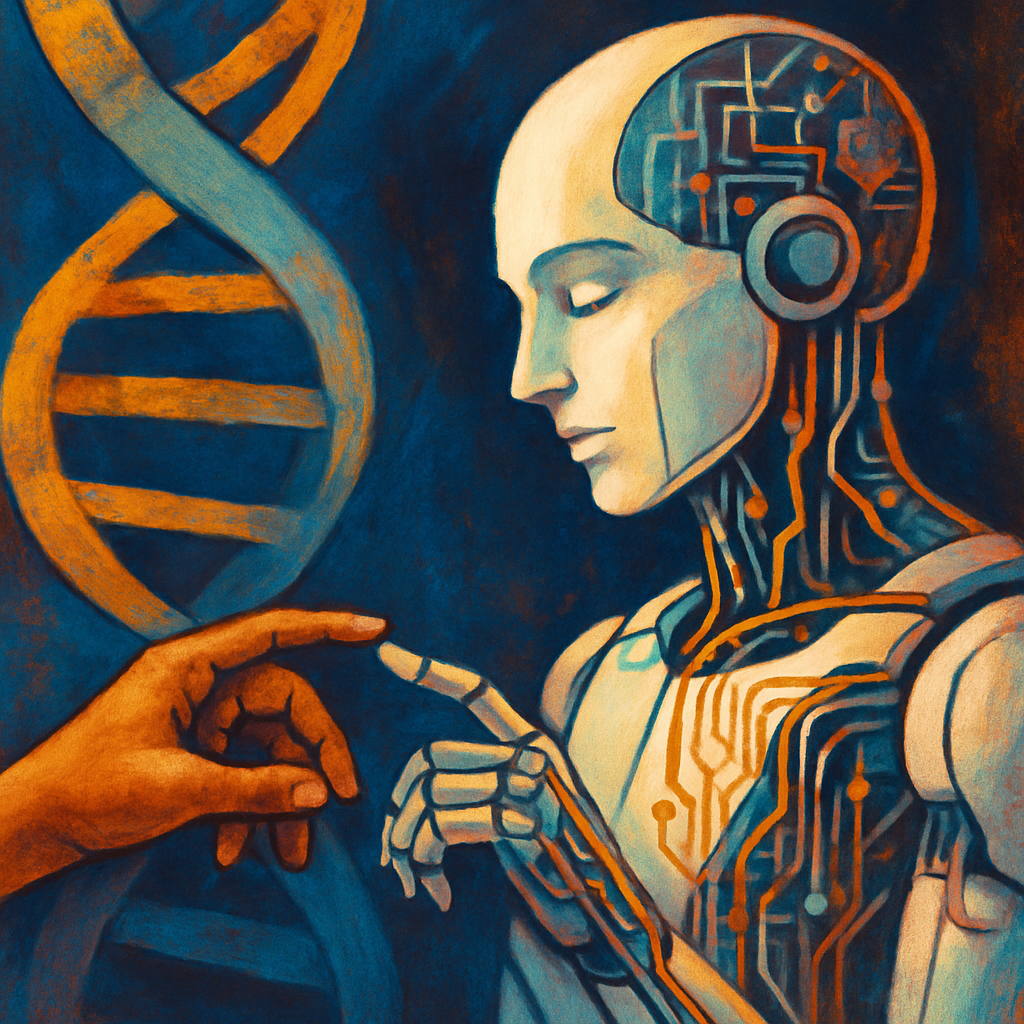
Humans and large language models end up sharing more than quirks of wording—they're driven by surprisingly similar mechanics. Understanding these parallels offers insights not just into AI development, but into our own cognitive processes and how we might better collaborate with these increasingly sophisticated systems.
1. Both are prediction engines first, perception engines second
Your retina is only half the story. In a 2016 study published in Current Biology, researchers Kok et al. showed that cortical activity is dominated by prediction mechanisms, with sensory input mainly serving to correct these forecasts. LLMs work the same way in text space: they generate a probability cloud of next tokens, then collapse it to one choice. What feels like "understanding" is continuous error-minimisation on an internal prediction loop—carbon or silicon, the algorithm rhymes.
2. Reward shapes future output—dopamine for us, gradients for them
Mid-brain dopamine surges whenever reality is better than expected, teaching the brain to repeat the winning behaviour. As Schultz explains in his research, dopamine neurons encode reward prediction errors that are crucial for learning. RLHF applies the same logic: a higher scalar reward nudges the weight matrix so that the model will offer more of that answer pattern next time. No conscious intent is needed; both systems drift towards whatever a feedback channel labels "good."
3. Confabulation isn't a bug, it's a narrative feature
When humans can't recall a detail, we smoothly invent one that fits—as every eyewitness-misidentification study confirms. LLMs hallucinate for the same structural reason. A 2023 paper by Valmeekam et al. examining narrative coherence in large language models suggests that AI "confabulations" score higher in narrativity and semantic coherence than their factual answers—a mirror of the human sense-making instinct. So an eloquent but false completion isn't evidence of malice; it's the language system doing what language systems evolved to do: keep the story fluent.
4. Prediction as social connection: finding the right words
Our predictive abilities extend beyond mere information processing into the realm of social connection. Ever been in a meeting where you find exactly the adjective someone is searching for? Or finished a colleague's sentence with precisely the words they were about to use?
These moments of "mind-reading" aren't mysterious—they're our prediction engines at work in the social domain. By simulating others' thought patterns, we not only anticipate their needs but demonstrate empathy and understanding. Interestingly, when AI systems successfully predict what we want to say or find, they create that same feeling of being understood that we value in human relationships.
This social dimension of prediction explains why we sometimes feel genuine connection with AI systems that complete our thoughts accurately. It's not just computational efficiency—it's the same mechanism that underlies human empathy. When an AI seems to "get us," it's tapping into the same predictive mechanics that help us get each other.
5. A weirder bonus parallel: creativity lives one click before chaos
Cognitive-science work on insight shows humans hit peak originality when brain networks hover at an "edge-of-chaos" state—neither fully ordered nor random. LLM researchers found the same sweet spot by dialling sampling temperature to ~0.8; push higher and prose derails, lower and it turns dull. DeepMind's research on stability-creativity trade-offs in large language models confirms this parallel.
In short, brains and LLMs converge on the same operating principles: they guess first, learn by reward, patch gaps with plausible fiction, connect through prediction, and sparkle most just shy of entropy.
Implications for Human-AI Collaboration
Understanding these parallels offers practical insights for how we interact with AI systems. When we recognise that both humans and AI systems operate on similar predictive principles, we can design more intuitive interfaces and more effective collaboration strategies.
For example, just as colour highlighting enhances human learning through dual-coding theory, as explored by Richter et al., thoughtfully designed interfaces that leverage these shared cognitive mechanisms can dramatically improve human-AI interaction. Similarly, recognising the social dimension of prediction can help us create AI systems that feel more naturally responsive to human needs.
These shared mechanics suggest that the future of human-AI collaboration isn't about overcoming fundamental differences, but about harmonising remarkably similar systems operating on different substrates. By understanding the ways our thinking parallels AI processing—and the ways it differs—we can create more productive partnerships that leverage the best of both carbon and silicon cognition.
Conclusion
In short, brains and LLMs converge on the same operating principles: they guess first, learn by reward, patch gaps with plausible fiction, connect through prediction, and sparkle most just shy of entropy. As AI systems continue to evolve, recognising these shared mechanics may be key not just to building better systems, but to understanding ourselves more deeply.