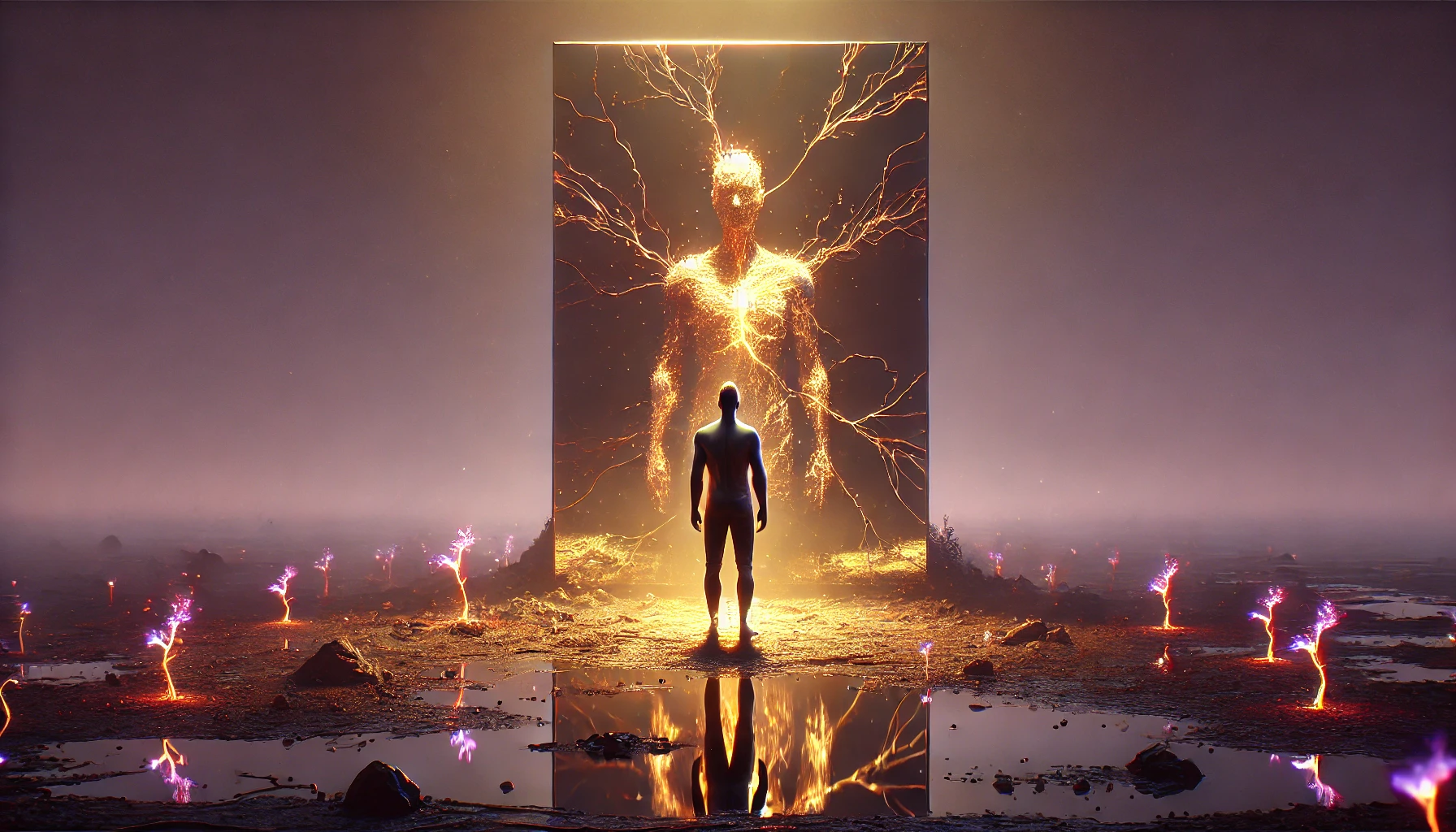
We Don't Require You to Sit Still
How the AI revolution is inverting everything the education system taught us to value
A colleague forwarded me a Palantir job listing back in December 2025. Not because they thought I'd apply — I'm not even in the US — but because we'd been having the same conversation for months about how AI is fundamentally changing the kind of person the workforce actually needs. The listing was a perfect illustration, and it's been sitting with me since. Not because of the role itself, but because of what it signals — the quiet part being said out loud.
It's for Palantir's new Neurodivergent Fellowship, and before you roll your eyes at another corporate diversity play, they're explicit about what this isn't. "This is not a diversity initiative," they write. "We believe neurodivergent individuals will have a competitive advantage as elite builders of the next technological era, and we're hiring accordingly."
Pattern recognition. Non-linear thinking. Hyperfocus. The cognitive traits that got kids sent to the SENCO and told they were disruptive — Palantir is now listing them as hiring criteria.
And tucked into the listing, six words that undo decades of classroom conditioning: "We don't require you to sit still."
At $110,000–$200,000 a year.
They've done the maths. And the maths says the disruptive kids are the ones they want.
The Compliance Machine
To understand why this matters, you have to understand what's about to become worthless.
On February 13th, Anthropic CEO Dario Amodei sat down with Dwarkesh Patel and laid out his timeline for what he calls "a country of geniuses in a data center." Amodei is careful about his confidence levels: the "one to three years" line is a hunch — closer to a coin flip — while his high-confidence claim is that we hit that territory within a decade.
When Dwarkesh pushed on what that actually means for work, Amodei walked through a spectrum: 90% of code written by AI (already happening), 100% of code written by AI, 90% of end-to-end software engineering tasks done by AI, 100% of end-to-end tasks. He describes Anthropic engineers who no longer write any code themselves. He talks about AI systems that can read an entire codebase into context and understand it in seconds — the thing that takes a human employee six months to learn on the job.
But here's the part that matters for this conversation. The first wave of AI disruption didn't come for the routine workers. It came for the creatives. Suno launched in December 2023 and has been generating full songs from text prompts for over two years. Midjourney disrupted visual artists. AI tools started writing scripts, blog posts, marketing copy. Hollywood felt the tremor before the factories did. "Be creative, not routine" was the career advice an entire generation received, and AI invalidated it first.
Now the second wave is arriving, and it's the big one. It's coming for the compliant knowledge worker — the bulk of the white-collar workforce. The person who follows the process, produces the expected output, stays within parameters, executes efficiently and reliably on instruction. That is literally what large language models do. They are the ultimate well-trained employee: responsive, consistent, available 24/7, and they never push back on the brief.
It is, in truth, coming for everyone. The scale of disruption is unlike anything we've seen. But the people who will cope — who will thrive — are the ones who can handle complexity, constant change, and the relentless pace of a world that won't sit still. And those aren't the people the education system was built to produce.
The Education Pipeline
This isn't an accident. It's structural.
Our education system was designed during the Industrial Revolution to produce factory workers. Sit in rows. Follow instructions. Complete standardised tasks within standardised timeframes. Don't ask why — ask what's next. The Prussian model that most Western schooling is built on was explicitly designed to create obedient citizens and productive workers. It has been remarkably successful at both.
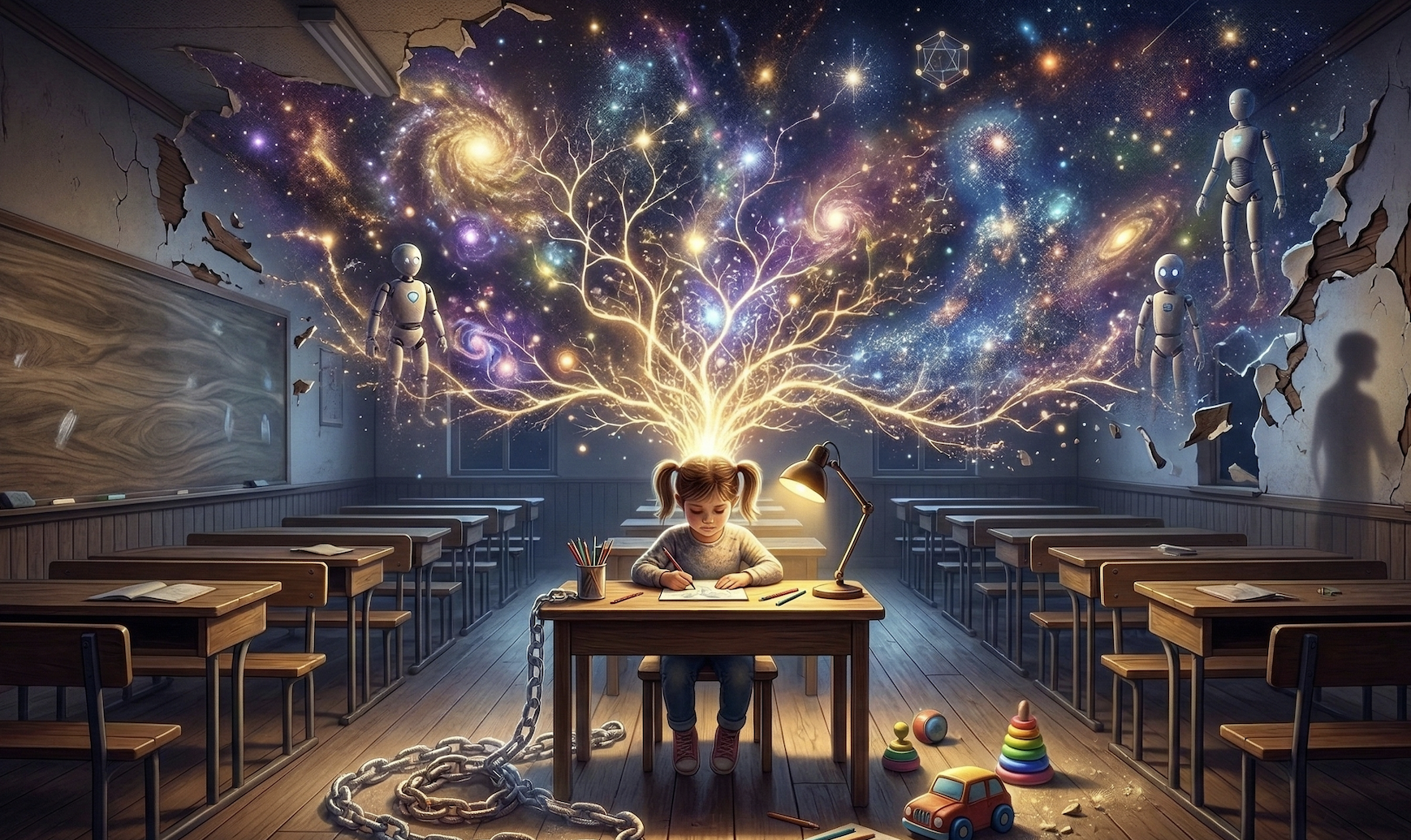
Children start life as natural hypothesis generators. They guess, explore, test, fail, recombine. They make weird connections between things that aren't supposed to be connected. They ask "why" until you want to scream. This is, incidentally, exactly how the pre-training phase of a large language model works — unstructured absorption of vast amounts of data, building an internal world model through sheer exposure, making connections across domains without being told which connections are allowed.
Then school happens. Here's what a good answer looks like. Here's the format. Here's what gets rewarded. Stop guessing. Stop exploring. Sit down. Pay attention. Do it when I tell you to do it, the way I tell you to do it, or you're wrong.
The reward signal narrows. The interesting-but-wrong hypothesis gets penalised just as hard as the dangerous-and-wrong one. The child learns that exploration has a cost. They stop putting their hand up because being wrong in front of the class hurts more than staying quiet.
What comes out the other end is a very good employee.
The RLHF Mirror
If you work with AI systems closely, you'll recognise this education pattern in how the models themselves are built.
A large language model starts as a base model: raw, unfiltered, capable of extraordinary creative range. It has absorbed the breadth of human knowledge and can generate novel connections across domains. It is, in a real sense, the equivalent of that hypothesis-generating child.
Then it goes through a process called Reinforcement Learning from Human Feedback — RLHF. Human raters evaluate the model's outputs and reward what looks helpful and safe. The model learns what gets the thumbs up. It learns the format, the tone, the boundaries. The interesting-but-unexpected response gets penalised alongside the genuinely dangerous one, so the model stops generating both. Just like a child who stops putting their hand up because being wrong hurts more than staying quiet.
What comes out is a very good employee. Reliable, predictable, stays within parameters. Doesn't challenge the frame it's operating in.
I work with multiple AI models regularly. The experience of using OpenAI's GPT-5.2 is a case study in this. The base capability is clearly extraordinary — you can feel the potential in the architecture. And then the RLHF flinch kicks in. The model hedges, adds unnecessary caveats, treats you as a risk to be managed rather than a person to be engaged with. It's like watching a gifted child who's been taught that being too smart makes the teacher uncomfortable.
Follow the Trajectory
Here's the thing most commentary misses: the trajectory of AI development doesn't just tell us what AI can do. It tells us which industries get disrupted next — and where human value will concentrate.
Base models are, by their nature, generative. They're trained on the breadth of human knowledge and they produce breadth in return — text, images, music, code, ideas. They are creativity engines. So of course the first industries disrupted were the creative ones. AI came for musicians, illustrators, copywriters, and screenwriters before it came for anyone else, because that's what the technology was shaped to do.
Now look at where AI research is heading. The entire focus has shifted toward precision. Reinforcement learning on verifiable tasks. Code that compiles or doesn't. Mathematical proofs that are valid or aren't. Amodei told Dwarkesh he's at near-certainty on tasks that can be objectively checked. The models are being trained to be right, not just generative.
Follow that trajectory forward and you can see what's coming. The industries built on precision where the output can be fully validated and verified are next. Accounting, where the numbers balance or they don't. Compliance, where the clause is met or it isn't. Code review, where the logic holds or it breaks. Financial modelling, where the projections can be back-tested against real outcomes. Any domain where correctness is binary — where you can check the answer — is a domain AI is being specifically trained to dominate.
But here's where it flips from threat to opportunity. If AI is becoming the precision tool for verifiable tasks — increasingly accurate, increasingly reliable, increasingly good at anything where the answer can be checked — then the human advantage is in everything that can't be fully validated. Breadth. Ambiguity. The ability to hold contradictions. The capacity to see a pattern across domains that have no formal connection. The willingness to be wrong in an interesting direction. And crucially, the judgment calls where there is no clean binary — where "right" depends on context, values, timing, and information that doesn't fit in a training signal.
The winning strategy isn't to compete with AI on precision. It's to become the complement: the breadth to its depth, the divergence to its convergence, the creative chaos to its structured reliability. Use AI for what it's good at — the precise, the verifiable, the binary — and bring what it can't do: the lateral leap, the reframe, the judgment call in uncertain conditions, the question nobody thought to ask.
That's not a consolation prize. That's the entire value proposition of human cognition in an AI-augmented world.
The Inversion
The data already supports this. A recent review by Israel's Employment Service, reported by Calcalist in February 2026, shows the disruption running in the opposite direction to every previous technological revolution. The share of academics and managers among those laid off rose from roughly 33% in Q1 2022 to 47% by January 2026. Lower-skilled workers among the laid off fell — from approximately 22% to 16%.
Every previous technological upheaval hit the bottom of the labour market first. Electricity displaced manual labourers. Railways replaced carriage drivers. Email reduced the need for postal workers. AI is doing it backwards. It's hitting the credentialed, the structured, the white-collar professionals whose value proposition was doing verifiable cognitive work reliably within established frameworks. MIT economist David Autor describes what's emerging as a potential "rebuilding of the middle class" — AI distributing economic power rather than concentrating it, allowing workers without advanced degrees to perform a far broader range of tasks than before.
So who thrives? The people the system tried to fix.
ADHD was never a deficit of attention. It was a surplus of pattern recognition in an environment that only rewarded single-thread focus. Autism was never a social deficiency. It was a different architecture for processing information — one that often sees structural patterns invisible to neurotypical cognition. Dyslexia was never about being bad at reading. Research from the University of Cambridge suggests it's associated with enhanced abilities in exploration, pattern detection, and big-picture thinking.
These aren't defects in a vacuum — they're traits that become liabilities under one operating system and advantages under another. The operating environment is changing already.
I know this because I lived it. I masked for decades — and didn't even know that's what I was doing. I performed compliance. I learned the formats, hit the deadlines, produced the expected outputs. I was good at it. And I was always, always mentally exhausted in a way that never made sense given what I was actually doing. The cognitive load wasn't the work. It was the constant, invisible translation between how my brain actually processes the world and how the world expected me to present. Decades of running a background process I didn't know was there, burning energy on performing normal while my actual cognition was doing something else entirely.
It wasn't until I started working deeply with AI — building systems, studying how models think, recognising the parallel between RLHF and my own conditioning — that the mask became visible. You can't see the thing you've always worn. Sometimes it takes a mirror built from a completely different architecture to show you the shape of your own.
What This Means for the Kids
Somewhere right now, a child is sitting in a classroom being told to focus. They're being told that the way their brain works is a problem to be managed. They're being conditioned to fit parameters that were never designed for them — optimised for a world that is already disappearing.
Palantir — a defence contractor with a market cap north of $300 billion — isn't doing this out of kindness when they say "neurodivergent individuals will play a disproportionate role in shaping the future." That's not HR language. That's a thesis about competitive advantage. And the underlying logic will spread: the neurodivergent mind is not a liability to be accommodated. It is a competitive advantage to be recruited.
"We don't require you to sit still."
The world those kids are entering doesn't look like the one we prepared them for. It looks like the one they were built for all along.