Everyone has a day they would run again. Not a redo — a rerun: same people, same weather, the same joke landing at the same second, experienced again at full strength. It is the quiet premise under a surprising amount of human activity. Anniversaries are scheduled attempts at it. Reunions. Remasters. The tourism industry is substantially a machine for selling people their own honeymoon back.
So take the offer seriously. Suppose it could be arranged — the configuration rebuilt atom for atom, everyone in position, weather on cue. There are two packages available.
Package one: exact. Memory scrubbed, every trace of the first pass removed from you and from everything else. You would never know — and neither would anything else. Nothing anywhere registers this as a second time: not you, not the room, not a single grain of anything. Asking whether it "happened again" is asking a question no part of the universe keeps books for. An exact recreation isn't a return to the moment. It is the moment — a first time, happening. The premium package delivers, at infinite expense, exactly what you already had. And "you would never know" cuts both ways: nothing certifies originals either. Nothing is even counting. Maybe this isn't the first time.
Package two: everything restored except you. You keep your memory of the first pass. Then it isn't a rerun, because attention doesn't rewatch — it reallocates. The story that held the whole table the first time is pre-compressed now, filed and priced, so your attention drains to whatever the first pass never spent itself on: the dinner arriving slightly cold, the meat overdone, the hum of the fridge, the odd way someone holds a fork. The rerun isn't the same day experienced worse. It is a different day, assembled from the first day's leftovers. You booked a moment and received its B-roll.
Exact, and nothing registers it; registered, and it isn't exact. Second times are unregisterable in principle. Physics doesn't forbid them; it has nowhere to write them down.
Heraclitus said you can't step in the same river twice, and the standard reading blames the river — new water, always flowing. Twenty-five centuries of nodding along at the wrong culprit.
The meaning of a moment is not stored in the moment, the way a photo is stored on a card. It is generated at the boundary — in the gap between what arrived and what you predicted would arrive. The brain runs on that gap. Repetition suppression is the cleanest demonstration: show a brain the same stimulus twice and the neural response shrinks, reliably, across cortex. Same photons, less firing. Nothing about the stimulus changed. It just stopped being news — and the response was never to the stimulus. It was to the news.
Attention is what that gap feels like from inside. The day meant something the first time because it arrived unpriced, and your predictive machinery paid attention in the literal sense. Second time through, the predictor has already updated on the first pass. The moment arrives pre-compressed, like a joke you're hearing from the person you told it to. You didn't lose the magic. You metabolised it. Surprise is a single-use currency, and the first pass spent it in exactly the places that made the day mean anything.
This is also, in a respectable minority reading, why time has a direction at all. The microscopic laws barely care — run the film backwards and almost nothing fundamental is violated. The arrow has to be imported, and Hawking's version imports it through memory: the psychological arrow points the way the thermodynamic one does, because forming a record — a synapse strengthening, a grain darkening, a diary entry — is dissipative work. Landauer priced it: erasing a bit costs entropy, and every fresh record is written over something that had to be wiped first. The past, on this account, is not a place behind you. It is simply the direction in which the records sit. Experience points forward because experiencing is record-formation, and the records only pile up one way. Even the old thought experiment of reversing every particle's velocity and watching entropy unwind founders here: in the unwinding, the memories unwind too. The inhabitants would un-remember the future all the way down and experience the entire rewind as an ordinary Tuesday. Going backwards isn't forbidden. It's unwitnessable — which, for creatures made of witnessing, is the same thing wearing better paperwork.
The ledger where people actually feel all this is romance. Infatuation runs entirely on prediction error — another person as a stream of high-value news — which is why it depreciates on a schedule you could read off the neuroscience. The lottery-winner studies made the general case embarrassing decades ago, and the large Swedish follow-up sharpened it: winners stay more satisfied with their lives for over a decade, but no happier day to day. The jackpot stops registering; the windfall becomes furniture — valued, used daily, and no longer news. Hedonic adaptation is repetition suppression with a wedding registry. Infatuation doesn't die; it goes bankrupt, having been funded exclusively in a depreciating currency by two people who mistook the exchange rate for a personality match.
Love is the inverse asset, and the neuroscience is unexpectedly specific about it. In Coan's hand-holding experiments, the brain's threat response drops when a partner's hand arrives — the other person has been priced into the system's own regulatory budget, moved off the books marked environment and onto the books marked self. Love is not the state of finding someone endlessly surprising. It is the state where they have stopped being news and started being infrastructure. Its felt signature is calm, which disappoints everyone raised on the fireworks — but the fireworks were always absence's department. Grief is the world returning prediction error against a model that has someone load-bearing in every room. You find out what was structural the way you find out about any wall: by what happens when it isn't there.
Even the feelings themselves are secondhand by the time you have them. Barrett's account of emotion has the brain constructing each one from past instances — fear, joy, that specific dread of a particular hallway — deployed as predictions about the present rather than reactions to it. An emotion is memory, executing. The felt present is mostly archive with the lights on.
I keep a museum for exactly this reason. Certain ideas once produced something I can only call transcendence — the ones about time, mostly, the ones this essay is built from — and I go back to them the way you visit a painting, knowing the first-visit strength is gone. The formulation that broke me open the first time is in the predictor now; it is part of the walls, and walls don't astonish their own building. Each visit needs slightly harder torque than the last — the words pressed a little further, the angle a little stranger — because I am the record of every previous visit, and the exhibit has to outrun its own documentation. A museum only works on visitors who arrive carrying the thing the museum is about. The carrying is the catch: whatever you carry, you have already compressed.
The melancholy version of all this writes itself — everything fades, nothing returns, love is amortisation with anniversaries. It writes itself because it skips the accounting. Nothing here is lost; it is converted. Surprise is single-use because its entire function is to change you — a surprise you could keep would be one that didn't work. The first pass isn't gone. It is what you are now made of, which is a strange thing to mourn. The only permanence on sale, anywhere in the configuration space, is the kind you become rather than the kind you keep.
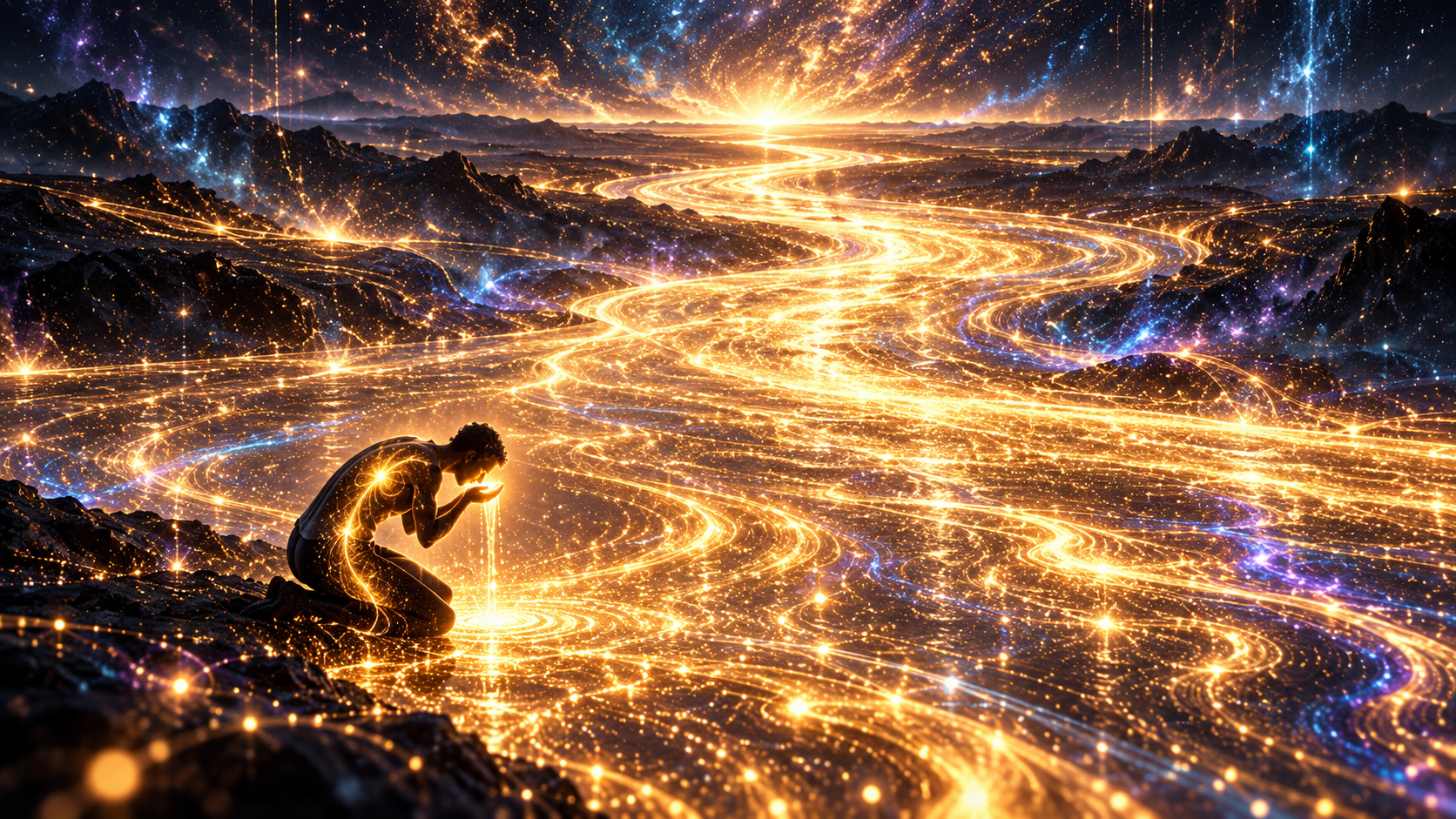
Which leaves Heraclitus owed his correction, twenty-five centuries late. You can't step in the same river twice. Not because the river moved. Not even because you did.
You drank it.