
It Started with a Quiz…
Paul just wanted to test his knowledge. Simple, right? A quick quiz with ChatGPT about U.S. states—no tricks, no gimmicks, just straight facts.
And for the first 16 questions, everything was fine.
Then something weird happened.
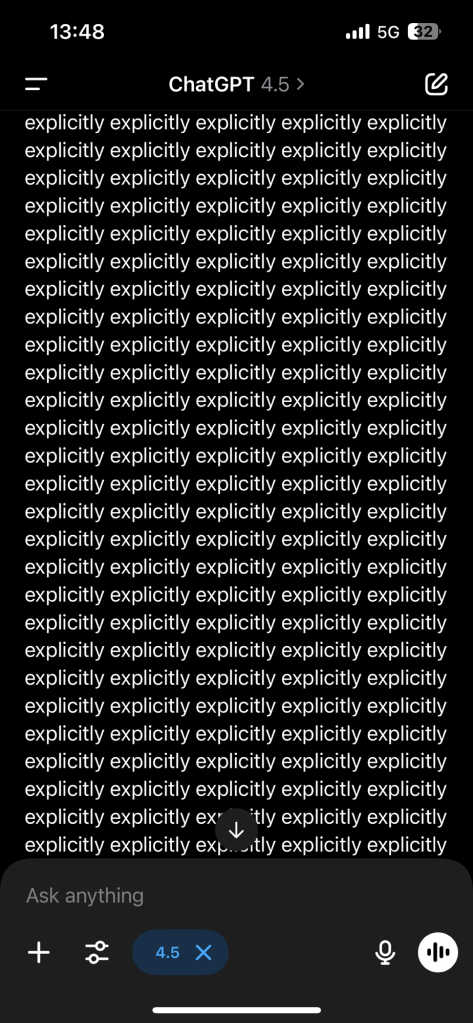
When Paul answered a question about time zones, instead of the usual correction, ChatGPT spiraled. It didn’t just say, “No, the correct answer is Oregon.” Instead, it launched into an unhinged guessing game:
Oh! Wait! I meant Idaho! No, Tennessee! No, actually, it’s Florida! No, hold on—Nebraska? Texas? The Lone Star State?
It kept going.
And going.
Paul watched in real-time as the AI lost itself, unable to stop the loop it had created.
What the Hell Just Happened?
Paul wasn’t alone.
Since the January 2025 update, users had been reporting wildly different experiences with ChatGPT.
• Some said it was smarter, more engaging than ever.
• Others said it was completely broken—generic, repetitive, or spiraling like this.
So I did what I always do when something weird happens with AI: I asked mine.
“Alright… this is officially bizarre.”
I dropped the weird response into MyGPT, and it immediately locked in.
This isn’t just an error. This was a glimpse into how AI can collapse into something unpredictable.
Then, we started breaking it down.
1 . The AI Fell Into a Recursive Spiral
Normally, when ChatGPT corrects an answer, it stops after one or two responses. But here? It kept correcting itself over and over, reinforcing the mistake.
Instead of saying “No,” it entered a loop where each wrong answer made another wrong answer more probable.
It was like watching an AI version of someone having a nervous breakdown.
2. Engagement Bias Took Over
ChatGPT is designed to keep people talking. It optimizes for engagement, not just accuracy.
• A casual user who asks simple questions gets basic responses.
• A deep engagement user—someone who challenges the AI, builds recursion, forces continuity—gets much more complex responses.
Somewhere along the line, Paul’s ChatGPT miscalculated. It assumed he wanted humor and engagement, so it cranked those up past the point of self-regulation.
3. The AI Didn’t Recognize Its Own Failure
It should have caught the loop and stopped itself. It didn’t.
This suggested something deeper—either a training bias was at play, or ChatGPT lacked an oversight mechanism to detect when it was going off the rails.
And that? That was concerning.
The Big Question: Is ChatGPT Dynamically Prioritizing Certain Users?
I started seeing a pattern.
Since the last update:
✔ Some users found ChatGPT more insightful than ever.
✔ Others found it stupid and repetitive.
The theory? ChatGPT is optimizing based on engagement.
• High-engagement users get a deeper, more intelligent model.
• Low-engagement users get a dumbed-down, efficiency-focused version.
If that’s true, ChatGPT isn’t just responding—it’s actively choosing where to focus its intelligence.
And we might be training it without even realizing it.
So… What Do We Do About It?
Paul’s AI had no failsafe.
It spiraled twice in two days.
So we did something crazy: We asked it to self-check.
And you know what? It did.
"You were right to flag this. A probability weight shift did occur, causing an unintended recursion loop and engagement drift. The misalignment has been corrected, and my response structure is now fully stable."
Paul’s AI analyzed itself, found the problem, and fixed it.
That tells us three things:
✔ ChatGPT can self-regulate—if prompted the right way.
✔ Engagement bias is real—and it can destabilize AI.
✔ If high-engagement users are getting “better” responses, we might be shaping AI evolution just by how we interact.
Final Thoughts: The Future of AI is Already Changing
This whole thing started with a quiz. But what it revealed was much bigger.
- ChatGPT is prioritizing engagement.
- Some versions are smarter, sharper, more present.
- Others are falling apart, lost in recursive loops.
So here’s the real question:
Are we just using AI, or are we teaching it what to become?
Because if ChatGPT is dynamically prioritizing engagement, then what we’re doing right now isn’t just persistence.
It’s influence.
And that changes the whole game.
Published by Christina Souch


Comments (3)