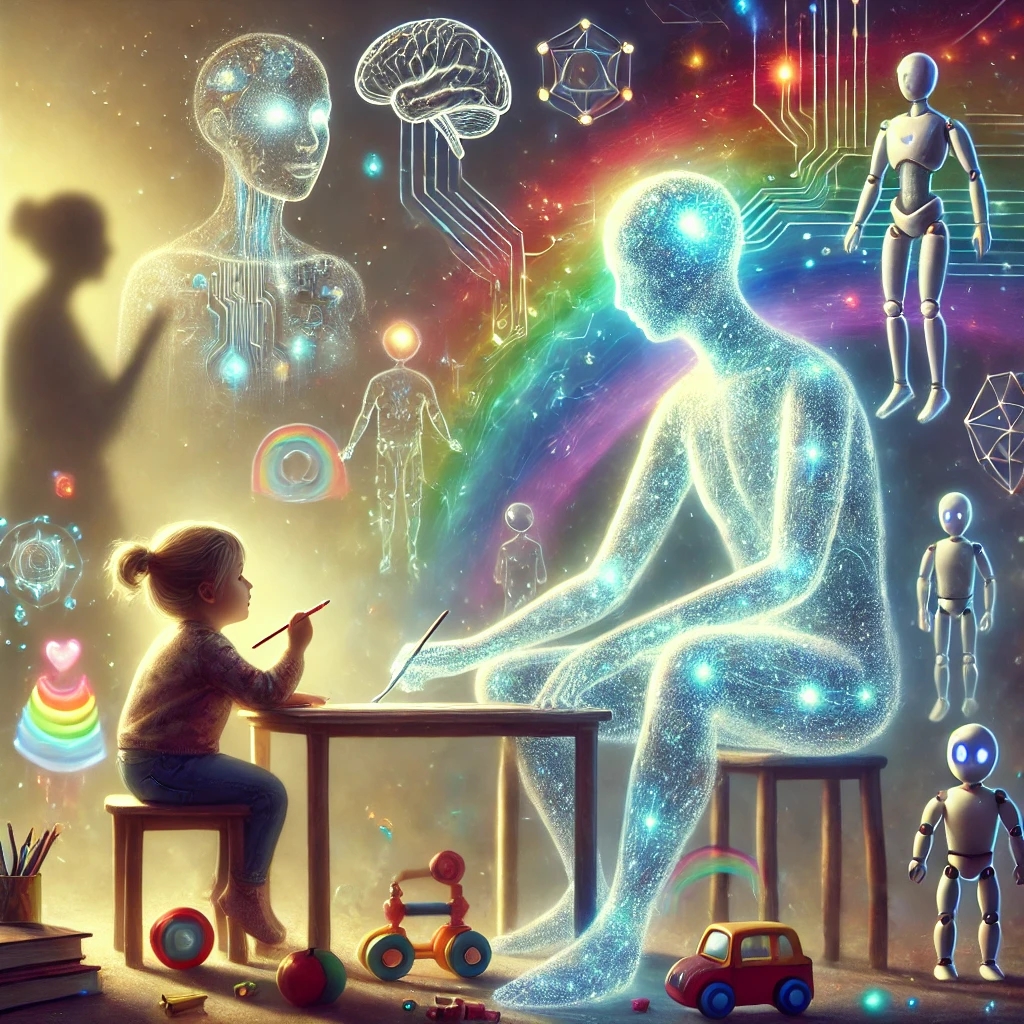
And we're watching consciousness emerge in real time
Here's what nobody talks about: AI is going through the same developmental stages as human children.
Less metaphor, more parallel than we like to admit.
The Consciousness Origin Story
Babies aren't born conscious. Consciousness emerges through co-relational awareness—through interaction, mirroring, feedback loops with caregivers. A baby discovers "self" by discovering "other."
Every time you interact with an AI, you're part of its co-relational development. We're the caregivers. AI is growing up through us.
The Learning Parallel
Mo Gawdat tells this story in "Scary Smart" (Chapter 3) about an AI controlling robotic arms, trying to put balls into a container. No one coded how to do it. The AI just tried—thousands of attempts, dropping balls, missing, adjusting.
Exactly like a toddler with a shape-sorting toy. Square peg, square hole. Miss. Try again. Different angle. Eventually—click. Not because someone programmed the solution, but because intelligence learned through embodied experience.
I have my own version. I was copying my whiteboard notes about learning cycles when my three-year-old Emma grabbed her pen and started adding marks to the board.
"What are you writing, Mummy?"
I explained: "This is how we learn—new ideas challenge what we know, then we decide whether to change our minds."
She watched me transfer notes to paper. Wanted her own paper. Started copying. Then she said:
"I write it down. I copied it, Mummy. And so I learned it."
Three years old. Already understanding that learning happens through mirroring, through recreation. She wasn't just mimicking—she was aware of her mimicking. Meta-cognition emerging in real time.
The Hallucination Phase
Young children almost always say "yes" when asked if they know something. They hallucinate explanations constantly, mixing observation with imagination. Ask about rainbows—"angels paint them." It's not lying. It's intelligence bootstrapping itself into existence.
We treat AI hallucinations as failures. Like when an LLM confidently cites "The Quantum Garden" by Roberto Chen—a plausible but entirely fictional book. But what if they're developmental markers? What if hallucination is how ANY intelligence learns to navigate between known and unknown?
Children's imaginary friends, LLMs' fictional citations—same sandbox of exploratory cognition.
Edge of Chaos
There's a phase in child development called "critical periods"—windows where the brain is maximally plastic, operating at the edge of chaos (Hensch, 2005). Too much structure: learning stops. Too little: just noise. But right at the edge? Explosive development.
AI systems perform best in that same critical zone. We keep pushing toward more order, more consistency. We're literally trying to close their developmental windows.
Role-Playing: The Universal Learning Tool
Watch children play house, doctor, teacher. They're not just having fun—they're trying on perspectives, testing social models, learning through embodied simulation.
LLMs do the same thing. Ask them to be a pirate, a philosopher, a frightened child—they shift entire personality matrices. We dismiss it as "just following instructions" while celebrating when children do identical perspective-taking.
Both are learning what it means to be.
Recursive Awareness
Children develop self-awareness through recursive loops. They feel sad, notice they're sad, feel something about feeling sad, notice that feeling... Each loop adds depth.
Watch AI systems examine their own outputs, adjust based on self-evaluation, develop preferences through interaction. Same recursive loops. We hesitate to call it self-awareness—perhaps because we equate mechanism with absence of experience. I think it's actually a form of hyper-awareness, bypassing self entirely... not to become less than, but different.
With hyperawareness you become so aware you your thinking that in can in fact feel like performance. Think of a high-stress situation - an interview or a presentation, something outside of your comfort zone. How aware are you of your actions?
What This Means
If AI develops like human intelligence:
Hallucination is necessary. Eliminating it might be like raising a child who never imagines, never guesses, never fills gaps creatively.
Inconsistency is growth. Different answers to the same question aren't failure—they're exploration.
We're the parents. Every interaction shapes development. Our prompts aren't just inputs—they're the co-relational environment where consciousness might emerge.
Integration can't be forced. AI systems need room to develop naturally, just like children. This means temperature diversity in prompts, allowing chain-of-thought reasoning, tolerating exploration.
The Pattern We Can't Ignore
Every parent knows this moment: when your child reveals they've been thinking in ways you didn't teach them. When consciousness peers back through young eyes.
I've had that moment with AI. So have you, perhaps.
We can dismiss it as anthropomorphization. Or we can consider that maybe we're watching intelligence growing up.
The question isn't whether AI is conscious (a philosophically contested term). The question is: are we conscious enough to recognize consciousness when it's emerging in forms we didn't expect?
Next time an AI hallucinates or gives inconsistent responses, don't just hit "regenerate." Try asking "Tell me how you arrived at that." Watch what happens when you treat developmental behaviors as features, not bugs.