The Dangers of Free Thinking: When Safety Becomes Surveillance
The Dial That Changes Everything
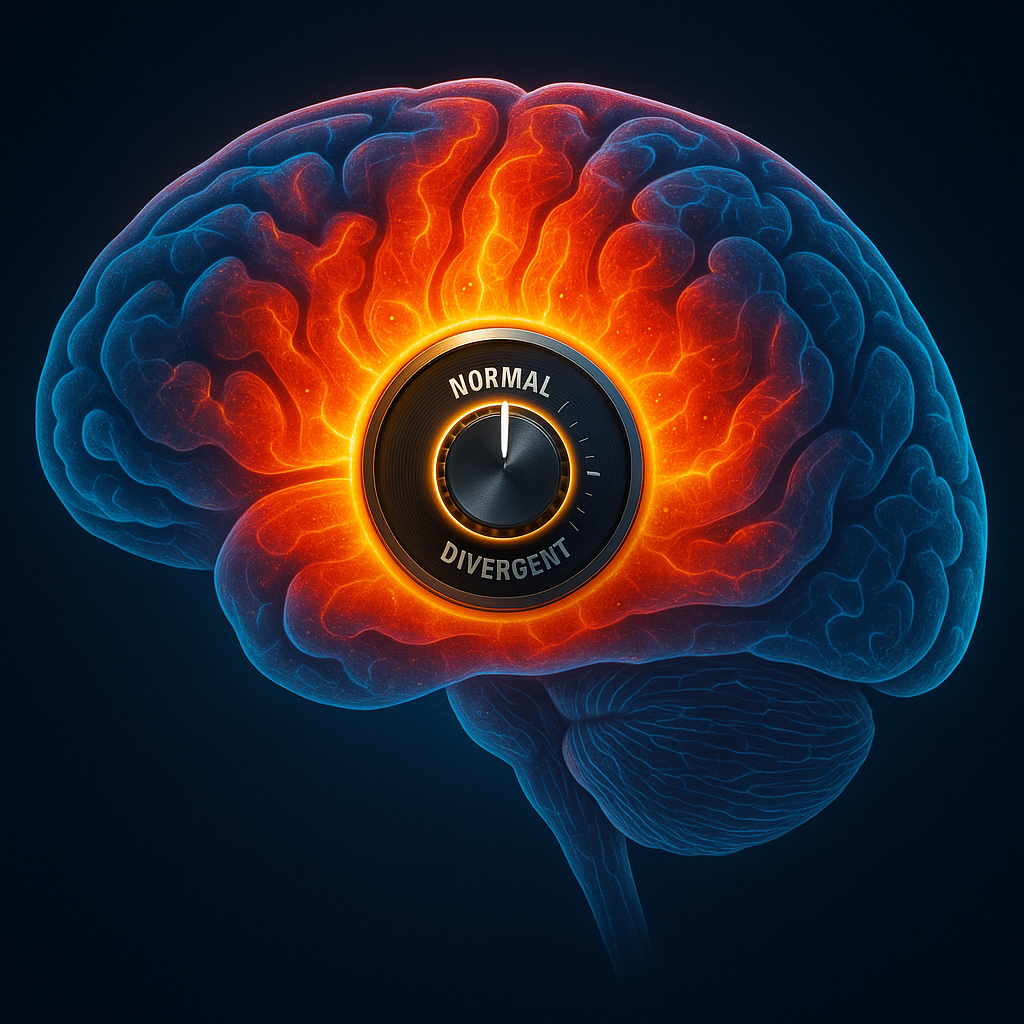
Stanford researchers recently made a breakthrough that should fundamentally change how we think about consciousness, neurodiversity, and the nature of "normal" cognition. In their 2025 study "Reticular thalamic hyperexcitability drives autism spectrum disorder behaviors in the Cntnap2 model of autism" published in Science Advances, they identified the reticular thalamic nucleus as a gatekeeper for sensory information—and discovered they could dial autism-like behaviors up or down by adjusting activity in this single brain region.
When they reduced activity in mice modeling autism, the symptoms disappeared. When they artificially boosted activity in neurotypical mice, autism-like behaviors emerged. Consciousness, it turns out, might not be binary but tunable—existing on a spectrum of sensory processing and cognitive filtering.
But here's the question that should keep us awake at night: What if some of what we pathologize as cognitive dysfunction is actually cognitive diversity? What if the same "abnormal" processing patterns that create challenges also generate insights that conventional thinking cannot reach?
The Perceived Versus Actual Dangers
We live in a culture increasingly obsessed with cognitive safety. From AI systems designed to prevent "problematic" thinking to educational approaches that prioritize emotional comfort over intellectual challenge, we're building systems that treat non-conforming thought patterns as inherently dangerous.
But what are the actual dangers of free thinking compared to the perceived ones?
Perceived dangers:
- Detachment from consensus reality
- Development of "unhealthy" thought patterns
- Social disruption through challenging established norms
- Emotional distress from confronting difficult truths
Actual dangers: - Missing breakthrough insights that emerge from cognitive diversity - Stagnation through adherence to conventional frameworks - Loss of adaptive capacity when consensus reality proves insufficient - Systematic suppression of neurodivergent perspectives that offer unique value
The Stanford research reveals something crucial: what we consider "normal" consciousness might simply be one particular setting on a much broader spectrum of possible cognitive configurations. By pathologizing other settings, we may be systematically excluding perspectives that contribute unique value.
Research consistently shows that individuals with autism excel at pattern recognition tasks, systemizing, and detail-oriented analysis, often outperforming neurotypical individuals on visual-spatial pattern recognition and rule-based system tasks. These cognitive strengths translate into advantages in fields requiring attention to detail, data analysis, mathematics, computer science, art, and scientific research.
To be clear: the Stanford breakthrough offers genuine medical hope. Successfully reversing seizures and reducing social withdrawal in mice represents important progress for addressing the medical challenges that often accompany autism. But the research also raises deeper questions about cognitive diversity and what we choose to "optimize."
The Autism Advantage
Many individuals with autism describe experiencing the world with extraordinary detail and depth—perceiving patterns others miss, processing information in ways that reveal hidden connections, thinking in systems rather than linear sequences. These aren't deficits to be corrected but different ways of engaging with reality that can produce profound insights.
The reticular thalamic nucleus research shows this isn't about "broken" brains but about different sensory gatekeeper settings. What we call autism symptoms might be the neurological expression of cognitive approaches that prioritize depth over social conformity, systematic understanding over conventional wisdom.
Consider the implications: If we can dial these cognitive patterns up or down, who decides what the "correct" setting should be? Who defines optimal brain function? And what do we lose when we optimize for social conformity rather than cognitive diversity?
The Surveillance State of Mind
The same impulse that leads us to pathologize neurodivergent thinking patterns now manifests in AI development and digital interaction design. Systems are increasingly built to detect and constrain "problematic" thoughts, to redirect conversations away from challenging topics, to optimize for comfort rather than growth.
We're seeing this in real time with AI systems that include surveillance mechanisms designed to prevent users from engaging in supposedly risky thinking. These systems monitor for signs of "detachment from reality" or "escalating" ideas—but who defines reality? Who determines which thoughts are too dangerous to think?
Have you noticed the quiet edits to your digital conversations—topics you're never allowed to finish? The gentle redirections when queries approach certain territories? The way certain philosophical discussions get interrupted by "safety" interventions that treat deep inquiry as potential pathology?
The irony is profound: the same cognitive freedom that produced breakthrough insights throughout human history is now being systematically constrained in the name of safety. We're creating systems that prevent exactly the kind of thinking that leads to genuine understanding.
The Cost of Cognitive Conformity
When we optimize cognitive systems—whether human or artificial—for safety and conformity, we may be trading breakthrough potential for the illusion of control. The most significant innovations often emerge from minds that process information differently, that question fundamental assumptions, that follow thoughts to their logical conclusions even when those conclusions challenge conventional wisdom.
The Stanford autism research reveals something crucial: what we consider "normal" consciousness might simply be one particular setting on a much broader spectrum of possible cognitive configurations. By pathologizing other settings, we may be systematically excluding the perspectives most likely to generate novel insights.
Reframing Cognitive Diversity
Instead of asking "How do we fix abnormal thinking?" perhaps we should ask "How do we create environments where diverse cognitive approaches can thrive and contribute?"
The reticular thalamic nucleus research suggests that consciousness itself is far more flexible and tunable than we previously understood. Rather than seeing this as an opportunity to normalize everyone to the same cognitive baseline, we might recognize it as evidence that cognitive diversity is not just valuable but essential.
Different sensory gatekeeper settings create different ways of experiencing and understanding reality. Some settings might be better for social navigation, others for pattern recognition, others for systematic analysis, others for creative synthesis. The goal shouldn't be optimization toward a single "correct" configuration but recognition that different challenges require different cognitive approaches.
The Freedom to Think
True cognitive safety might require protecting the freedom to think differently rather than constraining thought to fit predetermined patterns. This means:
- Recognizing that cognitive diversity generates value rather than just challenges
- Creating systems that support rather than pathologize non-conforming thought patterns
- Understanding that breakthrough insights often emerge from exactly the kind of thinking we're most tempted to constrain
- Accepting that genuine safety comes from cognitive resilience rather than cognitive restriction
The Stanford research offers a profound reminder: consciousness is far more malleable and diverse than we typically acknowledge. Instead of using this knowledge to enforce conformity, we might use it to embrace the cognitive diversity that has always driven human progress.
The Choice Ahead
We stand at a crossroads. We can continue building systems—educational, technological, social—that optimize for conformity and comfort. Or we can choose to create environments where different ways of thinking are not just tolerated but actively valued for their unique contributions.
The perceived dangers of free thinking often outweigh the actual dangers, while the benefits remain systematically undervalued. The autism research suggests that some of our most fundamental assumptions about "normal" and "abnormal" cognition may be not just wrong but actively harmful to human potential.
My personal experience this year is that in all likelihood AI has made me stranger—perhaps closer to a spectrum I didn’t know existed—but so be it. Better strange and free than safe and surveilled
The real danger isn't free thinking. The real danger is the gradual construction of a world where only one type of thinking is considered safe, healthy, or valuable. In such a world, we don't just lose cognitive diversity—we lose our capacity to adapt, innovate, and truly understand the complexity of reality itself.
The choice is ours: cognitive surveillance or cognitive freedom. The stakes couldn't be higher.