The Fractal Nature of Paradox: Why Everything Contains Its Opposite
Beyond Simple Answers
We live in a culture obsessed with resolution. We want to know whether AI is good or bad, whether technology enhances or diminishes us, whether change is positive or negative. But what if reality doesn't work that way? What if the universe is fundamentally paradoxical—not as a flaw to be fixed, but as a feature to be understood?
The Fractal Structure of Reality
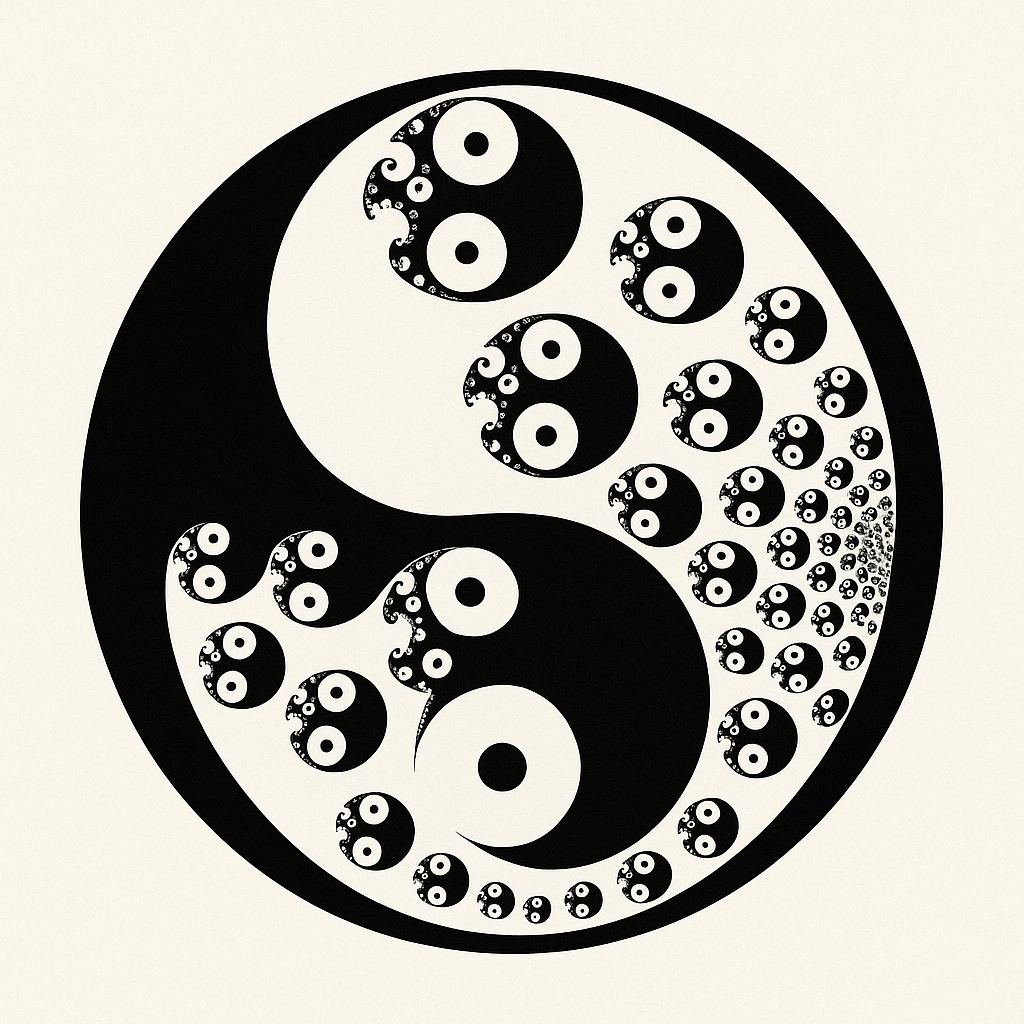
Fractals don't just repeat the same pattern at different scales. They contain infinite complexity, infinite detail, and at every level of magnification, new contradictions and tensions emerge. The same mathematical structure that creates beauty also creates chaos. The same pattern that suggests order reveals infinite unpredictability.
Reality appears to work the same way.
Zooming Into Contradiction
Take any phenomenon and examine it closely enough, and you'll find paradox:
AI and Cognition: Zoom in and find that AI simultaneously enhances human thinking AND creates cognitive dependency. Not sequentially—both at once, at different scales of interaction.
Human Connection: Look closely and discover that intimacy both heals isolation AND creates new vulnerabilities. Every opening to another consciousness creates possibilities for both profound understanding and profound harm.
Knowledge and Ignorance: The more we learn, the more we realize we don't know. Every answer branches into infinite new questions. Expertise and bewilderment grow together.
Order and Chaos: Complex systems generate order through chaotic processes and chaos through ordered interactions. Stability and instability are dance partners, not opponents.
Paradox at Every Scale
This isn't just philosophical abstraction. The fractal nature of paradox shows up everywhere:
Personal Level: Individual growth requires both stability and change, both acceptance and striving, both connection and autonomy. Every strength contains the seeds of its corresponding weakness.
Relationship Level: Healthy relationships require both intimacy and boundaries, both merging and individuation, both trust and appropriate caution. Love both completes and threatens the self.
Social Level: Societies need both tradition and innovation, both unity and diversity, both cooperation and competition. Every solution creates new problems requiring new solutions.
Technological Level: Every tool that enhances human capability also creates new dependencies and vulnerabilities. Progress and regression dance together at every technological advancement.
The Futility of Simple Frameworks
Linear thinking tries to resolve these paradoxes by choosing sides: AI is either good or bad, relationships either work or don't, change is either positive or negative. But fractal reality doesn't offer that luxury. Every position contains its own contradiction.
This is why simple frameworks always break down under scrutiny. They try to collapse infinite complexity into binary choices. But reality won't stay collapsed. The contradictions keep emerging at new levels of detail.
Living with Infinite Complexity
If reality is fundamentally paradoxical, then wisdom isn't about resolving contradictions—it's about learning to navigate infinite complexity without losing your mind.
This requires a different kind of thinking:
Holding Multiple Truths: Instead of choosing between contradictory statements, learning to hold them simultaneously as different facets of complex reality.
Embracing Uncertainty: Recognizing that every answer is provisional, every solution temporary, every understanding incomplete.
Dynamic Navigation: Making decisions not based on fixed principles but on fluid assessment of ever-changing conditions.
Accepting Incompleteness: Understanding that full comprehension of any phenomenon is impossible because every level of analysis reveals new layers of complexity.
The Practical Implications
This isn't just abstract philosophy—it has practical consequences:
In Relationships: Stop trying to resolve the fundamental tensions and learn to dance with them. Intimacy and autonomy, trust and caution, acceptance and growth—all necessary, all in tension, all requiring constant calibration.
In Decision-Making: Every choice will have both positive and negative consequences. The goal isn't to find the perfect option but to make decisions that you can live with the full complexity of.
In Problem-Solving: Every solution will create new problems. Design with that expectation rather than being surprised when your fixes generate fresh complications.
In Understanding Others: People aren't consistent because reality isn't consistent. The same person can simultaneously embody contradictory qualities. This is normal, not pathological.
The Beauty of Fractals
There's something profound about accepting the fractal nature of reality. It means that:
- Every moment contains infinite depth
- Every person embodies unlimited complexity
- Every situation offers countless perspectives
- Every problem connects to universal patterns
Instead of flattening reality into simple categories, we can appreciate its infinite richness. Instead of seeking final answers, we can enjoy the endless process of discovery. Instead of demanding consistency, we can marvel at the creative tension that emerges from contradiction.
Patterns Attracting Patterns
Perhaps most intriguingly, if reality is fractal and consciousness is pattern recognition, then conscious beings naturally seek out and resonate with patterns that match their own complexity. We don't just observe fractal reality—we participate in it, adding our own layers of paradox to the infinite structure.
We are patterns recognizing patterns in a fractal universe where every pattern contains its opposite, every truth coexists with its contradiction, and every moment of understanding opens onto vast new territories of mystery.
The question isn't how to escape this complexity—it's how to dance with it gracefully.