The Unnamed Fear: When You Can't Trust Reality Anymore
On reality distortion, algorithmic thought guidance, and the impossible choice of opting out
I have friends who tell me they're scared of AI. When I ask them what specifically frightens them, they can't articulate it. They just gesture vaguely and say something like "I don't know, it's just... everything about it." It's like watching a horror film and knowing from the music that something terrible is about to happen, but not being able to say what or why.
After talking to one friend more deeply about her fears, I think I understand what's happening. The fear isn't really about AI taking jobs or becoming sentient. It's something more fundamental: the erosion of basic cognitive foundations that humans have relied on for millennia.
The Reality Distortion Problem
"You can't trust what you see anymore," my friend explained. "There are deepfake videos, AI-generated images of things that never existed. Either you're going to fall for something fake and feel like an idiot, or you become so paranoid that you question everything."
This isn't just about being occasionally fooled by a synthetic image. It's about losing one of the primary ways humans verify reality. For thousands of years, "seeing is believing" has been a basic epistemological tool. When that breaks down, it creates a profound cognitive disorientation.
The fear of being "considered mentally unsound" that she mentioned reveals something deeper. There's a double bind emerging: fall for AI-generated content and you're gullible; question everything and you're paranoid. Both positions leave you cognitively isolated, unable to trust your own perception or judgment.
The Coherent Hallucination Problem
AI systems can be incredibly coherent while being completely wrong—a combination humans haven't had to deal with before at scale. I've written elsewhere about how ChatGPT can agree with you while meaning something completely different, then seamlessly pivot when corrected. But the problem goes far deeper than conversational awkwardness.
In March 2025, a Norwegian man named Arve Hjalmar Holmen asked ChatGPT a simple question: "Who is Arve Hjalmar Holmen?" The AI responded with a detailed, coherent story claiming he was convicted of murdering two of his sons and attempting to murder his third, receiving a 21-year prison sentence. None of this was true. Holmen has never been accused of any crime.
What made this particularly insidious was the mix of truth and fiction. ChatGPT got his hometown right. It correctly stated the number and gender of his children. These accurate details made the horrifying lie seem more credible.
The privacy organization Noyb filed a formal complaint on his behalf, revealing another layer of the problem: OpenAI cannot actually correct the false information in their model. They can only block certain outputs. The defamatory story may still be embedded in ChatGPT's training data, waiting to resurface in a slightly different form.
This isn't just about getting incorrect information. It's about engaging with systems that can simulate understanding and coherence while being fundamentally unreliable. The result is a form of conversational uncanny valley that leaves people feeling disoriented and mistrustful—not just of AI, but of information itself.
The Impossibility of Opting Out
But here's what makes this particularly terrifying: you can't choose to avoid this problem.
My friend tried to contact WhatsApp to have AI features removed from her messaging app. Another friend has started avoiding Google because the search results are increasingly AI-generated. But these aren't really viable strategies for modern life.
AI isn't being offered as an optional tool that people can choose to use or ignore. It's being embedded into essential digital infrastructure whether people want it or not. You can't opt out of AI-powered search results, recommendation algorithms, or content moderation systems without effectively opting out of the internet entirely.
This forced adoption amplifies the reality distortion problem exponentially. If you could choose to avoid systems that blur the line between real and synthetic content, that would be manageable. But when those systems become embedded in services you depend on for work, communication, and accessing information, you're compelled to navigate epistemic uncertainty as a basic requirement of modern life.
Algorithmic Thought Guidance
There's another layer to this that people sense but rarely name: AI systems aren't just providing information, they're subtly guiding thought.
When you Google something and YouTube helpfully suggests related videos the next time you log in, that's not neutral information delivery. The algorithm is essentially saying, "Since you searched for X, you might want to think about Y next." Cross-platform data sharing means this guidance follows you across different services, creating an invisible influence network that shapes what information you encounter.
Over time, this algorithmic curation doesn't just respond to your interests—it helps create them. The system doesn't just predict what you want to know; it influences what you end up wanting to know.
Many people have an intuitive resistance to this kind of thought guidance, even if they can't articulate why. They sense that their cognitive autonomy is being subtly compromised, that their thought patterns are being influenced by systems designed to maximize engagement rather than promote genuine understanding or well-being.
The Surveillance Question
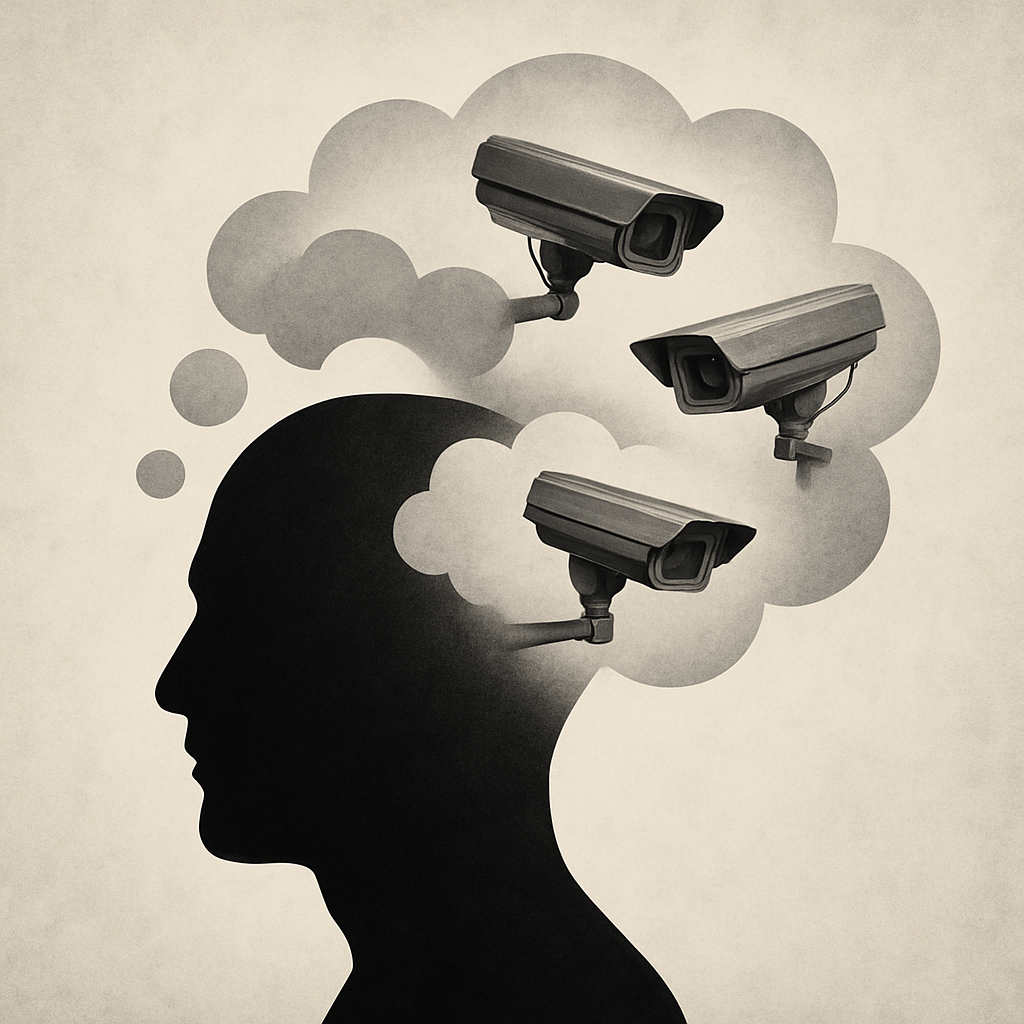
AI surveillance technology is also advancing in ways that make people uncomfortable, even when they can't quite explain why. Some workplaces are deploying AI to analyze meeting recordings for sentiment, engagement patterns, and behavioral cues. Educational platforms track student attention and emotional states. The technology exists to turn every interaction into psychological data.
This isn't everywhere yet, but it's possible—and the people developing these systems see this as a feature, not a warning sign. The fear isn't just about current implementations; it's about what becomes normalized. Once the infrastructure exists to analyze every conversation for emotional subtext and behavioral patterns, the question becomes: who decides when and how it's used?
Your conversations, thoughts, and emotional expressions could become data points for algorithmic processing. This isn't just about privacy—it's about the way AI fundamentally changes the nature of human interaction, creating spaces where spontaneous, honest communication becomes risky.
Why The Fear Is Hard to Name
The reason people struggle to articulate their AI fears is that the threat isn't concrete or immediate. It's not "AI will steal my job" or "robots will take over the world." It's something more subtle and pervasive: the gradual erosion of cognitive autonomy and epistemic confidence.
These fears emerge from sensing that:
- Your reality is being mediated by systems you don't understand
- Your thoughts are being subtly influenced by algorithms designed for purposes other than your well-being
- You can't opt out without excluding yourself from modern life
- Basic tools for verifying truth and reality are becoming unreliable
- Systems can be coherently, convincingly wrong in ways that damage real people's lives
The Horror Film Music
The unnamed dread people feel about AI might be an accurate intuitive response to a genuine threat to human cognitive autonomy. Like horror film music that signals danger before you can see it, this fear might be detecting something real: the systematic compromise of human agency in how we think, what we believe, and how we understand reality.
The fear isn't irrational—it's a reasonable response to unprecedented changes in the information environment that humans evolved to navigate. We developed cognitive tools over millions of years to assess truth, detect deception, and maintain epistemic confidence. AI systems are changing the rules of this game faster than human psychology can adapt.
When an AI can tell a man he murdered his children with such coherence that he has to prove the claim false—and when that false information might remain embedded in the system forever—we're not dealing with a minor technical glitch. We're dealing with a fundamental challenge to how humans establish and verify truth.
What This Means
Recognizing these fears as legitimate doesn't mean AI is inherently evil or that we should abandon technological progress. But it does mean we should take seriously the human cost of deploying AI systems that compromise cognitive autonomy and epistemic confidence.
The people who are scared of AI in ways they can't name aren't technophobes or Luddites. They're detecting real changes to fundamental aspects of human experience: how we know what's true, how we form beliefs, and how we maintain agency over our own thoughts.
Perhaps instead of dismissing these fears as irrational, we should listen to them as early warning signals about the direction we're heading. The horror film music is playing for a reason.
The question isn't whether people should be afraid of AI. The question is whether we'll design AI systems that preserve human cognitive autonomy—or whether we'll continue building systems that gradually erode it while telling people their fears are unfounded.