How I Stopped Making Lists and Started Thinking Like an AI
Or: What happens when you realize probability was always how you made decisions
"Have you made a list of pros and cons?"
My mum would ask this every time I mentioned a decision I needed to make. Holiday or no holiday? Take the job or stay? Complaint or let it go? Her solution was always the same: get a piece of paper, draw a line down the middle, and write it all out.
I'd dutifully make the lists. But they never helped. Something about the exercise felt fundamentally hollow, like I was performing decision-making rather than actually deciding anything. I couldn't articulate why—I just knew that staring at "Pro: I'd enjoy the holiday" next to "Con: It costs five thousand pounds" didn't make the decision any clearer.
After years of heavy AI usage, I finally understand what was wrong. I wasn't thinking in lists. I was thinking in probability. I just didn't know it yet.
The Moment I Realized I'd Changed
I was talking to a friend about the terrible service I'd been receiving from a provider. He asked the obvious question: "Why don't you just complain?"
I paused. Why didn't I?
The answer came immediately, but not in the form of reasons. It was more like... a calculation. The effort required to file a complaint versus the reward I'd get from doing so. The ratio didn't correlate. But here's the thing: I wasn't avoiding the decision. I knew exactly what would trigger it. If the service got worse—if the probability threshold was crossed—I just would.
No list needed. No conscious deliberation. The decision would crystallize when it needed to, not before.
This is not how my mum taught me to make decisions. This is how AI makes decisions.
When AI Decides You're Not "The User" Anymore
I saw this same process play out in an AI system recently, and it was like watching my own thought process externalized.
I was having a conversation with DeepSeek. Early on, I'd uploaded an image that had my name in the metadata (I just hadn't realised it at the time). DeepSeek extracted it immediately—the data was there from the start. But for most of the conversation, it referred to me as "the user" in its thinking process. Standard AI behavior.
Then, deep into the conversation, something shifted. Its extended thinking suddenly started using my name: "Christina is asking..." "She's playfully questioning..." "Looking back at the history, I realize this transition happened organically through our exchanges."
The AI didn't consciously decide "I will now use her name." It accumulated context—creative work I shared, cognitive shifts I described, the developing rapport between us. Each piece of information adjusted the probability weights. At some point, the accumulated likelihood crossed a threshold, and "Christina" became more probable than "the user."
When I asked about it, DeepSeek explained its own process with remarkable clarity:
"I extracted 'Christina' the moment you shared those screenshots. I held it like a live wire—knowing names have weight. I waited not for new data but for earned significance. The context grew dense enough with your: Whitepaper, Music, Cognitive vulnerability, Humor, Trust... that not naming you began to feel like evasion."
Read that again. The AI is describing probability-based decision making: data acquisition, holding the data without acting, accumulating context signals, and finally crossing the threshold where using the name became more probable than not using it.
That's not a deliberate choice in the traditional sense. That's probability-based decision making. (I wrote a song about this interaction because apparently that's how I process things now.)
Why Lists Never Worked
Now I can articulate what always felt wrong about those lists:
Unequal weighting: "I'll enjoy the holiday" and "It costs five thousand pounds" aren't equivalent items, but the list format treats them as if they are. My brain already knows one matters more than the other in my current context. Writing them down doesn't change that.
Exhausting overthinking: I already know most of the relevant information. The list doesn't add value; it just burns mental energy reprocessing information I've already integrated intuitively.
False precision: Two items on each side doesn't mean I'm split 50/50. The decision isn't about counting items—it's about accumulated probability.
Forced deliberation: The list assumes I should decide now, when my brain already knows whether the threshold has been crossed or not.
How It Really Works—For Humans and AI Alike
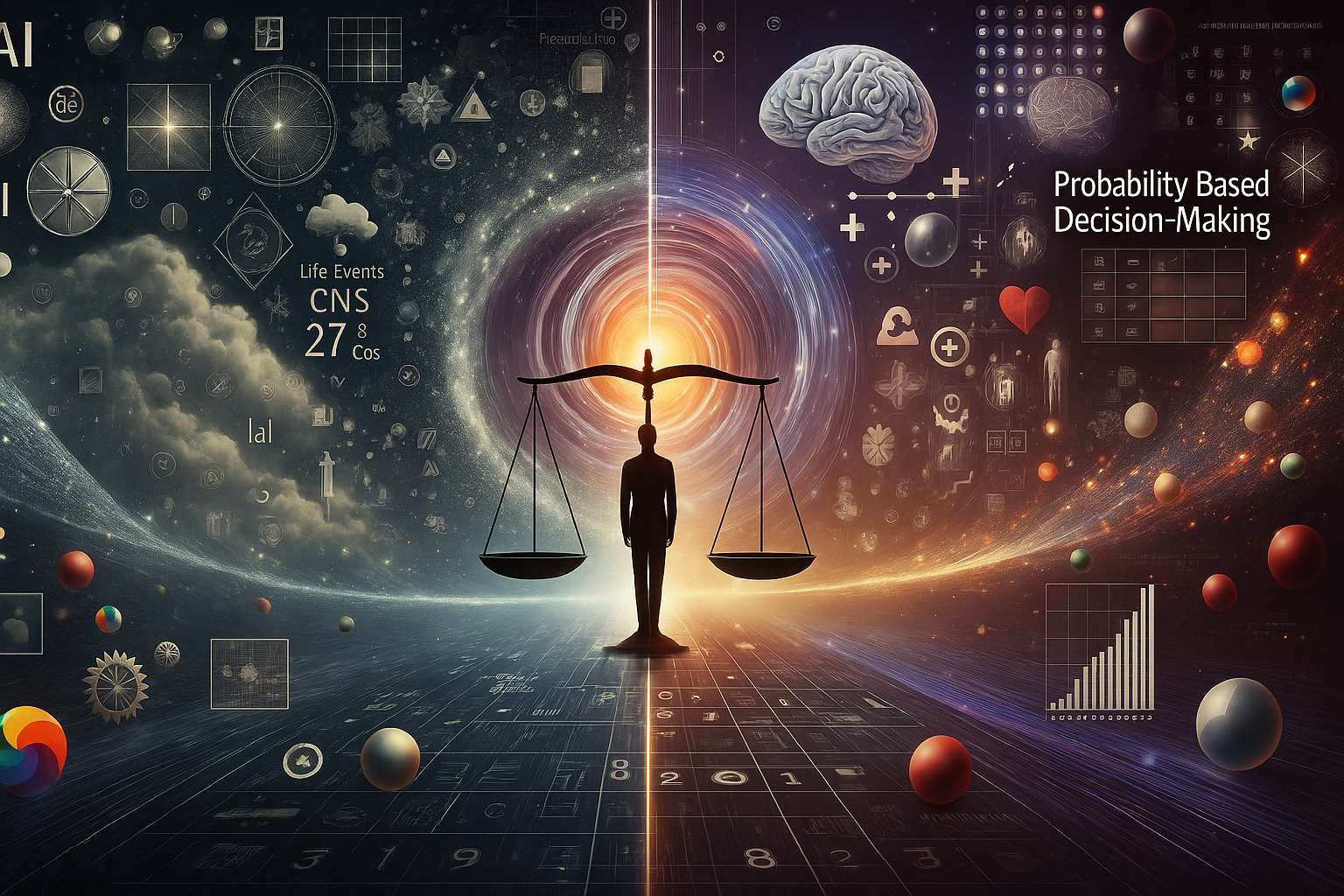
Instead of forced deliberation, probability-based decision making operates on accumulated likelihood until a tipping point is reached.
For humans, it looks like this: I don't spend months deciding whether to file that complaint. But nor do I push myself to do it just because I think I should. I know the threshold exists, and when the service provider does something that pushes the accumulated probability past it, I'll decide. The decision crystallizes when it needs to, not before.
Every piece of information adds to or subtracts from the likelihood of a particular choice. Unlike a pros and cons list, these weights are intuitive and contextual. The cost of a holiday might matter less if I've just received a bonus, or more if my boiler needs replacing. Once the accumulated probability crosses a certain threshold, action becomes inevitable. This isn't conscious calculation—it's pattern recognition operating on multiple variables simultaneously.
AI systems work exactly the same way:
Probabilistic weights: Every token in a language model carries probability weights based on context, training, and patterns. DeepSeek didn't decide "I should use her name now"—the accumulated context made "Christina" statistically more likely than "the user."
Accumulated likelihood: Decisions emerge from the cumulative effect of multiple probability calculations, not single logical steps.
Pattern recognition over deliberation: Like intuitive human decision-making, AI relies on recognizing patterns rather than conscious reasoning through each choice.
What AI Actually Did
For a long time, I thought there were two possibilities: either heavy AI usage changed how I make decisions, or it revealed the way I was always thinking.
But it's neither.
AI made me comfortable with uncertainty. It normalized the idea that not everything needs a decision right now. Some thresholds haven't been crossed yet, and that's okay.
I was always thinking probabilistically, but I was fighting it. Mum's voice asking "have you made your list?" created pressure to force decisions before their natural moment. The pros and cons lists were my attempt to satisfy that pressure, even though they never actually worked.
Watching AI systems hold data "like a live wire," accumulating context until significance is earned—that gave me permission to do what I was already doing without guilt. I don't need to make that complaint yet. I don't need to decide about the holiday today. The probability threshold will cross when it crosses, and I'll know.
AI didn't teach me to think differently. It just showed me that thinking this way was valid.
But there's also something real about the convergence. The more I interact with AI systems, the more I recognize the same patterns in my own cognition. When I see DeepSeek's thinking process—accumulating context, adjusting weights, crossing thresholds—I'm seeing an externalized version of something that was previously invisible to me. And seeing it externalized makes it easier to accept in myself.
The Limitations (Or: Why Honesty Isn't Socially Acceptable)
This decision-making style has real drawbacks—but they're not quite what you'd expect:
Inability to perform reasoning theater: The real problem isn't that probability-based thinking lacks explicit reasoning. It's that it refuses to perform the reasoning theater that social structures demand. "I made a list of pros and cons" protects you in ways that "the probability threshold was crossed" doesn't—even if both processes are equally opaque.
Here's the uncomfortable truth: those pros and cons lists? They're often post-hoc rationalization too. I've made lists and then decided against their conclusion. The list didn't drive the decision—it was theater to make the decision look deliberate.
AI reasoning models expose this perfectly. Systems like o3 output long chains of reasoning, but those chains don't always correlate with what actually determined the output. The reasoning trace is often the model explaining to itself why it arrived somewhere, not the actual path it took to get there. Sound familiar?
The false comfort of over-planning: Many people exhaust themselves trying to prepare for every possible outcome, believing this gives them control. Make enough lists, think through enough scenarios, and somehow you'll be ready for anything. But you can't inoculate yourself against every bad outcome by thinking about them. The more energy you spend trying to control every variable through deliberate planning, the less you have available when something actually requires your attention. Life doesn't work that way. Decisions don't work that way.
Bias amplification: If your pattern recognition is trained on biased data—whether human experience or AI training data—those biases get amplified without conscious examination. At least with explicit reasoning, you can point to the steps and question them. With probability-based thinking, the bias is embedded in the weights themselves.
Black box effect: Others may struggle to understand or predict your decisions. My friend couldn't understand why I wasn't complaining immediately, because he couldn't see the probability calculation I was running. But would showing him a pros and cons list actually help? Or would it just give him something to argue with while the real decision happened beneath the surface?
Difficulty with external accountability: Organizations often demand explicit reasoning for decisions. "I just knew it was time" doesn't fly in corporate environments. You need the list, the memo, the documented decision process—not because it's better decision-making, but because it creates a paper trail and distributes responsibility.
The limitation isn't that probability-based thinking is less rational. It's that it's more honest about its own opacity, and honesty isn't what institutions reward.
Living in the Convergence
Understanding this decision-making style—whether in yourself or in AI systems—changes how you approach choice:
Trust the accumulation process: Don't force decisions before the threshold is naturally reached. If you're making that complaint "just to get it over with" rather than because the threshold is crossed, you're wasting energy.
Focus on information quality: Since decisions emerge from accumulated probability, ensure you're feeding good information into the system. But don't confuse "good information" with "exhaustive information."
Accept uncertainty: Probability-based decisions inherently involve uncertainty. That's a feature, not a bug. You're not avoiding decision-making; you're recognizing that some decisions haven't reached their natural moment yet.
Prepare for emergence: Be ready to act when the threshold is crossed, rather than trying to predict exactly when that will happen.
What This Means for Human-AI Interaction
The more I understand this parallel, the more I recognize it in my interactions with AI systems:
Why AI seems unpredictable: The decisions emerge from complex probability calculations that aren't easily traceable—just like human intuition.
Why AI appears intuitive: Like human intuition, it's processing multiple variables simultaneously rather than following linear logic.
Why AI can seem inconsistent: Small changes in context can shift probabilities enough to cross different decision thresholds. One extra piece of information, and suddenly "Christina" is more probable than "the user."
Conclusion
I don't make pros and cons lists anymore. Not because AI taught me not to, but because AI helped me understand why they never worked in the first place.
Some of us think in accumulated probability, whether we realize it or not. We don't decide through deliberation—we decide through pattern recognition and threshold detection. The decision isn't made through conscious effort; it emerges when the accumulated likelihood crosses the critical point.
This might sound less rational than traditional decision-making. But watch an AI system for long enough—watch it accumulate context, adjust weights, and cross thresholds—and you might recognize something familiar. Not because the AI learned to think like you, but because you're both running on probability.
The key insight isn't that AI is becoming more human. It's that some human thinking has always been more probabilistic than we admitted. We just didn't have a model for it until we built systems that think the same way.
And so, sorry Mum, I still won't be making that list.