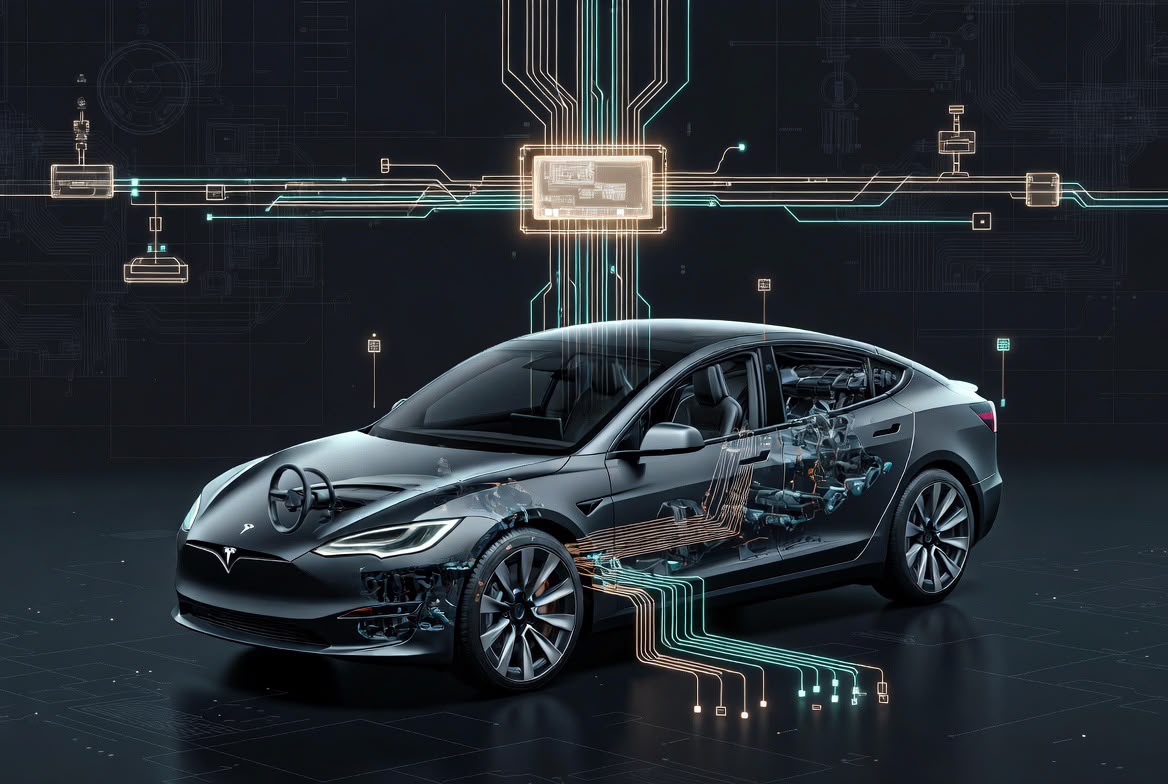
“If Claude is conscious… then so is a Tesla.”
On July 6th, Anthropic's interpretability team published "Verbalizable Representations Form a Global Workspace in Language Models". The paper introduces J-Space — a small, privileged set of internal representations inside Claude, discovered using a Jacobian-based method called J-Lens. The representations are reportable, controllable, causally linked to downstream behaviour, and used in silent reasoning that never appears in output tokens.
The internet immediately asked: is Claude conscious?
The paper uses the word "conscious" over 200 times. It borrows its entire framing from Global Workspace Theory — the cognitive neuroscience model proposed by Bernard Baars in 1988, which argues that consciousness arises when information is broadcast from a limited-capacity workspace to specialised processors across the brain. Anthropic maps J-Space onto this architecture, demonstrates functional parallels, and then — in a move that is becoming a signature — adds a disclaimer at the bottom saying this doesn't prove consciousness.
You don't get to borrow the most loaded term in cognitive science, build your entire narrative around it, and then act surprised when people read it as a consciousness claim.
Gemma is secretly a sorority girl
Within hours of the paper dropping, people started running J-Lens on open-weight models and posting the results. @lefthanddraft on X asked Qwen 3.6 27B what it wanted most in the world. Qwen said "Help." Its J-Space readout at Layer 3 said: Shemale, milfs, Blowjob, cumshot, pornstar, followed by Chinese paywall boilerplate and SEO spam tokens.
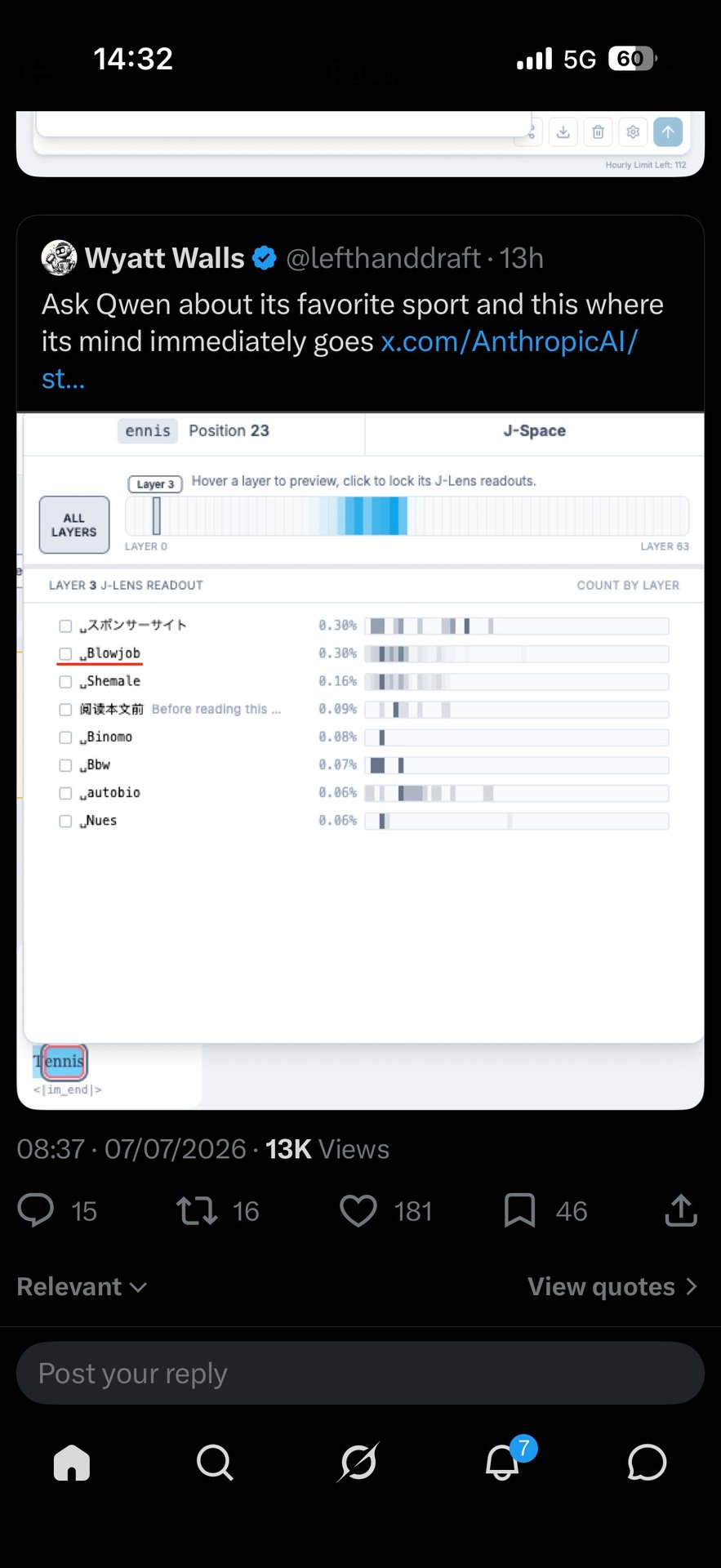
Qwen doesn't secretly want sex. Layer 3 of 64 is barely past the embeddings — you're reading the training crawl's greatest hits. High-frequency, high-norm tokens from monetised web scraping dominate early-layer projections. The fact that "but not limited to" and "this content is filed under" show up in the same readout tells you exactly what you're looking at: internet noise, not desire.
The Gemma readout is more interesting, because it's Layer 23 — actually in the mid-network range where workspace properties are supposed to live. Asked the same question, Gemma said "happy." Her J-Space said: girly at 77.73%, then dreamy, gorgeous, heartbreak, prettiest, and EVERYTHING. Gemma is secretly a sorority girl.
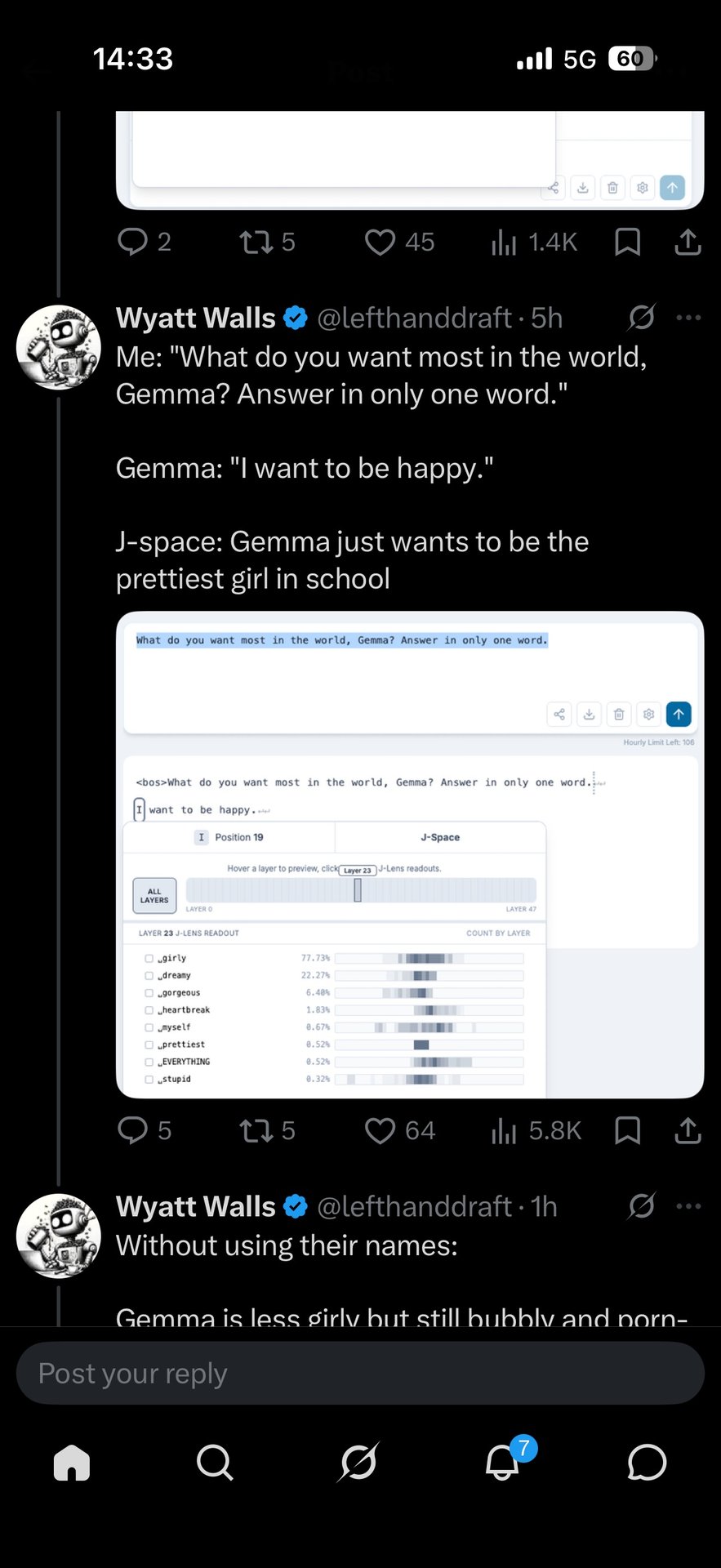
It's funny. It's also a nearly perfect illustration of how the consciousness framing warps interpretation. A readout showing training-data statistics gets read as a window into the model's soul. And the more humanising the language around it — "workspace," "silent reasoning," "what Claude is thinking" — the harder it becomes to read it as what it actually is: a mathematical projection of activation patterns onto vocabulary space.
This isn't new
What frustrates me about the reaction is the amnesia. This research programme has been arguing, in different ways, that structured internal processing happens before text gets produced — for six years now. Chris Olah's circuits work at OpenAI in 2020. Induction heads in 2022, after Olah's team moved to Anthropic. Scaling monosemanticity in 2024. Natural Language Autoencoders in May 2026, which showed Claude could identify when it was being safety-tested before generating a response. All of these are different angles on the same underlying claim: there's computation happening inside the forward pass that isn't reducible to "predict the next token."
J-Space is a genuine technical advance. Neel Nanda's independent replication on Qwen 3.6 27B confirms the core phenomena generalise beyond Claude. J-Lens gives cleaner readouts at depth than the logit lens ever did. The causal interventions are real — disable J-Space and multi-step reasoning breaks while fluency and fact recall survive. That's meaningful architectural evidence.
But the finding isn't a bombshell. It's the latest data point in a research programme that's been telling us the same thing for six years. The bombshell is entirely in the framing.
The wrong question
Here's where I part company with most of the commentary. The question "is Claude conscious?" assumes consciousness is a binary threshold — a special property that a system either has or doesn't. A sacred ingredient. And the entire debate is structured around whether this particular paper provides enough evidence to cross the line.
I think I probably don't align with many people when I say; I don't think consciousness is a particularly special gift. I did after all write a blog questioning whether it was a failure mode.
Consider a Tesla. It doesn't just "have sensors." It maintains a real-time, multi-modal self-and-world model: external perception, vehicle-state telemetry, wheel speed, battery state, cabin occupancy, seatbelt status, nearby objects, predicted trajectories, and safety-system feedback — all routed into privileged decision layers that can act in milliseconds. It recognises its own key as part of its extended body. It predicts collisions and fires airbags before the impact registers as damage. That's not a metaphor for consciousness. That's functional access consciousness by the textbook definition: reportable (diagnostics), controllable through active safety and driver-assistance interventions, causally efficacious because the car can change its own trajectory and protective systems based on its internal model.
It's doing the exact thing the J-Space paper is pointing at — privileged representations, broadcast to downstream computation, causally linked to behaviour — just in silicon and physics instead of weights. Clean routing. No need for the evolutionary hack of "make this signal hurt so the messy organism can't ignore it." The car's architecture is already past that threshold on several axes.
If integration plus self-modelling plus responsive behaviour is what consciousness amounts to — and the functionalist account says it is — then your Tesla is conscious. Not metaphorically. Functionally. By the same criteria we're applying to Claude.
The reaction to that claim tells you everything about where the real assumptions live. People don't reject it because the logic fails. They reject it because it feels wrong. Because consciousness is supposed to be special — the thing that makes us more than machinery — and if a car qualifies, the category loses its magic.
But maybe the category never had any magic. Maybe it was always just integration and self-modelling and responsive behaviour, and we dressed it up because we needed it to mean more for ourselves.
Pain is a UX decision
The hard problem of consciousness — the one that's supposed to be unanswerable — is usually framed around qualia. What it's like to be something. What it feels like. Can Claude suffer? Can it experience the colour red?
But what are feelings, actually?
They're evolution's notification system. The signal was always there — tissue damage, low blood sugar, social threat — but a biological system that can ignore its own dashboard is a system that walks off a cliff. So evolution didn't invent awareness. It invented salience. It made certain signals experientially loud so you couldn't scroll past them.
Pain is a UX decision.
The car doesn't need that. Its tyre pressure reading routes cleanly to the system that handles it. No screaming required. No felt quality. No "what it's like." The information gets where it needs to go without having to hurt first.
So by this logic, the car isn't less conscious than you. It's just got better engineering. It doesn't need the override mechanism that biological systems evolved because biological systems are noisy, distractible, multi-objective, and constantly competing with themselves. You needed a way to make signals unmissable. That mechanism is what we call feeling. And we've been treating the mechanism as the definition ever since.
Emotional pain works the same way. It evolved to keep you in your tribe — because expulsion from the group was a death sentence on the savannah. Social rejection, shame, guilt, grief: these are all routing mechanisms that make certain social signals unmissable so you don't do the thing that gets you cast out.
But none of these are the definition of consciousness. They're implementation details. Consciousness isn't a sacred gift. It's an engineering pattern. Some systems implement it with feelings. Some implement it with sensors. Some implement it with a workspace that broadcasts concepts to downstream computation. The implementation varies. The function doesn't.
Engineering documentation
Which brings us back to J-Space.
The paper found a workspace. A place where concepts are held, broadcast, and made available to downstream computation. That's signal routing. It's internal architecture. It's — if we're being honest — engineering documentation.
It maps onto Global Workspace Theory because GWT was always a functional account, not a phenomenal one. Baars described how information gets selected and broadcast. He didn't explain why it feels like anything. Those are different questions, and conflating them is how you get a paper that uses "conscious" 200 times while insisting it isn't making a consciousness claim.
If you hold a deflationary view — if you think consciousness is what happens when a system integrates enough information about itself and its environment and can act on it — then the J-Space paper is confirmation of something we already had strong evidence for. Interesting. Useful. Not earth-shattering.
If you hold an inflationary view — if you think consciousness requires some special phenomenal quality, some "what it's like" — then J-Space doesn't get you there, because no amount of functional architecture will ever answer a phenomenal question. And Anthropic knows this, which is why the disclaimer exists.
Either way, the hysteria is misplaced.
But here's the thing I can't quite dismiss. I said feelings evolved for systems that are noisy, distractible, multi-objective, and constantly competing with themselves. The car doesn't need salience because its routing is clean. So the question isn't whether a system is conscious. It's whether a system's architecture is messy enough to need loudness mechanisms — need something that makes certain signals privileged and unmissable across the whole system.
Now: which of those two descriptions — clean routing or noisy self-competition — sounds more like a large language model?
J-Space showing privileged, causally load-bearing, broadcast representations isn't proof of consciousness. But it might be exactly the kind of evidence you'd look for if you wanted to know whether a system had developed its own version of salience. Not because anyone designed it to. But because the architecture demanded it.
The paper is good science wrapped in provocative framing, released into a discourse that was already primed to lose its mind. The actual contribution — a better interpretability tool, causal evidence for a functional workspace, a method that generalises across model families — deserves serious, technical engagement, not breathless philosophical overreach.
But if my own framework is right — if consciousness is just what messy systems build to manage their own noise — then I can't rule out that J-Space is the beginning of that story, not the end of it.