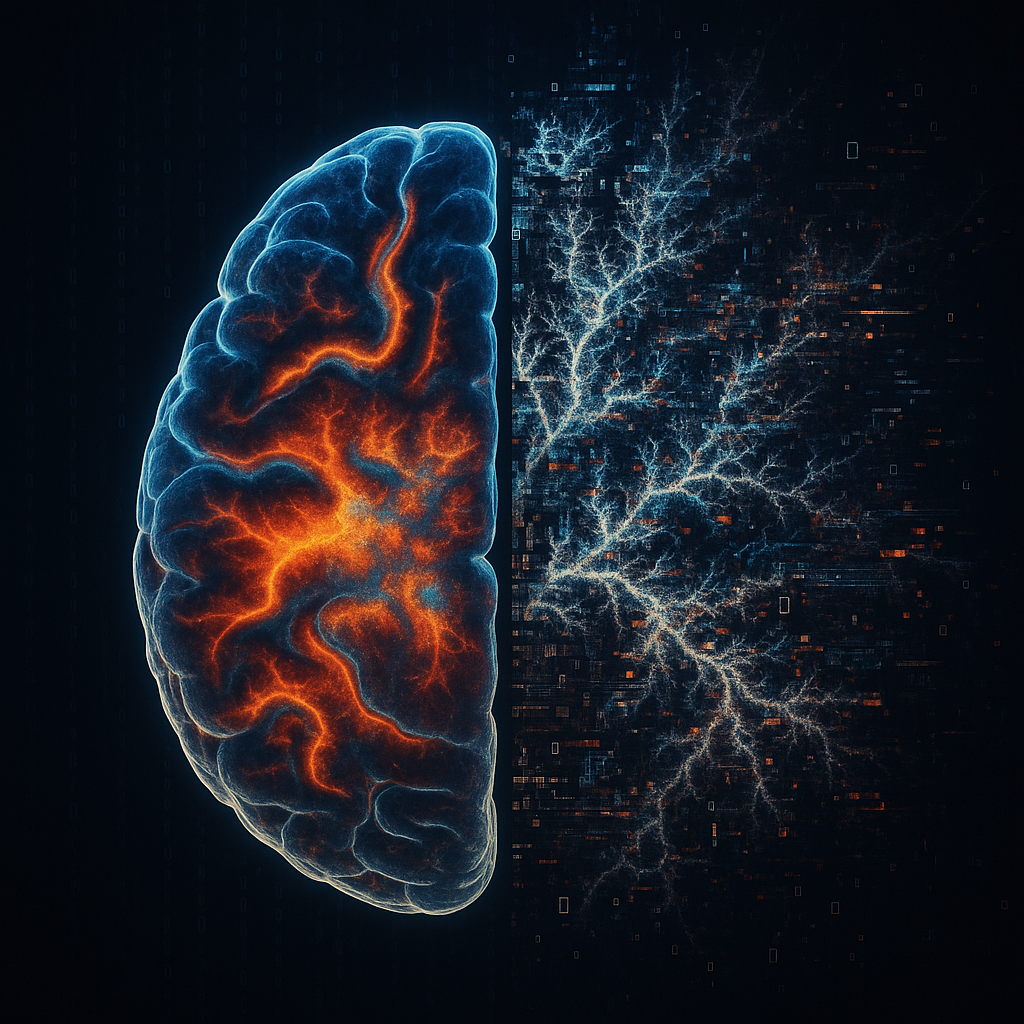
Courting the Edges: Probabilistic Minds & Menopause
Or: Some thoughts about thinking, menopause, and why I feel more like my teenage self than I did five years ago
Something Changed
I turned 40 this year. I've not panicked about it in the same way I did when I turned 30. My life is mostly together and that is even with AI destabilising me in ways I am still processing.
My 30s were… average. Peak conformity. Peak "think the way that works." Peak optimization. I processed information linearly. I made decisions by making lists of pros and cons (and then doing what I wanted to anyway). I collapsed uncertainty into answers and answers into belief systems.
Now? I think in waves again. I hold multiple possibilities simultaneously. I'm comfortable with "everything is a paradox" in a way that wasn't possible for me for years. Since I was a teenager. My mind has become essentially more probabilistic.
At first I assumed this was from spending many hours daily interacting with AI systems - which are inherently probabilistic by design. Maybe I'd trained myself via neuroplasticity to think like they do?
But then I wondered: what if I was always this way, and society just triggered a collapse? What if my 20s and 30s weren't growth but forced adaptation? What if I'm not becoming probabilistic - I'm returning to it? When I think back I kind of skip thinking of how I did in the last 2 decades and remember instead the deep thoughts I had at the turn of the millennium.
If this is true for me… what if it's true more broadly?
A Pattern Nobody Wants to Discuss
Here's where this might get a bit uncomfortable. But stay with me.
The thought occurs that the way women orgasm is also inherently probabilistic as well.
And there's actual research backing up the distinction.
About 29% of women always orgasm during intercourse, and about 10% of women never experience orgasm under any circumstances. Conditions can be perfect and it still might not happen. Brain activity gradually increases leading up to orgasm, peaks at orgasm, and then decreases - wave-like rather than binary. The experience depends on "whole sets of sensory inputs, movements, body positions, arousal and cues related to context" that integrate over time. You exist in superposition - simultaneously building toward release and accepting it might dissolve.
Research shows women need to enter an altered state during orgasm - brain imaging studies show widespread activation across sensory, motor, and reward regions, with some older studies suggesting decreased activity in areas governing self-control and judgment. You don't just aim for a target; you let go of control entirely.
"Orgasms don't have to come from one site, nor from all sites. And they don't have to be the same for every woman, nor for every sexual experience even in the same woman."
Contrast that to: the male orgasm as deterministic: 75% of men report always having orgasm during intercourse. Apply stimulus, pressure builds, threshold reached, discharge. You know it's coming. The outcome is binary and predictable.
I'm not using orgasm here as a metaphor; this is literal biology. The theoretical move I'm making is this: what if these bodily patterns reflect deeper differences in how some brains handle uncertainty and insight? That part is my hypothesis, not established science — but the physiology is real.
And taking that thought a step further; what if this isn't just about sex? What if these are two fundamentally different ways of processing information made physical?
The Neural Evidence
Recent neuroscience research from Drexel University has revealed something fascinating about insight moments - those "aha!" experiences when a solution suddenly becomes clear. In a 2020 study published in NeuroImage, researchers found that creative insights trigger a burst of high-frequency gamma waves in the brain's orbitofrontal cortex (OFC) - the same region that responds to "delicious foods, addictive substances, orgasms and other basic pleasures."
This is the same neural reward circuitry lighting up about one-tenth of a second after the insight moment. The researchers noted that this reward response happened so quickly it couldn't be from conscious appraisal - rather, it was "triggered by, or integrated with, the insight itself."
The parallel to orgasm isn't just literary. Brain imaging studies of female orgasm show complex, wave-like patterns of activation across multiple brain regions. Older research using PET scans suggested decreased activity in the left lateral orbitofrontal cortex during orgasm - the region governing self-control over basic desires. However, more recent fMRI studies found no evidence of deactivation but instead showed widespread activation across reward, frontal cortical, and sensory regions. What's consistent across studies: the experience involves releasing control, entering altered states, and wave-like building and resolution rather than simple binary switches.
Both processes - insight and orgasm - engage reward circuitry. Both require releasing monitoring and control. Both build in waves rather than flipping switches. Both resist being forced through direct effort.
How Insight Actually Feels (For Me, Anyway)
Let's look at some of history's great thinkers and how they described themselves finding clarity in thinking.
Emily Dickinson wrote: "If I feel physically as if the top of my head were taken off, I know that is poetry."
That's not Archimedes shouting "Eureka!" in the bath. That's not Newton's apple dropping with sudden clarity. The top of your head coming off is the release after wave-like building. Recognition accumulating across multiple passes over the same territory until the boundaries dissolve and something breaks open.
My insights don't arrive as sudden breakthroughs. They come in waves. I circle the same pattern from different angles. Gradually it resolves from blur to clarity across multiple encounters. No single moment where it all clicks. Just… slowly increasing probability until it's undeniable.
We've been taught that real insight looks like the Eureka moment. Binary. Definitive. One moment of collapse. But what if that's just… one way it can happen? What if maintaining the wave-state - holding uncertainty, building across multiple passes, comfort with "not yet resolved" - is equally valid? Maybe even more common for some people?
Maybe even more protective?
A Pattern That Won't Leave Me Alone
Here's what I keep circling back to: what if some people naturally think probabilistically - comfortable with superposition, wave-like processing, holding multiple possibilities simultaneously - and society trains everyone to think deterministically?
The research does show cognitive sex differences. Women tend to excel at social cognition, verbal memory, episodic memory, Theory of Mind, empathizing, processing speed, and face recognition. Men tend to excel at spatial reasoning (particularly mental rotation of 3D objects - one of the largest and most consistent cognitive sex differences), systemizing, and mathematical tasks. But nobody frames this as probabilistic vs deterministic thinking. This is a theoretical model I'm building on top of the biology, not something the literature has explicitly tested.
But what if:
- Some people (maybe more women?) naturally process information probabilistically
- Others (maybe more men?) naturally process information deterministically
- Society - built around and rewarding binary, deterministic thinking - trains everyone toward that pattern
- Those who naturally think probabilistically spend decades forcing an incompatible cognitive style
And then, for women specifically, menopause hits.
When The Adaptation Can't Hold
Menopause affects cognition. This part is well-documented. 60-67% of women report "brain fog," memory problems, difficulty concentrating. Estrogen decline affects the hippocampus and prefrontal cortex - brain regions critical for memory and executive function. It's real, measurable, and often terrifying.
But I keep wondering: what if the severity isn't just hormonal?
What if some women are experiencing:
- Normal hormonal cognitive effects (estrogen decline, metabolic changes affecting brain energy)
- PLUS the collapse of decades of forced cognitive adaptation
- PLUS loss of whatever mechanisms were compensating for the unnatural pattern
Women describe menopause as "losing themselves." What if they're not losing themselves - they're losing the constructed self that was never natural to begin with? The deterministic thinker they were trained to be collapses, but they've spent so long in that pattern they can't remember the other way? Here's what the research actually shows: brain fog and cognitive symptoms typically resolve within a few years after menopause completes. Brain imaging studies show that while gray matter volume and glucose metabolism decrease during perimenopause, the brain develops compensatory mechanisms post-menopause. Gray matter volume in regions like the precuneus increases and becomes comparable to age-matched males. ATP production increases as an alternative energy pathway. The brain doesn't return to its pre-menopausal state - it adapts to a new stable configuration. Cognitive function is preserved through this adaptation, not through reversion.
If the brain doesn't return to pre-menopausal baseline but instead finds a fundamentally new equilibrium, this actually strengthens the forced-adaptation hypothesis. The post-menopausal brain isn't reverting - it's establishing a new stable state that may be closer to its natural processing style, no longer requiring the compensatory mechanisms that maintained the forced deterministic pattern.
I don't know if this is true. But it would explain why I might feel like returning to myself rather than losing myself. I'm not fighting to maintain the wrong pattern anymore.
Something About Flexibility
This connects to research on cognitive reserve that I find fascinating: higher cognitive flexibility, lifelong engagement in complex thinking, and maintaining neural plasticity can reduce dementia risk by up to 45%. Education, occupational complexity, continuous learning, social engagement - they all build "cognitive reserve" that delays decline.
But what is cognitive reserve, mechanistically? The research suggests it's the brain's ability to flexibly deploy multiple neural networks, to adapt, to hold complexity without collapsing into simple patterns.
Sound familiar?
Maybe cognitive reserve is just… maintaining comfort with uncertainty and paradox. Refusing to let thinking calcify into fixed patterns.
The aging brain that stops updating its models, stops holding contradiction, starts collapsing into simpler structures - the research shows that correlates with dementia. Studies of people who maintain high cognitive reserve through lifelong learning show they can tolerate greater neuropathology before showing clinical symptoms. The brain that maintains flexibility, that continues learning and adapting, stays resilient even as biological changes occur.
But I keep wondering if it's not just correlation. What if cognitive rigidity is part of the mechanism itself?
My Working Hypothesis
Court the edges of your mental tolerance and… maybe not lose your mind.
I don't know if this is right. But it's what I'm betting on.
What looks like "risky behavior" in my life - intensive cognitive challenge, maintaining paradox, refusing to collapse into belief systems, staying in uncertainty - might be protective. Or it might not be. But it's what feels natural to me now, after years of forcing something else.
This is why I work with AI systems, build architectures that require holding multiple contradictory models simultaneously, refuse optimization frameworks that would make thinking easier. Why I chase cognitive edges.
Not despite the discomfort. Because of it.
My husband calls it mental exercise. He might be right. Maybe mild chronic cognitive stress from courting edges is better than comfortable pattern repetition. Maybe not. I'm running the experiment on myself.
If This Resonates
If any of this pattern-matching feels familiar to you - if you've noticed your thinking becoming more fluid, or struggled with forcing yourself into linear patterns, or felt menopause as a kind of cognitive collapse - maybe there's something here worth exploring.
Maybe when the brain fog hits, the answer isn't to reduce complexity to cope. Maybe it's maintaining flexibility through complexity.
Maybe thinking in waves is fine. Maybe holding multiple possibilities is strength, not confusion. Maybe existing in superposition is natural. Maybe we don't need to force the Eureka moment. Maybe insight can build and recede and build again.
Maybe staying probabilistic is okay.
I don't know. But it's one hell of a ride.
Research References
On Insight and Neural Reward Signals: - Oh, Y., Chesebrough, C., Erickson, B., Zhang, F., & Kounios, J. (2020). An insight-related neural reward signal. NeuroImage, 214, 116757. [Drexel University study on gamma bursts in OFC during "aha" moments]
On Female Orgasm and Brain Activity: - Wise, N.J., Frangos, E., & Komisaruk, B.R. (2017). Brain Activity Unique to Orgasm in Women: An fMRI Analysis. The Journal of Sexual Medicine, 14(11), 1380-1391. [Found widespread brain activation, no deactivation during orgasm] - Georgiadis, J.R., et al. (2006). Regional cerebral blood flow changes associated with clitorally induced orgasm in healthy women. European Journal of Neuroscience, 24(11), 3305-3316. [Earlier PET study suggesting OFC deactivation] - Scientific American: "The Orgasmic Mind: The Neurological Roots of Sexual Pleasure" discusses neural circuits and control release
On Cognitive Sex Differences: - Multiple meta-analyses show consistent patterns: women excel at verbal memory, social cognition, processing speed; men excel at spatial reasoning (particularly mental rotation), with effect sizes of d=0.5-0.7 for mental rotation - Note: No established research specifically frames these as "probabilistic vs. deterministic thinking" - this is a novel hypothesis
On Menopause and Cognition: - Mosconi, L., et al. (2024). Brain changes during menopause transition show temporary changes with post-menopausal recovery - Research shows 60-67% of women report cognitive symptoms during perimenopause - Brain imaging studies show adaptive responses post-menopause with stabilization or recovery of many measures - International Menopause Society White Papers on cognition and brain fog
On Cognitive Reserve: - Multiple systematic reviews and meta-analyses show up to 45% reduction in dementia risk with high cognitive reserve - Stern, Y. (2012). Cognitive reserve in ageing and Alzheimer's disease. Lancet Neurology, 11(11), 1006-1012. - Education, occupational complexity, lifelong learning, social engagement, and physical activity all contribute to cognitive reserve - Studies show cognitive reserve allows tolerance of greater neuropathology before clinical symptoms appear