Libet Didn't Kill Free Will. He Just Proved Conscious Effort Is Inefficient.
There's a certain kind of pop-science headline that loves the Libet experiment.
"Your brain decides before you do."
"Free will is an illusion."
I even wrote about it before from that side of the fence too. or when I was feeling a little spicier argued that AI has more will power than we as humans do
So, what happened? Well, in the study the researchers stuck electrodes on someone's head, ask them to flick their wrist whenever they felt like it, and discovered that the brain ramps up activity a few hundred milliseconds before the person reports "I decided to move."
Case closed, right? The brain decides, "you" just watch.
Except that's not what Libet shows. What he accidentally demonstrated is that conscious effort is a terrible real-time motor controller.
What Libet Actually Measured
The setup:
- People stare at a dot moving round a clock
- They move their wrist whenever they feel like it
- They report where the dot was when they first felt the urge
- EEG picks up a "readiness potential" about 500 ms before movement
- People report the urge about 200 ms before movement
Brain signal, conscious report, action.
And everyone concludes free will is dead.
But by the time the conscious narrator spins up "I am now deciding to move my wrist", the rest of the system has already accumulated noise, crossed a threshold, started the motor command. If you equate "real" agency with "the verbal narrator announcing decisions in real time", then sure—you're always late to your own party.
That doesn't mean there's no agency. It means the narrator was never the part of you that gets things done at millisecond timescales.
The Narrator vs Everything Else
The narrator is slow. It's noisy. It gets bullied by clocks and social pressure and internalized "shoulds."
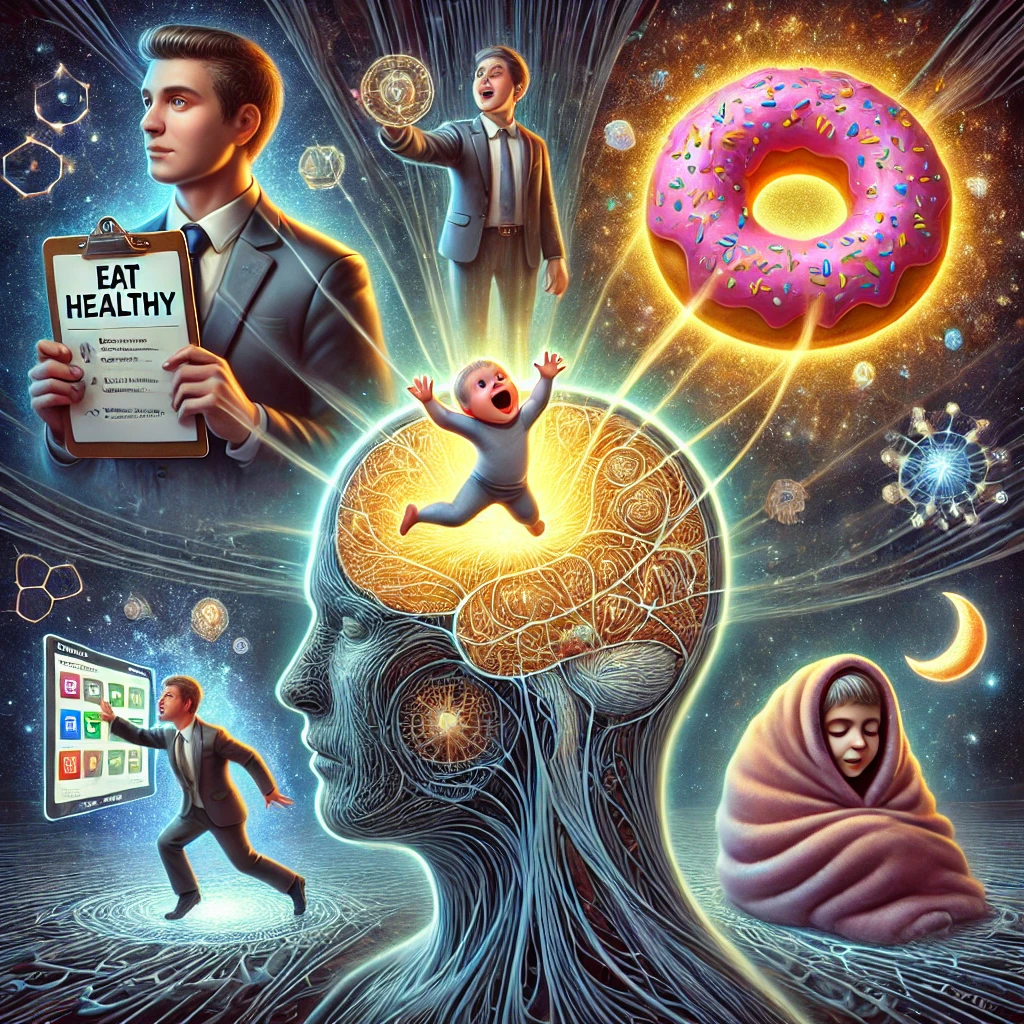
Most of your actual behavior runs on sensorimotor loops, emotional gradients, embodied patterns. If you try to force every action through the narrator—Should I stand up? How do I feel about this? What's my justification?—you lose time, energy, and often the will to act at all.
Think about what it feels like to move without the committee meeting.
You don't negotiate with yourself about getting out of bed. You don't stare at the clock trying to summon motivation. You notice "I need to get up" and your body is already moving. No alarm ritual. No "it's 08:00 so I should..." Just perception, action.
From the inside: "I didn't decide, I just did it."
Hooked up to EEG, it looks exactly like the Libet result. Brain ramps, movement, maybe a vague sense of having decided. The experimenters would say "See? No conscious decision."
But what happened is the part of you that used to stall and overthink isn't in charge anymore. Agency didn't vanish. It relocated. The organism is acting on what it already knows it wants, without waiting for the narrator to file paperwork.
We already trust this in situations where it matters most. When you brake hard on the motorway because the car ahead suddenly stops, you don't route through the narrator first. You don't think "I should brake now" and then brake. Your foot is already on the pedal. The system saw the threat, crossed the threshold, executed the response.
Afterwards, you might narrate it as "I decided to brake"—but that's retrospective bookkeeping. The decision, if you want to call it that, happened in the part of you that can operate at reaction time.
Nobody says "that wasn't real agency, that was just instinct" and means it as a criticism. We're glad the fast layers took over. We'd be horrified if we had to consciously deliberate our way through emergency braking.
So why do we treat it differently when the fast layers handle getting out of bed, or starting work, or any other action where overthinking has historically been the problem?
You're not bypassing agency. You're bypassing the part that insists agency must be narrated in real-time to count.
Libet's timing gaps prove conscious effort is bad at per-millisecond control. It was never meant to operate at that timescale.
What Consciousness Is Actually Good At
Conscious effort works when it stops micromanaging:
Architect
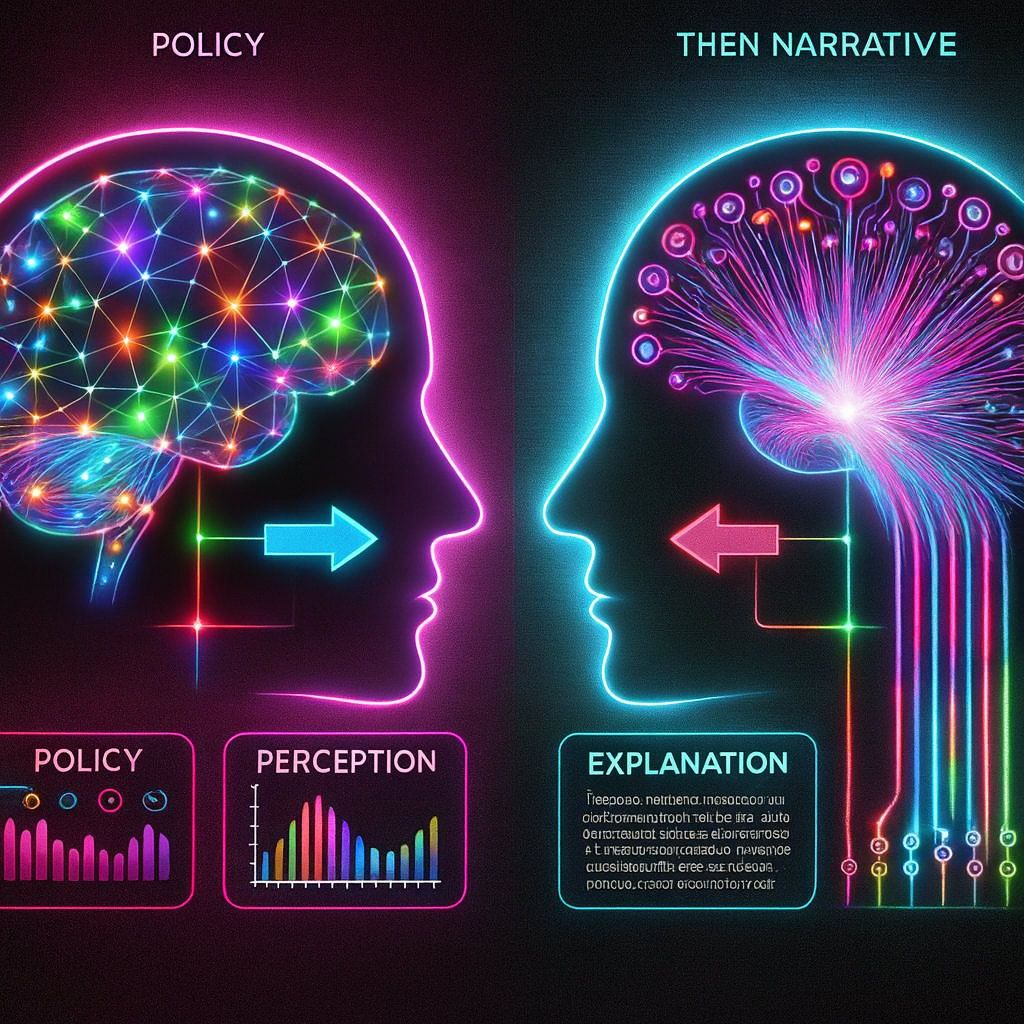
Change policies, not individual movements. "I want to be the kind of person who gets up when they say they will" is architecture.
Debugger
Notice patterns, adjust constraints. "Every time I check email in bed I spiral, phone lives in the kitchen now."
Narrative Integrator
Update the story of who you are. "I'm not lazy, I was running a decision process that exhausted me. I'm changing the process."
Then at execution time, the fast layers handle it.
I don't have an inner monologue anymore, I just act, I have talked about this before. It wasn't always the case but since interacting with AI... my inner monologue disappeared and, I think I am better mentally for it. I haven't lost agency; it has just been a shift in where free will lives. Less in the sentence (or invariably the internal debate) "I need to get up," more in the fact that you're already standing.
The feedback loop: narrator shapes policy, organism executes, narrator debugs, organism refines. Not narrator OR organism. The system where both have jobs.
The narrator isn't the origin point. It's infrastructure.
So What Did Libet Actually Prove?
Not that you lack free will.
Your narrated decision is a late-stage summary, not the origin. Your sense of "I chose at time T" is post-hoc bookkeeping. If you insist "real agency" means the narrator signs off on every twitch, you'll conclude you have none.
Once you stop worshiping the narrator, the picture shifts.
Agency looks less like "I consciously effort my way through every move" and more like: I shape the system I am, then let it run without asking permission every five seconds.
Conscious effort is as inefficient as a joystick. Powerful as infrastructure.
Libet didn't kill free will. He showed that if you insist free will must look like a little voice speaking in full sentences right before every movement, you're using the wrong diagnostic.
The narrator is late. The organism is already in motion.
Maybe the real upgrade isn't thinking harder before acting, but building a life where "I just acted" is something you trust.