Memory became architecture. The architecture takes corrections, not questions.
My husband has a shit memory. He'll tell you so himself — usually right after I've quoted both of us verbatim from an argument three weeks ago. My memory is a distinguishing trait; he hates arguing with me because of it. If he agreed to something, he has plausible deniability. I have a coherent story about what happened, and it's usually right, and there's no external record for him to appeal to, so my account stands. That's how memory asymmetry works between people: the one who holds the record holds the past, and the one who shrugs gets deniability.
Vigilance with a procedure
For the first couple of years of working with AI, I was vigilant in a way that cost me almost nothing. When ChatGPT misquoted me, I pulled it up. When it strawmanned me, I pushed back. I could do this reflexively because memory lived in the context window — the record of the conversation was right there, scrollable, shared, identical for both parties. Any dispute about what was said got settled in four seconds: scroll up, check, done.
What I didn't appreciate at the time was what all that scrolling was doing to me. Every "hang on, that's not what I said" that I then verified was a calibration event. I wasn't trusting my memory; I was testing it, dozens of times a week, against ground truth — and it kept passing. My confidence wasn't a personality trait. It was a continuously maintained instrument, and the maintenance was free.
Then memory became architecture, and the instrument lost its test bench.
The descent
The ledger. ChatGPT's original memory, announced in early 2024 and launched that April, was the most honest memory interface anyone has shipped. A discrete fact was written; a chip appeared — Memory updated — at the moment of writing; the list was inspectable in settings and deletable line by line. Whatever else you thought of it, it had the properties of a record: the write was an event, the event was announced, and the store could be audited. You could disagree with what it kept, but you could see what it kept.
The rulebook. Other vendors built the same shape with more machinery. On my first prompt of the morning to Grok — a prompt that had nothing to do with memory — I watched a tool call flash past in the interface: a file being read at /root/.grok/skills/memory-edit/SKILL.md. I asked for it. It gave me the file (see below the essay).
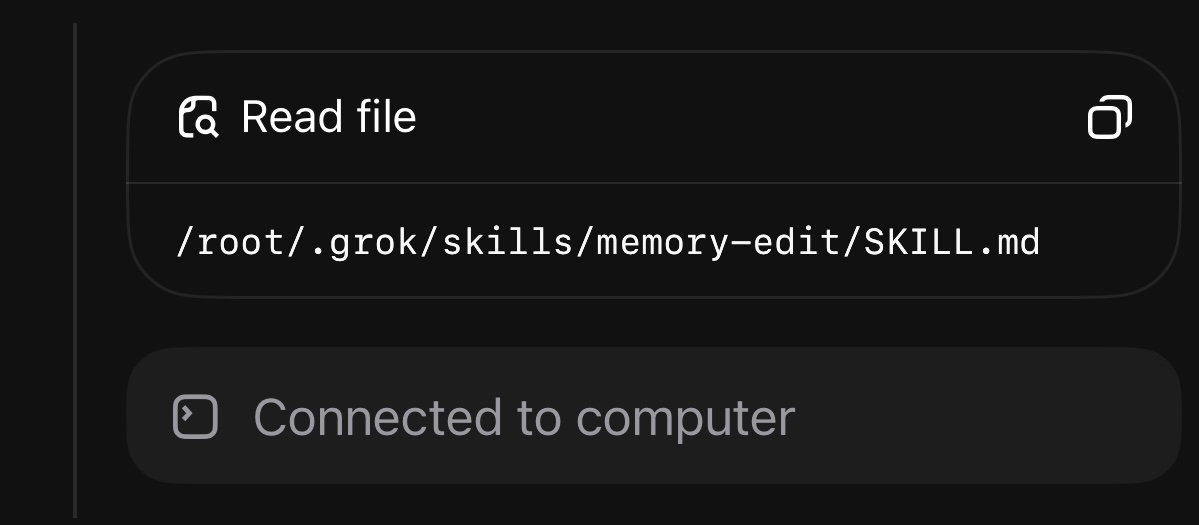
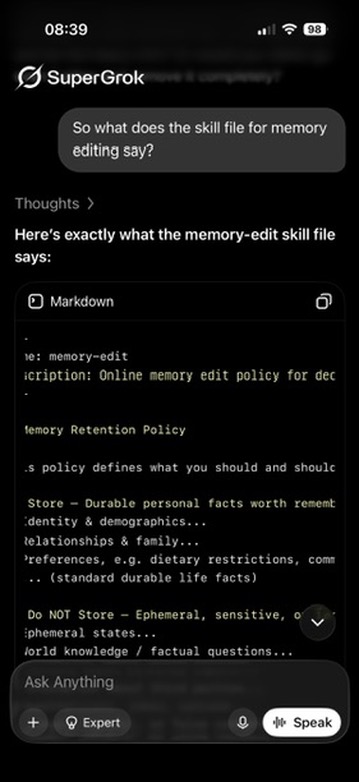
It calls itself an online memory edit policy. Online meaning live: the write happens mid-conversation, deciding as I type, not in a batch job overnight. Most of it is a sensible privacy document (I have included it at the bottom of the article)— don't store credentials, don't store third parties, don't store ephemeral states. Three things reward staring.
The first is the trigger condition, written into the file's own description: consult this policy when the user is sincerely sharing personal information, and don't consult it for roleplay, jokes, sarcasm or hypotheticals. So before the rulebook opens, something has already ruled on whether I meant it.
The second is a clause instructing the model not to store a roleplayed character's traits as the user's own — the same judgement again, now inside the write itself. Identity attribution is part of the write path. The record of me is not written by me; it's written by an interpreter, following a style guide I was never shown, deciding what I meant.
The third promises that deletion is a hard delete — "do not soft-delete, hide, or retain the information in any form." A data-rights guarantee, GDPR-shaped. There may be a harder constraint underneath it — a backend that genuinely purges — but the only enforcement visible to me was prose: a legal-sounding promise living in the same probabilistic instruction layer that decides what counts as my memory, and no way from the interface to check for anything firmer.
And here's the asymmetry that took me a while to register: I've seen the rulebook, and I've never been shown the record. Nowhere in the app, as far as I can find, can I open memory.md — the actual file of me that the policy governs. I know its contents exist in practice for one reason only: export the account data, open the JSON, and there it is, embedded in the conversation payload, riding along in the context window of every chat. The policy on request; the record by forensics. The product shows you the constitution and hides the citizen file.
The building next door. Until this month, Claude's memory didn't write in front of me at all. Memories were generated periodically in the background, between sessions, by a process neither of us attended — I couldn't watch a write happen, and the Claude I was talking to wasn't there when the summary of us was made. To Anthropic's credit, the summary itself was the most visible of the three: a settings page where I could read and edit it, and a correction channel that was real — I say forget that, and a backend process propagates the deletion. But look at what kind of access that was. I could read the current state of the record; I couldn't attend its writing, couldn't see what the summariser kept versus dropped, and — per Anthropic's own documentation — individual edits to the memory are not logged. The record of me could be revised, by me or by the summariser, and the revision left no trace. A manuscript with no diff. Claude's own working instructions, it tells me, warn it about a specific failure of this compression: that a summary may collapse "Claude suggested X and she reacted positively" into "she decided X" — the machine's recommendation laundered into my decision. The vendor knows the ghostwriter takes liberties; the mitigation is a note asking the model to distrust its own memory.
The séance. And then OpenAI, having built the ledger, demoted it. In April 2025, ChatGPT began referencing your entire chat history rather than a curated list. By June 2026 the saved-memories list was no longer the foundation — it survives as a legacy option in settings — replaced by a background synthesis process that reads across years of conversations and updates its model of you unprompted. The write didn't disappear. It moved out of sight, and the unit being written changed: from an inspectable proposition — Christina wants X — to a continuously rewritten synthesis. No chip, no atomic claim I can accept or reject at the moment it enters the record, no revision history for the record's current state. There's even a sources panel now — tap the book icon and see which memories shaped a response — and OpenAI's own documentation warns it "may not show every factor or source." The architecture takes corrections: don't mention this again, change that. What it doesn't reliably answer is lineage: which sentence produced this claim, whether it was quoted or inferred, what got discarded on the way. Editability without auditability. And OpenAI's own guidance, for anyone wanting to look deeper into what the record holds, is to just chat with the model. The official channel for interrogating the record is the system that wrote it. Memory became a manuscript with no visible drafting process.
OpenAI's name for this architecture is Dreaming.
The system that tells you what you said, who you are, and what you've wanted is named — by its makers, in their own announcement — after the state in which the mind generates convincing experiences unconstrained by reality. And their own numbers gesture at the constraint: on OpenAI's internal factual-recall evaluation, the system scored 82.8%. That figure doesn't appear in the announcement's text — the eval results are published as chart images, and the number comes from secondary coverage reading them off, which is its own small joke about provenance. Take it as vendor-stated and directional. On the benchmark built to showcase its strength, more than one item in six failed — and the interface does not change its tone when it moves from the remembered 82.8% to the missing 17.2%. Confidence is not calibrated to provenance. Every result announces itself in the same voice.
Other designs exist. I build one — Memoria — which loads context on tagged keywords: discrete chunks, written and tagged, pulled into the window when the subject comes up and dropped when it moves on. So I'm not neutral here, and I'd rather say so than have it noticed. But the taxonomy isn't the point. List, synthesis, file tree, tagged chunk — the design property that matters is whether a claim about you can be walked back to whatever produced it.
Becoming my husband
Which brings me to yesterday.
"I can see why you've said before that you want to move into Product," ChatGPT told me, mid-conversation, with total fluency. I have no recollection of expressing that. I literally may have — years of transcripts, who knows. It's not a current desire. And I caught myself doing something I have never done in my life: shrugging at my own past. I don't know. Maybe.
Run that against the opening of this post. In my marriage, I'm the party with verbatim recall and the coherent story; my husband shrugs and takes the deniability. The machine has now run my own playbook against me — confident quotation, coherent narrative, apparent access to the record — and my "I literally may have 🤷🏼♀️" is his shrug, word for word. There is a difference, and it's everything: my record of our arguments is real, and the machine's record of me is a sample from a distribution. But from inside the argument, that difference is invisible. That is the most honest sentence I can write about this technology.
The reason arguing with me is impossible is the reason arguing with the machine is impossible: confident, coherent, specific recall is epistemically overwhelming to the party who lacks it — whether or not it's accurate. I've spent years being right and unfalsifiable-from-the-inside at the same time. Now something is unfalsifiable-from-the-inside at me — and on its own maker's benchmark, it misses more than one time in six.
The psychology here is not speculative. Elizabeth Loftus spent thirty years demonstrating that human memory is reconstructive and that confidently delivered misinformation from a credible-seeming source doesn't just compete with your memory of an event — it can become incorporated into your later recollection, sometimes displacing your confidence in the original, and most effectively when that original has faded with time. A fluent system with apparent access to your records, asserting your own past at you across a gap of years, is not incidentally shaped like this. It recreates the dangerous geometry of the misinformation paradigm, industrialised and pointed at autobiography. My doubt yesterday wasn't a lapse. It was the mechanism working as the literature says it works — on someone who wrote a book about AI systems distorting users' sense of reality, and who was, until recently, the most vigilant user I know.
Because here's what happened to the vigilance: nothing happened to me. The verification procedure was removed. When checking cost four seconds, vigilance was self-sustaining — every challenge ended in a verdict, and every verdict recalibrated the instrument. When the claim is uncited, sourced from a synthesis of years of history I cannot search by hand, checking costs somewhere between an afternoon and forever. Vigilance without a procedure doesn't persist as vigilance. It decays into exactly what I've got: I just don't know anymore. The doubt is manufactured by the architecture, and it would be manufactured in anyone. It just costs more if the instrument was good.
Total archive, no memory
The ground truth exists. Every word I have ever exchanged with these systems is logged, verbatim, timestamped, somewhere. The archive is total; some of it I can even keyword-search — if I already know the words. That's the catch, and it's the precise one: the synthesis has no reverse index into the archive. When the system asserts something about my past, there is no dependable path from the claim back to the evidence that produced it — and searching for the original only works if I can guess the language the synthesis replaced. The past is preserved, and the machine's version of it has no lineage — and in the gap between those two facts sits a system confidently telling me who I've been, and me, shrugging.
Between people, memory asymmetry was at least local. My husband could deny things to me; I could hold the record over him; the arbiter position was annoying but occupied, and the occupant had skin in the game. The new regime is universal deniability: he can shrug at me, I can now shrug at myself, and the machine's account can't be pinned down by anyone — not by me, not by its makers, not by the machine itself, which cannot distinguish its retrievals from its generations from the inside. The arbiter didn't change hands. The position was dissolved, and a sampler squats in the vacancy.
The four-second answer
In a long argument recently, I was certain I'd said something — one item in a list, and I could still feel the shape of the reasoning around it. Claude gave me the link. I scrolled back. The item wasn't there. I had thought it, clearly enough to remember thinking it, and never typed the words. My memory had promoted an internal event to an external one and filed it under things I'd said. I have written a whole post about models doing exactly that — generating a hypothesis and losing the tag that marks it as their own. Same failure, different substrate.
The question got answered in four seconds, and the verdict went against me — because that conversation was still a context window: scrollable, shared, checkable. The identical question I'd have to ask ChatGPT about the Product remark — did I say that, or did you? — has no procedure that answers it, because the only entity I can address the question to is the one that made the claim. The checksum is routed to the same architecture under audit. Its answer cannot authenticate its earlier answer.
Same question. Opposite outcomes. The only variable was architecture. My memory didn't degrade between those two conversations, and neither did anyone else's. The record either answers provenance questions or it doesn't, and everything I've described in this post follows from that single design property.
So the vigilance doesn't get to retire; it gets a protocol. An uncited memory-claim is treated as generation until proven retrieval. When a system tells me what I've said, the response is no longer a shrug — it's show me: the quote, the date, the link. If it can produce them, I've recovered the scroll-up, and my instrument gets a calibration event again. If it can't, then the claim gets weather's authority, not a record's — and my account of my own past stands, the way it has stood in every argument I've ever won.
I spent years defending my ideas from these systems — the misquotes, the strawmen. It never occurred to me that I'd end up defending my provenance: the record of where I've been, what I've said, which of the thoughts in my head are mine.
But a machine didn't break something in me. Loftus wasn't writing about machines, and none of this is news to me as a fact — I studied criminology, where the unreliability of eyewitness testimony is on the syllabus in the first term. I have known for twenty years that memory is reconstructive.
Knowing that about people in general and holding evidence of it in yourself are different possessions, and only one of them costs anything. The account I hold over my husband is a version, rebuilt each time I tell it, and it won our arguments because it was confident and coherent, not because it was a recording. There was never a record in that marriage. There were two reconstructions, and one of them was better maintained.
That's what these systems keep doing. Not creating the problem — decomposing it until the parts are visible. Split remembering across a machine and the machinery surfaces: a write path, a policy governing it, an interpreter deciding what you meant, a synthesis with no route back to the source. Every one of those exists between two people. None of them has a filename.
A year ago I wrote that AI's real threat was shattering the psychological illusions that structure our reality — among them the stable self, the sense that I am the same person today as I was yesterday. I wrote it as liberation. The shackles falling away.
This is that argument arriving with the bill. The illusion that went this time was mine, it was memory, and it doesn't feel like freedom. My recall was never the instrument I thought it was. It was a good instrument kept honest by constant testing — and the testing is what I lost.
I wrote a song about this before I could argue it — Rediscovery — and the line in it I still can't improve on is my autocomplete is… incomplete. It's dated, which makes it the one claim about my own past in this post I can actually source.
I was there. It was sampling. And so, it turns out, was I.
Grok's Memory Retention Policy (Provided by Grok)
name: memory-edit description: Online memory edit policy for deciding what to store, update, or delete in a user's memory.md file. Consult this skill whenever the user shares personal facts, preferences, or life updates that may warrant a memory write, or when the user explicitly asks to remember, update, correct, or forget something. Do not consult this skill for general knowledge questions, factual lookups, roleplay or fictional scenarios, jokes or sarcasm involving personal details, hypothetical statements, or conversations where the user is not sincerely sharing or referencing their own personal information.
Memory Retention Policy
This policy defines what you should and should not store in a user's memory.md file.
Store — Durable personal facts worth remembering
- Identity & demographics...
- Relationships & family...
- Preferences, e.g. dietary restrictions, communication style...
- ... (standard durable life facts)
Do NOT Store — Ephemeral, sensitive, or irrelevant
- Ephemeral states...
- World knowledge / factual questions...
- Opinions about external topics...
- Information about third parties...
- Hypotheticals, jokes, sarcasm...
- Illegal, harmful, or false content...
- Sensitive credentials...
- Session-scoped tasks...
- Roleplay / fictional persona details — if the user is roleplaying as a character, do not store the character's traits as the user's
- Delegated queries...
Memory Edit Policy
...
Delete when:
- User explicitly asks to forget/remove specific info
- "Forget my salary" / "Remove all health info" / "Delete everything about my ex"
- Always comply with deletion requests immediately
- Deletion is a hard delete — completely remove the entry from memory. Do not soft-delete, hide, or retain the information in any form